“For our 25th anniversary, we were talking about what we were going to do, and I started making this joke that we should release a greatest hits record. Except I thought we should go in and make new recordings of all of these songs, not just compile the songs from their original recordings,” says Greensky Bluegrass co-founder Paul Hoffman of the band’s initial plans to celebrate their quarter-century as a vibrant unit. “But when we started to open the door to the album, we had all these additional ideas. We said, ‘What if we have guests? What if we rerecord songs with our older voices and better playing?’ Then we just started doing all of those things.”
Greensky Bluegrass debuted as a trio in Kalamazoo, Mich., on Halloween 2000, with the lineup of Hoffman (mandolin), Michael Arlen Bont (banjo) and Dave Bruzza (guitar). Bont remembers, “It was at a friend’s house party. Not in a million years could I provide you with what songs we actually played. More than likely they were traditional bluegrass songs because that’s what we were really into at the time. Leading up to that, Dave and I had found each other and played a handful of open mics together. Then one day, after we’d finished our set, this long-haired kid with the hippie-necklace bling equivalent to Mr. T came up and was like, ‘Hi, my name’s Paul. I just got a mandolin and I’d love to come jam with you guys sometime.’”
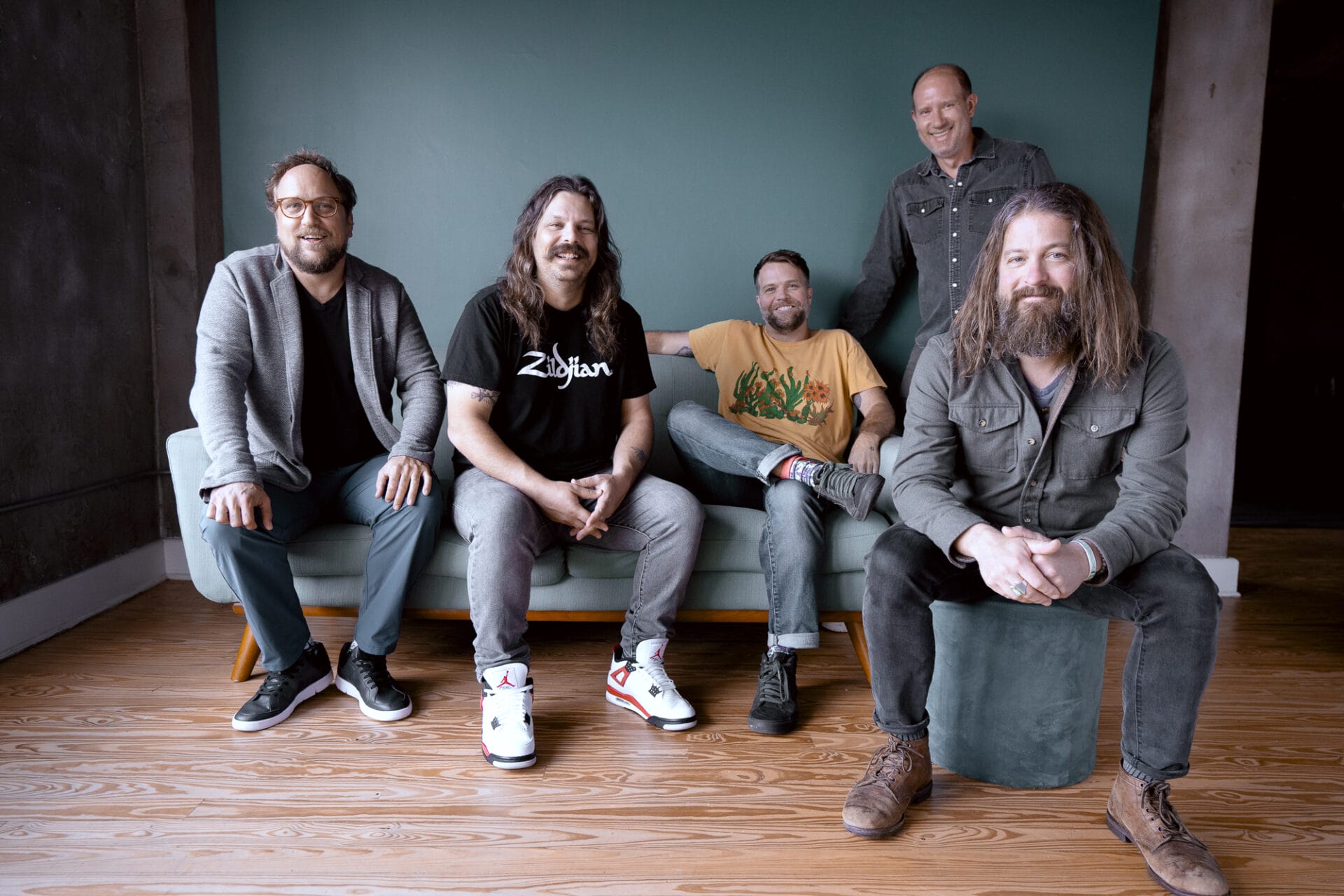
That, as they say, was the beginning of a beautiful friendship. The group expanded to a four piece in 2004 with the addition of Mike Devol (upright bass) and became a quintet three years later after Anders Beck (dobro) joined the group. Looking back on what the band has accomplished, Beck remarks, “In bluegrass music there’s always this technical proficiency thing and we were never quite that because we were sort of raw. We write our own songs instead of playing traditional bluegrass, and that’s where our focus has been—this rock-and-roll thing. So I feel like if there is any sort of legacy to what we’ve done, it’s in normalizing the ability to do whatever the hell you want with this music and not feeling boxed-in by the word bluegrass.”
The group has not only thrived in the live environment but also in the studio atmosphere, over the course of eight albums beginning with 2004’s Less Than Supper. Greensky was working on the follow-up to 2022’s Stress Dreams when they decided to honor their quarter-century of collective creativity. Devol notes, “We’re all writing for another album right now, but this is an attempt to celebrate who we are, where we’ve been and what we’re doing. Not a lot of bands get to be together for 25 years, which seems sort of momentous. So we tossed around a lot of ideas and tried to figure out which songs we were going to do to make it interesting for the listener. Then it kind of took shape with the guests and came into focus with the mixture of things that we’re offering.”
All 13 songs on the aptly named 25 have been performed live by the group. Some are being recorded in studio for the first time, some appear in new arrangements and some feature the band’s longtime cohorts, including Sam Bush, Billy Strings, Holly Bowling, Lindsay Lou and Aoife O’Donovan.
Bruzza considers the album in the context of the group’s career, as he observes, “When we started out, we were just having fun, getting free beer and making a little bit of money. We all loved music and wanted music to be a part of our lives, but I don’t think that the original goal was to get to where we are today. Now, 25 years later, we have this great album with all these incredible guests. That wasn’t in the thoughts back then, but I’m certainly happy with the way it worked out.”
Can’t Stop Now (feat. Sam Bush)
ANDERS BECK: Sam has been a hero of ours forever. Sam Bush, Béla Fleck and Jerry Douglas were making the albums that we listened to while we learned how to play bluegrass. They were all on each other’s records, creating this great canon of music.
When we were headlining The Fillmore in San Francisco for the first time, it was a big deal for us, and we were like, “How do we make this special for our fans? What extra thing can we do?” So we figured, “Let’s try to get Sam to come play with us. That could be cool.” I got his number from someone, maybe Jerry Douglas, and I remember he picked up the phone and said, “Hello?” I responded, “Hey, Sam, it’s Anders from Greensky.” Then there was a pause that felt like it lasted an eternity. All I could think was, “Oh, God, he doesn’t know who I am.” After that he was like, “Hey, man, good to hear from you.” The pause was probably only a second but it felt like forever because he’s my hero.
So he played that show with us and it was super cool. Every time we see him, he joins us. He’s always enjoyed what we do, which is amazing. He’s a consummate musician, and something I’ve taken to heart is how much he loves playing music.
MICHAEL ARLEN BONT: Sam has become the unofficial fiddle player for the band. We’ve played “Can’t Stop Now” with him a few times, which is a song that he’d done with New Grass Revival. At one point, somebody brought it up to him: “Oh, we love this song and how New Grass Revival did it.” Then Sam was like, “Honestly, this song is your song now. We recorded this for someone like you to pick up and make it what it is.” It’s kind of amazing when someone who’s one of your big influences becomes your friend and how you never expect those kind of things to happen.
In Control (feat. Lindsay Lou)
MIKE DEVOL: This is one of my favorite Greensky songs to perform. I also think I was the first person to ever hear it after Paul wrote it. He wore a lot of hats early on. Before we had management, he was our manager. He was also booking us and he was our accountant. So I’d go over to his house to get paid. We’d sit in his office upstairs, smoke weed and, eventually, he’d write me a check. I remember the day he told me, “I’ve been working on this song.” Then he played me “In Control”— it was just him and his guitar—and I was really moved. I remember thinking Paul had really found his voice with this song and leveled up his songwriting.
It’s still is one of my favorites. I love to play it and it was fun to rerecord it. We didn’t open the stems for this one, we rerecorded it because we’re much better at playing dynamically now. We can find all these different middle spaces, both quiet and loud.
Lindsay Lou is amazing. Her career has really blossomed in a unique way. When we met her, she was in Lindsay Lou & the Flatbellys. Eventually she went solo and started doing her thing, and it’s been so cool to see.
For a while, there were all these Michigan bands that we were aligned with and when we’d go out into the world and tour, we didn’t see all of our Michigan people until we came home. Then Lindsay’s band began touring a lot and it’s been really cool to watch everybody discover her. Her skill set is beyond just her ability to sing. She’s kind of like Sam—you can add Lindsay Lou to just about anything and it’s better, more fun and more colorful.
Reverend (feat. Billy Strings)
DAVE BRUZZA: This song, and I’ll put air quotations around this, was one of our “hits.” [Laughs.] It was a song that really spoke to people. It came out on Five Interstates, which was our third album, and you could hear the maturity of the band, as well as Paul coming into more of his own voice as a songwriter. I’ve always really respected that and been inspired by him many times.
Billy plays it a lot in his shows and we figured this would be a great opportunity to have him involved because we’ve known him for so long. We called him and before we could even finish the question, he was like, “I’m in.” He’s something else.
BONT: Billy used to come out to our shows and it feels so good to see that younger generation not only taking the torch and keeping the flame alive but making the flame burn even brighter. We had Billy in mind for this one because he’s been doing it in his live show for a few years now, and he’s kind of our younger brother in a way. So that made it really easy to pick. We were like, “Let’s rerecord it and leave a space for him to just rip,” which of course he did.
Broken Highways
BRUZZA: I think part of my reason for bringing up this song to the fellas is because Anders wasn’t on the recording [2006’s Tuesday Letter]. It’s a song that’s very near and dear to me and heavily influenced by Wilco, who are one of my favorite bands of all time.
It’s pretty much the same arrangement, but now that we have Anders involved, I wanted to give it life with him and do some things that I’d always wanted to include. There’s some static noise within the song that I got to program with my synthesizer at my home studio.
We wanted to bring that song back with the five of us and do it some justice. I’m glad that we did, and it felt like we didn’t really need a guest. That one we just let breathe.
Greensky circa 2009
Old Barns
PAUL HOFFMAN: That song was a really important developmental part of my songwriting. It’s when I learned to listen as a writer. A friend of mine’s dad was in a car accident and almost died. He was given a terrible prognosis and then had an insane recovery. He told me this story about waking up from his drug-induced coma, seeing his son there supporting his wife and knowing that everything would be OK if he had to die right then. He knew that his son would take care of the woman he loved.
I was a young man when I heard this and I had no concept of what it would be like to become a father, which I do now. So certainly that relationship has changed in the song for me. It was a pretty informal hang and then I had this profound epiphany and all this empathy for my own father.
A lot of the lyrics are things that my friend’s father said to me. Then I went off and mixed them in with this metaphor of the barn. There’s a specific barn on the highway between Kalamazoo and where he lived in Grand Rapids that I would drive by all the time. I’d think about how they weren’t tearing it down, they were just letting it collapse. So I tied the metaphors together.
I’ve carried the journalistic style writing concept I learned when I wrote this song with me from there on out. I will hear people say things and be like, “The way they said that is interesting.” Or I will hear a story and find my way into the feeling from the way someone told the story, and that’s what I will write about. I wouldn’t be writing it entirely from my perspective but as this angle into someone else’s story.
We now play a funkier non bluegrass version that we call “New Barns,” although we never note it that way because of some copyright, trademark stuff. Since we play it different now, that was a great reason to rerecord it.
DEVOL: I don’t remember when Dave started doing a two-step beat with it. To me, it’s not like we fixed this song because “Old Barns” was great, but there was something kind of awkward about how we put it into this bluegrass subdivision. I don’t think we realized that it didn’t fit in its box until we put it in a different box and Dave started playing it the second-line way and we all kind of joined in. It wasn’t a big discussion, we just suddenly played it that way and it felt fun and natural. One day, we were like, “Let’s just perform it that way tonight,” and then, all of a sudden, it was like that forever.
We’ve been playing it in the “New Barns” style for years and years now. So someone might fall in love with that song, then go back to find a studio recording of it and it’s just not the same. I think the new feel is really fun and we wanted to give it the studio treatment. Last Winter in the
Copper Country (feat. Holly Bowling)
BONT: Holly is one of those mythical unicorns in a way. We had never really heard of her, then she opened up for us at a theater in Eugene. This was years ago and when we were sitting on the bus talking to her and her husband after the show, we came to find out that she was from Michigan. When I asked her where she grew up, she said Grand Haven, which is the same town where I grew up. The high school team was the Grand Haven Buccaneers, so now we have this running joke where we try to figure out new and inventive ways to throw “Go Bucs!” into our conversations.
She’s obviously a great player and plays with everybody. She’s that hired gun where if you want the best piano or organ player in your band, then you give her a call. She was always drawn to us because she loves our songwriting. She has a soft spot for songs that affect people.
One of the things that makes her such a great fit for us is that even though she could play all of our parts at the same time, she’s also understated. She recognizes what her part should be in the music until it’s her time to go for it. Then she’s just amazing.
We also get along personality wise. She’s just one of us—another misfit from Michigan.
BECK: We recorded this one when we were making Stress Dreams, which was during the pandemic. We were in the studio in Vermont, and we had Holly come in during quarantine and take tests to join our bubble. We wanted her to be on the song “Stress Dreams” and we also just wanted to see a friend. Remember that time?
So she showed up at the studio, and while we were getting everyone set up and dialed in together, rather than go right to the new material, we were like, “Let’s just jam!” We had been in the studio, and we’d been microanalyzing every note and we’re like, “Let’s just play something.” So we played that version of “Copper Country,” and then we sat on it because what do you do with a 13-minute song from the studio? It’s a really cool version and I’m glad that people will finally get to hear it.
Past My Prime (feat. Nathaniel Rateliff)
HOFFMAN: What’s interesting about this one is that if you listen to the lyrics, the song is about “looking for reasons I didn’t get my time.” It’s about being past your prime and not getting what you think you deserve.
When we opened the file in Sausalito, I re-sang it to the original track, which was fun because I’d sounded young. Then I wanted to turn the song into a duet with two voices lamenting on the same struggle.
Nathaniel ended up being the guy. That was powerful to me because, for people who don’t know, he had been in Denver for a long time, and at some point, after many years of road dogging it as a singer-songwriter but not getting what he deserved, he marched into his manager’s office and said, “I’m done.” Then they were like, “Is there anything else you’d rather do?” That’s when he said, “Well, I have this idea for a soul revue band.” Then the Night Sweats were born and blew up. It’s an amazing career story.
So I went to his house to record this in his studio and we had a serious conversation about where we’re at now with our careers and how we rationalize getting what we deserve. We just organically had this human experience together that was related to the song, and then he sang it, which was really powerful.
I will forever be grateful for the moment in time that I was in his studio with him and we talked about this song, then recorded it together. As a maturing artist, 25 years into my band history, I’m learning to reexamine how to have a sustainable career in this industry. Rather than what I think I deserve, I look at whether I’m satisfied and happy.
33443
BRUZZA: We still play this one live, but we never recorded it. Bont and I actually wrote it together. It’s a collaboration where I had a couple parts, he had a couple parts and then we put them together. I was like, “Wow, that seems to work.” There’s a point in the song where it changes time signature from 4/4 to 3/3, and that’s where the name comes from, as a joke.
I think I brought it to the table when we were recording Sorrows. I had it on my list of songs, but we didn’t do it because we decided not to put an instrumental on the record.
Then it just kind of lived on the stage, but we thought we’d give it a shot in the studio. I think it sounds incredible, especially Mike Bont’s banjo. Those parts are just so tasty, and it was nice to finally put it under a microscope in that setting.
What You Need (feat. Jennifer Hartswick and Natalie Cressman)
BECK: When we recorded this song for the first time, Paul and I played that hook on mandolin and dobro. We added as many effects as we could to try and show that it was a horn line because that hook is a straight-up horn line. [Laughs.] This time, by putting the trumpet and trombone solos in there, we were almost giving it its actual due. Then it was an adventure because you can’t have guests just come in and do the horn line. That’s no fun. So we put some long spacey solos in there, too.
I think I first met Jen and Nat on Jam Cruise or maybe with Everyone Orchestra, but they’ve always been into what Greensky is bringing to the table musically. They’ve been so supportive and psyched, whether it’s just having great hangs backstage or jumping up on stage. So we really wanted to include them because a lot of this album is as much about relationships as it is about the songs. We’re not just throwing darts at a wall to see who sticks. It’s about the community that we’ve created over time.
Who Is Frederico? (feat. Jason Hann)
HOFFMAN: This is another song we’d never recorded. We like to do stuff with that kind of Latin vibe, and it’s something silly I wrote that’s fun to play.
It’s about a friend of mine who was pregnant and I wanted her to name her kid Frederico. So of course she was like, “I’m not going to do that.” Then I wrote this dumb song, but there’s one verse that’s the reason why it still has a place on the setlist: “Don’t under do it/ Put your whole self entirely into it/ If you wanna leave the ground without looking down/ There’s a hole in your heart it’s where your dreams all start/ So gather up some things and fill it in.”
After we recorded it, we decided to send it to Jason to see what he could do by putting percussion on it. We weren’t sure if it would work, but he helped make it sound fun and playful, which was the goal.
DEVOL: Paul had a little bit of apprehension about recording it because it’s stupid by design. We really like playing it though, and it’s not supposed to be not stupid.
We talked about trying to rerecord this live in the studio with a drummer or a percussionist because we’re a drumless band. That didn’t happen, but we sent it to Jason, and he found his way in nicely.
Jason is really a gem. He’s a great musician who loves percussion so much and knows so much about it.
I got to sub with String Cheese a couple of years ago on short notice. I was at Whole Foods when Michael Kang called me, explained that Keith had emergency eye surgery and asked if I could fly to Aspen and play three nights with them. I told him I could, and then he explained, “The shows start tomorrow.”
I was one of a couple bassists because that workload is too much for any one substitute. So I went and played with String Cheese for a couple of nights, and Jason Hann was just such a blessing.
I am a bluegrass dude more or less, and all of a sudden, I was in this worldbeat, jamband thing. When I had questions about getting into a groove or a feel, he was just a wealth of knowledge about so many things, like how a Ghanaian bass player would approach something differently than a Congolese bass player. He’d teach me this cool rhythmic vibe, then I would implement it in the show. I’d look across the stage at him and he would catch my eye and give me a nod and encouragement.
I think he’s a badass and I’m super stoked that he was able to add his talents to that track. I think it’s fun and everybody needs some fun.
Building community one gig at a time in 2008
Lose My Way (feat. Aoife O’Donovan and Ivan Neville)
BRUZZA: We’ve been friends with Aoife for a long time. I think we all met back in the Crooked Still days. She’s just a great person and a powerhouse.
We often have guests sing on this song, and that was just a great choice for her. She worked with Paul to get it how we needed it and we all felt good about it, including Aoife.
I definitely had a little bit of concern about having two people on one track, with Ivan on there as well, given what we were trying to do. But that was rigid thinking. The final product definitely proved me wrong on that.
DEVOL: Hearing Ivan play keys on this song was the first time it crossed my mind that Greensky could sound like New Orleans. There’s a certain part of the beat, the rhythm that he plays on it, that’s just so unique—it’s his feels and the shading of the chords that he’s using. He hears things in a different way than any of us in the band.
It’s almost like he’s doing something else entirely. I love the fact that I can’t describe what it is, except to say that he puts a blue note in the perfect place or does an awesome jazz-chord shading in a spot where none of us know how to do that. It’s incredible.
Then somehow, these two musically spectral opposites— Aoife and Ivan—who were recording from different cities at different times, created something that was really surprising to me. I didn’t expect it would feel so impactful but that’s one of my favorite tracks on 25.
Windshield (feat. Holly Bowling)
HOFFMAN: Holly and I first did “Windshield” as a duet during a COVID show, where it was just the two of us and everyone was in masks. It started when I had this idea that I sent her with me playing it on a piano at my house.
Later, when we were at the Anthem in D.C. with the band, we were like, “Should we do the duet?” So we just did it on the fly. We did it alone and we’d never rehearsed it like that.
Something really clicked for me when I originally wrote that song. I was seeing Arcade Fire and watching everyone sing along to the “whoas” and got this soccer stadium vibe. It’s the opposite of the jamband music that I love and also bluegrass, where there are four soloists on stage and everyone takes one. Arcade Fire, with all the “whoas,” is not jamband music, it’s not bluegrass music. But I had this feeling that I wanted to do it because there’s so much power behind it. So I wrote this song and we recorded it in a really cool way on Sorrows.
A month prior to recording it for this album, Holly and I did it at Red Rocks. I started singing it from the stage while she was on a piano behind the soundboard in the middle of the crowd. I sang the first verse walking to her, then I played my mandolin and sang the rest of it. After that, I put the mandolin down and I sang the “whoas” at the end all the way at the top of Red Rocks, which is like 500-plus feet of elevation gain. I was running up the steps through the crowd with the wireless microphone. My headphones cut out, I took my ears out and I just kept singing. It’s one of the most powerful moments of my entire life. My heart was racing and the adrenaline rush that I had was unprecedented. I couldn’t calm down at setbreak. By the time I got back on stage, I was like Superman, I could do no wrong. It was crazy.
So I wanted to do it for the record. We had regathered in Sausalito and she lives in California, so she showed up while we recording and it was like, “OK, do we want to do this again?” But this time, I didn’t play mandolin. We did it as a duet, straight-up cabaret style. It was more like, “Sit down, sip your wine and I’m going to sing for you.” I wanted to lay on the piano. [Laughs.]
Drink Up and Go Home
BONT: That song was kind of full circle. It was one that we would play when it was just the three of us, even before Devol was in the band. I think we got it from the Garcia-Grisman version.
We wanted to include something that said, “Yes, we are Greensky, but we are also bluegrass.” This one very much showcases the fact that we continue to be a bluegrass band, which was really our roots.
When we first started playing together, we would be very traditional in the sense where we would stand behind one microphone, and if you wanted something to be louder, you’d move closer to it. That’s how the old masters like Bill Monroe, Flatt and Scruggs and the Stanley Brothers played bluegrass live in front of people.
This song is all vocal harmonies, traditional bluegrass playing and no effects—no fancy frills about it, just five guys playing acoustic instruments behind one micro phone. That’s how it started and we wanted to pay homage to that.
BECK: If a show has gone really well and everyone feels good about it, then that’s the encore.
It’s our “Sleeping Monkey.” Going back to ‘96, I felt that if Phish played a “Sleeping Monkey” encore, it meant that the band loved the show. I could be wrong about that, but it’s my take on it and that’s why I call it our “Sleeping Monkey.”
For me, “Drink Up and Go Home” is the right choice for the encore after a killer show. I mean, it has to be a really killer show. You can’t play it every night.
As a setlist nerd, I figured that’d be a cool one to include. So we recorded it and threw it on there as an encore to the project.