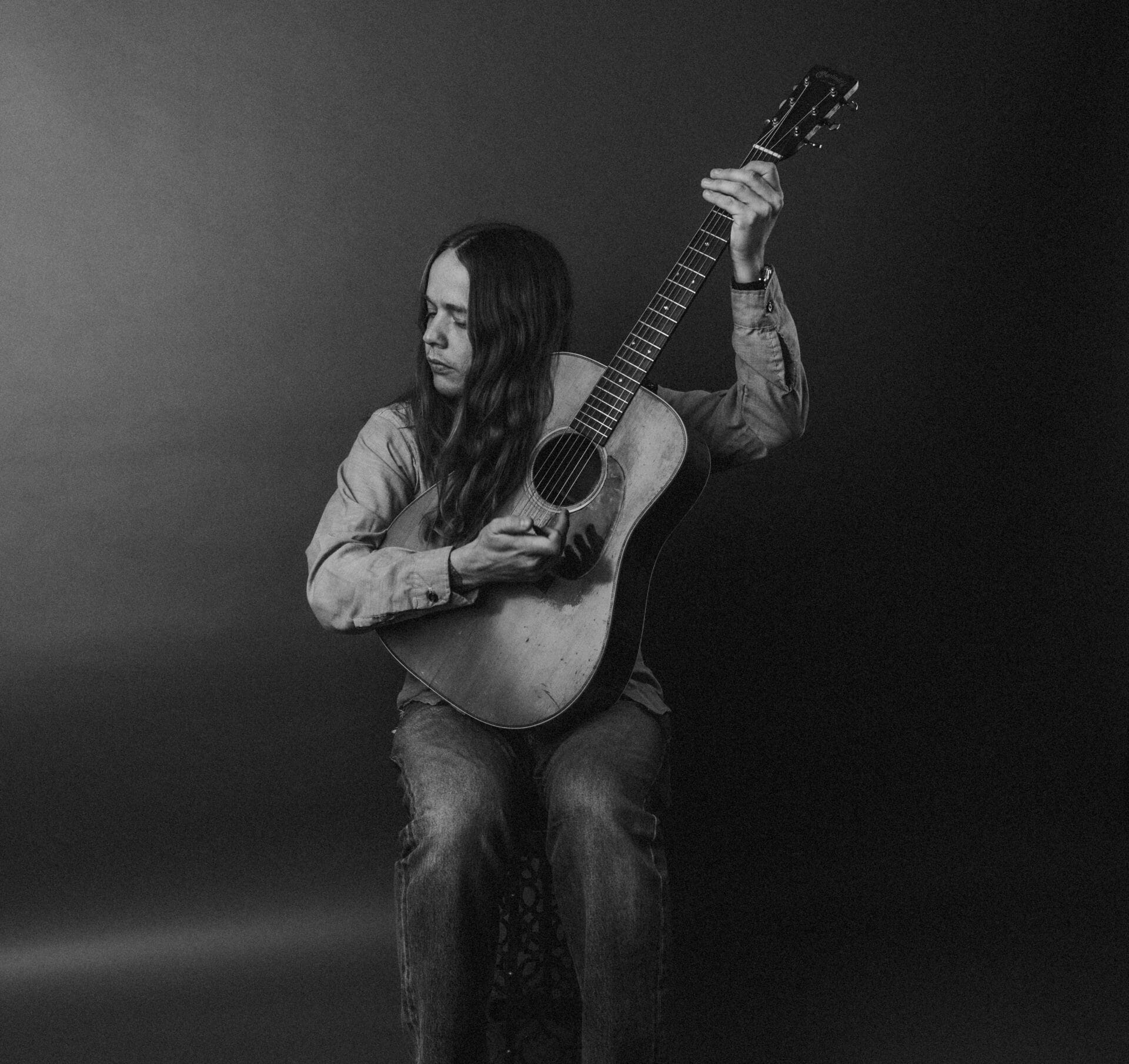
Billy Strings takes nothing for granted, including his prowess on the guitar.
This is why during his downtime on a Sunday afternoon in mid-October, a few days after returning from a European tour, the musician is back in motion. Or at least his hands are, as Strings, the recipient of countless accolades as an instrumentalist, runs his fingers across an acoustic.

“I probably view it the same way that some people view going to the gym,” he says. “When I don’t do it, I feel really bad about myself. When I’m doing it, I would love to play for at least an hour a day, if not three. But an hour a day is good for me to feel like I’m learning new stuff and kind of moving ahead. “Musically, you can get into these plateaus where it feels like you keep playing the same licks over and over, and I just get sick of hearing myself play the same shit. So I try to practice as much as I can. It’s a lot harder now that I’m a dad and my schedule makes it hard when I’m on the road. So between the touring and being a dad, my guitar practice has fallen down a little bit. But just this morning, I’m kind of getting back into this Bach piece that I was working on months ago and I had neglected. I’m feeling like I just got back in the gym and I need to get back to work. It’s time to stop screwing around.”
His approach to the instrument is driven by personal development that’s devoid of ego. Prior to the European run, he took to the road with fellow guitarist Bryan Sutton in support of their new record, Live at the Legion. He reflects, “I look up to Bryan, who’s a very sweet person that I love dearly. As a guitar player, I’m a big fan and there’s a lot to learn from him, just as there’s a lot to learn from everybody. This morning, I was talking to my friend Luke Black from Mountain Grass Unit. I subscribed to his Patreon page so that I could check out some of his stuff. Like I said, there’s a lot to learn from all these guitar players. I’ve studied a little bit with Jake Workman and I also do lessons with Robb Capellottto, who’s my regular guy. My life got in the way and I fell off my practice for a little bit, but I’m back on my shit now.”
Strings’ devout fanbase, which regularly fills arenas, might well contend he’s been regularly on his shit for quite some time. Industry award voters concur, as he has twice received a Grammy for Best Bluegrass Album (2019’s Home and 2024’s Live Vol. 1). Meanwhile, the International Bluegrass Music Association named him Guitar Player of the Year in 2019 and 2021, as well as Entertainer of the Year on four occasions, including 2025.
The IBMA also selected him to deliver the keynote at the annual World of Bluegrass conference in mid-September. “That was really the first speech I ever did besides my vows at my wedding,” he says, refencing his 2023 nuptials to former tour manager Ally Dale, with whom he now shares a one-year old son, River Roy Apostol.
When asked whether he was more comfortable delivering his remarks or appearing in front of 60,000 music fans, while opening for Dead & Company at Golden Gate Park this past August, he laughs, “I was much more comfortable on stage at Golden Gate than I was giving that damn speech. I would rather be there a million times over. Giving that speech was nerve-wracking.”
Still, the probity and passion that inform his music also made for a moving address. On the dais, the artist who would turn 33 a couple weeks later while gigging in Norway, recalled, “As far back as my memory goes, bluegrass music has been one of the main guiding forces that shaped me into the man that I am today. Growing up immersed in this music has been one of the best experiences of my entire life. As a child, I witnessed all the joy that a Martin guitar could bring when it’s in the right hands and the B string’s in tune.”
Looking back on his youth, Strings has been forthright about the trauma and turmoil he experienced. When he appeared at London’s Royal Albert Hall on October 10, he shared an Instagram post that contained an image of his modest childhood home, juxtaposed with the regal venue, accompanied by the message, “From the meth den to @royalalberthall .. fkn sko.” Similarly, from the podium in Chattanooga, he acknowledged, “Throughout my adolescence, I would experience my own hardships that contributed to my own melancholy, and I quickly learned that these scars and painful memories of childhood, and lonesome thoughts of home, are some of the main ingredients for bluegrass music. The fortunate flipside of that is that I also learned how bluegrass music can be the only cure for those painful everlasting memories. It can be a powerful medicine. That’s probably why I never stopped playing all through elementary school, middle school and high school. Music was my best friend, my survival tactic, my coping mechanism and it became my social currency, which it very much still is.”
Strings is also a consummate teammate, who later offered a brief appeal on behalf of a band member in declaring, “I’m proud to be a bluegrassser and I’m proud to do my part to carry the tradition forward and share these songs with the next generation. And for crying out loud, nominate Jarrod Walker for Mandolin Player of the Year.”
He now supplements that exhortation with appeals for the three other members of his group. Strings contends, “They all deserve it. Alex Hargreaves is one of the best fiddle players in the world. Billy Failing’s a monster on the banjo. And Royal Masat, I’ve never heard a better bass player. So I’m lucky to have these guys every single night. I feel lucky to stand on stage with them.”
During their European tour, Failing enjoyed a birthday of his own, and the London audience responded in song. The banjo player is Strings’ longest tenured bandmate and the guitarist observes, “He’s been with me almost 10 years now. He just keeps getting better and better. We were kind of kids out there traveling around, and we’ve both grown as people and musicians together. I think that’s really special.”
Indeed, family in its many forms is deeply significant to Strings. He described his initial connection with bluegrass at the Conference: “I saw the smiles on the all around the table as my father played in the kitchen of our little trailer up there in Michigan or next to a campfire somewhere along the Stony Creek, singing songs he learned from legends like Doc and Merle, Lester and Earl, the Stanley Brothers, Jimmy Martin, Larry Sparks and the Osborne Brothers till his face was beet red. His music brought people together and I knew way back then that’s what I wanted to do.”
In 2022, Strings released Me/And/Dad, his collaboration with Terry Barber, the man who raised him, to honor their relationship.
As for his mother, Debra Apostol—a creative spirit in her own right, who was often in the audience at her son’s shows— tragedy struck this past June, when she passed away in her sleep of an accidental drug overdose. Strings learned of her death on the morning of a gig at Rupp Arena in Kentucky.
He ended up taking the stage that night, preceding his performance with a raw and heartfelt monologue that concluded, “The reason I decided not to go home and be with my family right now is because I already am. I spent most of today in a daze. And I just want you to know I’m going to do my best to do tonight’s show. And also, if you’re just casually coming to tonight’s show and you’re like, ‘What the fuck is going on right now?’ I’m sorry, but we’re a family here and if you’re going through some shit, I’m going through it too. And tonight, I need you. So please, instead of a moment of silence, can you please make as much noise right now for mom!”
Revisiting that cataclysmic day, Strings adds, “We were in Kentucky, down there in those mountains, and all I could picture is some little kid who watches me on YouTube every day. His dad works at the factory and doesn’t have much money, but somehow he managed to get these concert tickets. It could be the one good big thing that little kid’s been looking forward to, and am I going to cancel on him? Fuck, no! If I say I’m going to be there on stage, then I’m going to be there, unless I’m physically too ill or there’s something wrong with my son.
“So that’s why I showed that night. What I didn’t know was that it was going to be so cathartic for me as well. At first, I wasn’t sure if I was going to be able to do it. I thought I might go out there, play a song or two and then be like, ‘This is just too much’ and have to call it. But as I played, the music started to come out and then it started to feel good. All of a sudden, it was like I was playing with the courage of a son who was defending his mother’s spirit on her journey. I was playing her home.”
In an era of artificiality and pretense, Billy Strings’ integrity and candor is a welcome countermeasure. It also seemingly serves as a catalyst for his venerable talent. He muses, “As someone who’s been making a living at this since I was like 18 or 19, there are different ways to go about it and deal with the music industry. I feel like back in the day, I used to try to comb my hair a certain way or wear a suit or try to pretend like I was some somebody that I’m not. It just always felt bad to me. So I have leaned into trying to be myself and trying to be honest with the world about everything. I mean not only how I portray myself as an artist but also in my day-to-day life, just trying to live in truth.”
***
As you’ve been playing to larger and larger audiences, has it been a challenge to balance your personal musical goals with the crowd’s expectations?
A lot of those thoughts fly through my head, especially before a gig. It’s something that adds to my anxiety and stage fright because it feels like there are all these people out there. They’re raring and tearing and ready to go, and they want to see some magic. They’ve heard that this kid’s a whiz on the guitar and I’m backstage completely tired and worn out from the tour or whatever I’ve been doing.
I’m like, “How am I going to do this for these folks tonight? How am I going to summon this thing when I don’t even know how I do it?” Then I just go out there and try to pull it. But what happens is that the crowd gives it to me, they give me the show.
There are so many nights when I’m walking on stage or somebody says, “OK, it’s time to go on,” and I feel like I’m going to pass out or something, both from exhaustion and anxiety. Sometimes I have to sit down. I can’t really breathe. Then I get out on stage, I start singing and about halfway through that first song, I’m like, “Huh, I can breathe again.” Then by the second song, I’m going, “Not only can I breathe again, but I’m feeling kind of fucking good.” And by the third song, I’m cocky.
Do you have a particular thought or mantra you say to yourself before you walk out there?
Yeah, I usually say, “I ain’t afraid of you people!” Something that Béla Fleck and Bryan Sutton have told me is to just give it 80% before I walk on stage. I don’t necessarily need to come out at 100% and then, of course, I end up giving it 120%. I can’t help it. I really need to learn how to restrain myself. I’m going to get hurt.
The idea is to just go out there, try to look at the people and try not to think about stuff too much.
I’m doing something that takes a lot of really intense thought, but the best thing I can do is not think about it.
So it’s definitely a mind game. It’s an inner game and I’m always trying to learn more about it, but I still have a lot of stage fright and anxiety and imposter syndrome. But eventually, I get on stage and it kind of goes away.
I look out there, I see people smiling and I’m like, “It’s all good. They’re not going to kill me or anything.”
You mentioned Luke Black earlier. Even though you’re relatively young, what has it been like for you to have this next generation of pickers taking inspiration from you?
Speaking specifically about Luke and the Mountain Grass Unit boys, I remember seeing these kids in the front row and they must’ve been 13-14 years old. They were just kids. But I was thinking, “Damn, that’s kind of cool. These younger folks are into it.” We actually played with them a little bit. They were pickers and we picked some in the back lot of the venue. I don’t know how long ago that was. I think they’re in their 20s now. They’re all out of college.
Luke was telling me, “Dude, your music was my high-school anthem. That’s what we were listening to in high school.” So it’s crazy to see these cats coming up, rocking that sound and just killing it. They’re excellent musicians, and I’m proud to say I knew those guys when they were kids.
I think the members of Greensky Bluegrass share a similar sentiment relative to yourself. It’s a beautiful continuum in a lot of ways.
They inspired the hell out of me. They’re my brothers and they’re one of the best bands in the fucking world. I used to go open for them, and they kind of turned me on to this whole jam thing. I was a bluegrasser until I started hanging out with Greensky, and then I learned how to jam. [Laughs.]
Just coming from bluegrass and stuff, I didn’t quite understand the stretching out of the music. I didn’t understand bebop or really fast music like that. I come from country-boy chords. There are only three of ‘em. I didn’t know any of them big $10 chords growing up.
So I was hanging out with Greensky, and I eventually fell in love with the Grateful Dead after not really understanding it for years. Then something clicked and I realized, “Oh, it’s kind of the opposite of bluegrass.” In bluegrass, you have your little solo and you stick pretty close to the melody, but this is the opposite of that. We sit there in the music like we’re floating in Jello and just tickle it.
You gave one of my favorite quotes about the Grateful Dead, where you said that, at first, the music sounded to you like five people playing five different songs all at the same time. To my mind, that’s not inaccurate, and it’s a compliment.
You’ve got all these different people kind of making all these different things, but somehow it’s all jiving together. People are off on their own trips and people are tripping together at the same time. It’s like people cooking a meal and everybody’s adding different spices. What if we add some paprika? What about chiles? What about honey? What about brown sugar instead of regular sugar? It’s like everybody’s tasting it in real time.
In your IBMA speech, you mentioned that one of your goals is to induce someone who is unfamiliar with bluegrass and attends one of your shows to go home and then Google Tony Rice or Earl Scruggs. How conscious are you of that on a given night?
That idea is always there. It’s traditional music. It’s the same reason I kind of laugh when somebody calls me playing “Reuben’s Train” a cover. I mean, yeah, it is a cover, but it’s traditional music. I grew up playing it with my family and then with my friends and people that I love. It’s passed down, so it’s different than if I were to play a Black Sabbath song or an Ed Sheeran song. I’m just playing “Train 45” because this is what’s in my fucking blood. This is what I grew up with.
So because it’s a tradition, I have a duty to carry it on. I feel a duty to give credit to the ones that paved the way—all the greats that I look up to. Basically, it’s just music that I love and I want other people to know it and love it too. So I’ll tell them to check out the Osborne Brothers. Check out Jimmy Martin. Check out Don Reno. Check out Doc Watson. Check out Bill Monroe and Ralph Stanley. Have you listened to Ralph Stanley with Roy Lee Centers and Keith Whitley? Holy fuck.
I feel like that’s kind of my job here on Earth. When I was a kid, I was seeped in these songs. They’re in my brain and in my blood.
That’s what I was talking about earlier, just truly being myself. When I’m playing traditional bluegrass music on stage, that’s when I feel like I’m being the most authentic—when I’m playing some old song.
A lot of bluegrass songs are tales of heartache. When you were growing up, how did you respond to that subject matter? Did it give you comfort in some way?
I had a very colorful childhood. Some of it was pretty tough, and some of it was beautiful. But with the tough parts, the bluegrass music was always a medicine for me. It’s like those sad songs are a cure for the actual sadness in your life. The songs are the antidote for the hard and lonesome memories of childhood and home. So it’s always been a salve for my heart that I can just continuously put on. It’s like aloe when you get a sunburn. When I start feeling sad I want to put some of that on, so I pick up my guitar and sing some old song.
In terms of your own songwriting, do you consciously reach for those themes?
I think life propels me to write. Lately, I think some of my best stuff I have written out of challenges. Losing my mother a few months back in June has certainly given me something to write about and try to connect with her on. It’s usually when my life gets turbulent that I start writing a bunch. If things are smooth sailing and everything’s good, it’s kind of hard to write anything. But I still try to sit down and do it because who knows? I try to follow whatever happens in the moment. I’ve got songs from so long ago that are still unfinished, and maybe I’ll finish them one day. I recently found something from 2017 where I’m like, “Huh, I never finished this one. I should try to do it.”
Then I’ve also got songs I’m making right now. Some of it’s about deep life stuff, and sometimes I just get a goofy idea—maybe it’s not about anything or it’s about how the words sound cool together.
I kind of feel like a dog where if I get on a trail, I just keep sniffing and looking for it. So it might start with a guitar lick or it might start with three words. Sometimes it’s just the title of a song where you think, “It’d be cool to call a song ‘Broccoli and Milk.’” Then you go and you pick up your guitar and say, “Well, what makes me think of broccoli when I play?” So you start playing that broccoli thing, and then next thing you know, you’re singing about broccoli and milk.
I try to follow whatever’s in front of me, let the songs lead the way and try to get myself out of the way as much as I can. If I’m writing down stuff that comes off the tongue easy, it’s probably pretty good. If I’m sitting there forcing it and especially if I start thinking about what people might think about it, then I might as well throw that song away.
After your current tour ends, you’ll be off the road for nearly two months. Will you just hunker down with your family or do you think you might enter the studio?
As soon I am off the road, I’m going to be with my family first, but I’ll also be writing music. Then we’ll get into the studio here and there—definitely by January, but probably before then.
I’m working on songs and a lot of them are about my mom. I’ve taken a lot of the poetry that she’s written and I’ve been organizing it. I haven’t really dove in yet, but I plan on it. The two of us always wanted to make songs from it.
She also made visual art, so I want to use some of her art as inspiration for this next record and try to honor her with this next batch of art that I’m working on. That’s where my head’s at anyway, and I think it will be a beautiful thing to honor her with it. So yeah, I’m kind of working on a record for Mama.
In terms of existing songs, are there particular ones that have taken on new hues in the wake of her passing?
The big one recently has been “Stratosphere Blues/I Believe in You.” That was on the last record, and every time I sing that one it’s almost too much. It’s all about addiction and having that weight on your back and not being able to shake it, but other people are believing in you and thinking, “Come on, you can do this.” It’s a hard song to sing because it was almost like seeing something coming, but when I sing it now, it’s more potent. I actually think I enjoy singing it more now because it is more potent.
Thinking back on your recent shows in Europe, is there a particular image or moment that immediately comes to mind?
I got my son some rubber duckies in Copenhagen, but I didn’t bust them out until the night of Royal Albert Hall. So before the gig, I gave my son a bath and he was playing with these rubber duckies that looked like Jimi Hendrix and Jimmy Page, which was the coolest thing to me. [Laughs.]
But also with Royal Albert Hall, I walked on the stage for soundcheck and my eyes started stinging. I didn’t know what to expect. I go from gig to gig and I don’t really think about it much, but I walked out on the stage and I did not expect to be struck like that. I got emotional and I said, “Holy fuck, I’m at Royal Albert Hall!” It’s just so beautiful in that room, and man, we had a great time.
People often ask me: “What’s your favorite place to play?” I can never think of something to say. There’s Red Rocks and obviously the Ryman. I also love Mission Ballroom and The Cap. There are epic rooms all throughout the land, but I think I have my answer now.
It was a beautiful experience playing in that room. You’re in there with the fans who are surrounding you on all sides, and the acoustics are magnificent. It was a really pleasurable experience all around.
Did you find that the audiences over there responded differently than U.S. audiences?
There were certain nights when we played something tender and it got really silent in the room. Sometimes over here in the States, people go right on partying. You don’t really hear that much over here, where the whole theater is just going boom! boom! boom! Every once in a while over there, they do get stomping though.
Also, in Oslo one night, they sang me “Happy Birthday” in a different language. So I got a Norwegian happy birthday from the crowd, which was cool. I feel like if you go over there and you play some good ol’ classic stuff, like Willie Nelson or something, they lose their shit. Folks over there want to hear that from Americans.
Bluegrass originated in part from Irish folk music. When you were in Dublin, did you have the sense that those audiences connected with it in some deeper way?
I can tell you that we did, for sure. In Ireland, we went out to the pubs and heard some locals playing some good music. We loved being able to go see the local musicians and hear that sound.
The pubs were fun. I don’t even drink, and that shit was awesome.
Was that specific to Europe, or will you go out and see music on an off night in the U.S.?
I’ll go see some music, maybe if Knocked Loose is playing. On the Outlaw tour, we’d go watch Bob Dylan and Willie Nelson every night. If Bob Dylan was on stage, I was in the crowd—except the night I was on stage with him. [Laughs.]
How did that come about?
What happened was I had written Bob a letter quite some time ago. I actually had procrastinated on it for over a year. It began when I stayed at the Saint Cecilia Hotel in Austin. I walked in the room, they had this nice paper and I said, “I’m going to use this paper to write Bob Dylan a letter.” So I took the paper, put it in my backpack, and I traveled for a year without writing a letter.
Then I ended up back at the Saint Cecilia a year later. I walked into the same hotel room, saw that same paper from last time, and I said, “OK, fuck this.” So I left my luggage sitting right there, grabbed the paper and I wrote Bob Dylan a letter.
I sent it to him, and then I never heard from him, although I didn’t expect to. Then we were at the Hollywood Bowl, he was coming off stage, and I was standing there. I didn’t know he was getting ready to walk through, and right as Bob Dylan’s walking by, somebody was saying to me: “Hey, Billy, good set earlier.”
At that point, Bob just stops and he goes, “Billy!” He looks at me and he says, “Man, thanks for the letter.” I said something to him about how much I enjoyed his set and he tells me, “I listen to you all the time.” I was like, “What?” Then he shook my hand and my hand tingled. It’s tingling right now while I’m telling this story. My hand tingled all night after he shook it. That was either some crazy cosmic transference or some leftover Bengay. [Laughs.]
But then a night or two later, I’m sitting in the green room smoking a bowl after our set, when this lady walks in and she’s like, “Bob would like you to play tonight.” I was like, “What?” And she asked me: “Are you too stoned?” I was like, “No!”
She said that he wanted to do “All Along the Watchtower.” I had seen them play a few nights on this tour, and it was my favorite song of the set that they were doing. I loved that version of “All Along the Watchtower,” which was so different and cool. I was like, “Fuck, yeah, this has been my jam the whole tour!”
Then I thought, “Oh, shit, I better change my clothes.” As I was going out to the bus, I see Bob, who walks right up to me and says, “Hey, man, I’m going to sing the first verse, the second verse and then play after the second verse.” I was like, “All right, play after the second verse.” Then he walked right by me. That was all he said, and he went to the stage. I was like, “Holy shit, this man means business!”
So I went over while he was playing and I asked them: “I am sitting in, right?” They told me: “Yes.” So I asked, “Well, when do I go out?” They said, “It’s after this song,” but then he busts into a different song. I was like, “Oh, shit! Well, maybe it’s after this one. I’m ready whenever.”
I still didn’t quite believe it was going to happen. But then I’m on stage holding my guitar and I’m thinking, “This is fucking crazy.” So I went and played with him. It was amazing and beautiful. I could not believe it.
I got to send a video to my mom. I was texting, calling her—“You’re not going to believe this shit. I’m playing with Bob Dylan!” That’s what it’s always been like. Anytime I achieve anything like that, I call my parents to let them know and talk to them about it.
After I played with him, we were sitting around in our green room all excited. I think Royal was doing a toast, and then in walks Bob Dylan, who sucked the air out of the room. He was like, “Hey, man, thanks for playing.” Later on, he sent me a letter, a really nice note.
So he was very sweet, and that was amazing. The thing about him, though, is I stood right there, shook his hand and looked right at him, but all I remember is these ocean blue contemplative eyes and this white light behind him, like an aura. I can’t picture his face. All I can picture is these deep blue, piercing eyes and the white light. When I think of him, that’s how I picture his face. It’s just these eyes, and it’s beautiful.
We were talking about Golden Gate earlier. What approach did you take to putting together your setlist in that particular setting?
I think it was kind of suitable starting the whole thing off with a bluegrass act, being that’s how Jerry started. I also wanted to touch on some of what Jerry did with Old & In the Way and David Grisman and his more folky, acoustic kind of stuff. I also thought we’d play some of our songs that were inspired by the Dead or had sections that we jam on. I don’t think “Dreadful Wind & Rain” was on the setlist, we just started playing it because that’s what felt right in the moment.
You closed with “Thunder,” which you wrote with Robert Hunter’s lyrics. Can you talk about the origins of that one?
I was in Texas at the Moody Theater, getting ready to play there and I was worn out on the road. I was really feeling down on myself. Maybe I read some comment that threw me off, but I was just feeling, “Man, I suck.”
All of a sudden, I get this phone call and it says, “Kreutzmann Hawaii.” I’m going, “Huh? Bill Kreutzmann lives in Hawaii.” So I answer the phone and he’s like, “Hello, this is Bill Kreutzmann. Bill the drummer.” I’m thinking, “Well, holy fuck!” But I say “Hello, sir. How are you?” Then he tells me that he loves me. He loves the way I do their songs, and he loves my music and my guitar playing. He’s like, “Jerry would’ve loved you,” and this and that.
Then he says, “I have this song that Robert Hunter left me, and I want you to take a crack at writing the music for it.” Now as I said, I was feeling really down on myself that day, and I was like, “Are you fucking serious? You want me to make some music for these Robert Hunter lyrics?”
So I told him I’d take a crack at it. Then probably a half-hour later, I sent him a demo of what I was thinking, and he was like, “I fucking love it! It’s perfect!”
I remember I just broke down crying because in a moment where I was feeling so down on myself, Bill the drummer called me and bestowed upon me this great honor and trust with this sacred thing from his late friend.
I couldn’t stop crying, and I remember my wife came on the bus and she was like, “What’s the matter?” I was like, “Bill Kreutzmann…” And I couldn’t even talk. For whatever reason, I had been feeling down on myself and then I was like, “Fuck that! Bill just called me and asked me to do this amazing thing!”
Later during the Dead & Company set, you appeared on “Wharf Rat,” which was one of the weekend’s highlights. How did that come together?
With those guys it’s all nebulous and sort of its own life form. You never quite know, “What are we going to play? When’s it going to happen? Is there a setlist?” I had heard “Wharf Rat” might be a contender, though. Then when I got there that day for soundcheck, they were on stage jamming.
My amp was already out there, so I walked on stage while they were vamping around, plugged in and joined. John looked over and gave me a little nonchalant smile, then I interjected myself a little bit. Then the next thing you know, I started playing “Wharf Rat.” Everybody was right there with me, and that’s how we rehearsed it. They were just kind of vamping around when I got on stage, I started the song and we went into it. Nobody said, “Let’s try ‘Wharf Rat.’” So we ran the song, and me and John kind of figured out that there’s a moment for a double-guitar thing. He started playing the lead, I grabbed the harmony and it was cool.
During the show did it play out the way you’d rehearsed it?
Whatever we rehearsed is not exactly how it went but whatever we did was what we were supposed to do. [Laughs.]