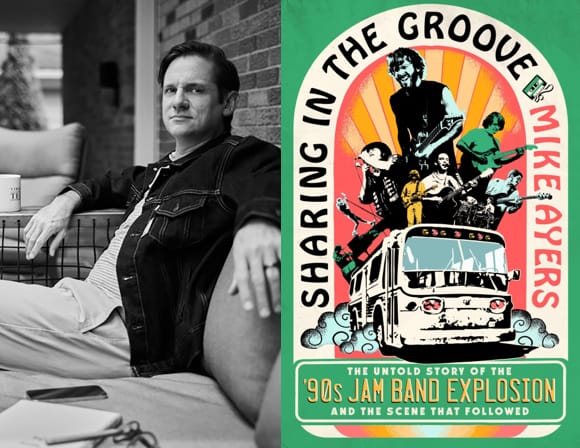
If you’re a Relix reader— and it would appear that you’ve met the terms and conditions to qualify for this designation—then Mike Ayers’ new oral history is for you. However, in the spirit of such books as Our Band Could Be Your Life: Scenes From the American Indie Underground 1981-1991 and Meet Me in the Bathroom: Rebirth and Rock and Roll in New York City 2001-2011, you need never have hollered “Hood!” at a Phish show, pined for the return of the H.O.R.D.E. tour or remembered exactly where you were when you heard the tragic news on 8/9/95 in order to appreciate the sweeping narrative and detailed insights that appear throughout Sharing in the Groove: The Untold Story of the ‘90s Jam Band Explosion and the Scene That Followed. Ayers, a steady Relix contributor who has also written for The Wall Street Journal, The Village Voice and Billboard, as well as 2020’s One Last Song: Conversations on Life, Death and Music, pulls together many threads while weaving a variegated fabric of the scene in all its vibrant glory.
You’ve been a music journalist for over two decades. Can you recall the initial impulse that led you in that direction?
I got super obsessed with music in the early ‘90s when I was starting my teen years. I grew up right outside of D.C., and I started to hit shows at the 9:30 Club. Lollapalooza ‘92 with Pearl Jam, Ice Cube and the Chili Peppers was a seminal moment for me.
I really got in tune with how people were experiencing music during my college career. At Virginia Tech, I was a sociology major, so I was studying culture. I was marrying that with art studies and going to live shows all the time, driving around the Southeast and the North, seeing Phish as much as possible, seeing MMW as much as possible. In 2000, I saw Panic on Georgetown University’s campus over spring break, which was very different than seeing a band in an arena. As I kept progressing, I’d be very interested in the social aspects and why people connect to art and music.
When I moved to New York in 2001, I started hanging out with people who were working at music publications. I think they could tell that I had the bug and I started to talk to them more seriously about writing for them. I had a professor at the New School who wrote for the Village Voice all the time, and she put me in touch with an editor at the Voice.
So I started writing little concert coming-attraction blurbs for their back section at 25 bucks a pop. Every week, I’d pitch things that I was interested in writing about, and if the editor wanted it, he’d write back. So maybe I’d only pick up one, but it was such a thrill to be writing for the Voice at that time, writing about music and trying to explain to people the appeal of an artist.
I also started writing for Billboard around that time, so I’d be pitching to both. For me, it was about loving artists and loving the written word and trying to explain it to people. I got hooked.
You mentioned Medeski Martin & Wood, who appear in the book. They didn’t have the same profile as Panic or Phish during that era. How did you initially come across them?
It was on rec.music.phish. People were talking about MMW pretty early on. If I remember correctly, I started hearing things about them in the summer of ‘95. I was online all the time, reading anything and everything I could about Phish in the Usenet group, and occasionally people would talk about other bands. That’s when MMW started to pop up.
Then people flipped out about that show at Emo’s [in Austin] when Trey sat in on Oct. 14, 1995. I talked to Billy Martin about it for the book and asked him if he remembered the impact of that show. He didn’t necessarily recall things changing for them, but I told him: “Well, from a fan’s perspective, it spread like wildfire.” That was the tape that everybody was pushing on everybody immediately, myself included. I was a pusher.
It wasn’t necessarily the Trey sit-in; it was that they were doing something that I had never heard before. I became obsessed with them pretty quickly in late ‘95, so much so that when they played at Cat’s Cradle in April ‘96, when I was in Blacksburg, Va., I got some people to go with me down to Carrboro, N.C., which was a three-and-a-half to four-hour drive. You couldn’t buy tickets online for a show like that at that point. It took us a little longer than we hoped to get there and the bouncer was like, “Nope, it’s sold out. You can’t come in.” We begged and begged, but we ended up listening to most of the show outside from the parking lot as best we could, and then we drove the four hours back to Blacksburg.
Then Shack-man came out, which was just a beautiful record, and by ‘97-‘98, they were playing small theaters all around. They were throwing DJ Logic in and continuing to evolve. They had this forward-thinking mentality and didn’t want to rest on any laurels. They knew they could have done that, but they wanted to push things forward, if people liked it or not.
It’s rare to find that mentality. Phish was the same way, as were a lot of the acts from that era. I think it’s great.
Karl Denson has a great quote in the book, as it relates to musicians who might be conflicted about attention from jamband enthusiasts. His response is that these are their fans, “so shut up and appreciate it.” Still, one can understand the anxiety that some musicians might have experienced because you also share an account of some tastemakers at SXSW who wanted to shut down any recognition because they felt these groups and their supporters were uncool.
The ‘90s were very genre-dictated. It was not as democratic as it is today. Record labels marketed to punk or hippie kids based on certain stereotypes, and I think that bled into some artists’ perceptions about how their careers were going to go. In Greyboy Allstars’ case, they were playing dance clubs in Europe at the beginning, and they had that kind of cool factor. Then, all of a sudden, the Wetlands crowd started to really pay attention and a lot of the artists didn’t know how to approach it.
MMW is interesting too because they were going down South in their early days and deliberately not playing jazz clubs. They were playing the places where ARU was playing. They were playing indie-rock clubs and not your stuffy jazz clubs. So they were probably bound to pick up some rock-and-roll fans. It just so happened that their improv philosophy was the same philosophy as a lot of the jam artists. It just came from a different background.
Chris Wood recalls that they were emulating their heroes—people like Charles Mingus and Cecil Taylor—while their audiences were relating the music to Phish and the Grateful Dead. He wasn’t dismissive about this, and I thought it was a fascinating observation.
They were listening to Cecil Taylor and playing with John Zorn. The Knitting Factory downtown scene was wildly different than what was happening in Burlington.
They talk about playing in Wisconsin between two Phish gigs in ‘96, where 3,000 people showed up and that seemed like it was out of nowhere. They were shocked; they thought it was wild. It was something that they certainly didn’t expect, but I think they handled it well. A lot was thrown at these artists by labels, with demands to sell records and then to sell tickets. Then they were supposed to go to their shows and satiate an audience that wanted to hear these certain things in a nitpicky way. That’s a lot for 30-year olds.
Your book opens in Princeton, N.J. Can you talk about why you started there and how the structure unfolded?
I was thinking a lot about moments. I asked myself, “What were the essential moments in not only these acts’ careers, but also a musician’s career?” So it was learning how to play, getting together, getting signed, working for a radio hit, listening to the man, rejecting the man, those sorts of things. The arc is around growth.
So for this scene, for this culture, Princeton just stuck out at me because there were a lot of folks there—Blues Traveler, Trey, Tom Marshall, Chris from Spin Doctors, Lo and Tomo from God Street. So there was kind of this thing happening where everybody knew each other or knew of each other.
Then New York City happened for a lot of them afterward, and there were clubs starting to support what they were doing, like Nightingale’s and Wetlands. These places wanted them to serve up original music as much as they could, and they were happy to deliver it.
At the same time, this was also happening in Athens, in Colorado, in Burlington. You had these pockets that were all happening at the same time around this ethos of playing live.
As for the stories, I was familiar with little nuggets going in, just from being there back then. The Spin Doctors were on the H.O.R.D.E. tour in ‘92, then in ‘93 they were playing the MTV Alternative Nation tour with Soul Asylum and Screaming Trees. Then three years later, they were not doing anything like that at all, while Phish was playing to 70,000 people at a festival they put together that largely no one was paying attention to.
So these bands started out with a very similar ethos around experimentation and wanting to play live, but the paths they took were all very different. That’s what I wanted to explore, and I did deliberately want to end at the end of the decade, which was one of the last innocent moments when no one really had the internet in their pocket all the time, and people were experiencing live music in a certain way. I thought that was a great way to end, but as a postscript, it’s great that so many of them are still kicking and doing really great stuff.
You do a fine job of tracking how everything coalesces despite those varied backgrounds and environments out of which they emerge.
I think it is a super fascinating throughline and the word that you used, coalesce, is exactly what happened. If you had told me in 1995 that a whole bunch of people are going to like Greyboy, Medeski, Phish and Dave Matthews Band at the same time, I would have been like, “I don’t know about that.” But it was true. It happened, and you’re still seeing it happen. They broke down these fandom walls, whether they intended to or not. They were so good at making music in front of people that it was infectious.
Meanwhile, there was another factor that impacted a number of these artists. The book details the challenges that moe., God Street Wine and Strangefolk faced in regard to their label deals. Was that a theme you’d contemplated at the outset?
Yeah, I wanted it to be. At that time, the labels certainly had this power to dictate artists’ careers and some didn’t work out. I was familiar with the stories of Strangefolk, moe. and God Street, so I wanted to dig deep into that. It turned out to be an issue for certain artists.
Another theme that I think is really interesting is that radio back then was just so prevalent in terms of music discovery and success. Dave Matthews certainly had it, and God Street wanted it but the labels kind of screwed them and they didn’t get it. Hearing them talk about going from a van to a huge tour bus and then progressing back to a van was heartbreaking, but it wasn’t because their work ethic was faulty. They were extremely hardworking at their craft, yet these external forces crushed their spirit.
Radio, back then, was a goal for some and for some it was not at all. Phish is a great example as well, where in ‘96, they’re playing the Clifford Ball to 70,000 people and not thinking of Billy Breathes coming out in two months. They were just so hyper-focused on the live show and the label was secondary, which worked out just fine for them.
Jumping back to your prior book, what prompted One Last Song, and how did it come together?
One night I had seen a show in the city and I was taking the train back from Hoboken to my house. I was sitting on the train waiting for it to go, and I was listening to “Terrapin Station” from the Dead, probably a late ‘80s version—I’m kind of partial to the late ‘80s. I was thinking to myself: “I love this song and I have loved this song for decades at this point, and it never gets old to me. I continue to hear new things every single time I listen to it. This is crazy. If I had one song to listen to the rest of my life, this would be it.”
Then a couple moments later I was like, “That would actually be a really good book.” I thought about it the next morning and then, six months later, I was still thinking about it occasionally. I was like, “That would be a really good book. How would it be structured? Would it have art?” Then one morning I was starting to get a little irritated with myself and was like, “OK, I need to know if this is a good idea or not a good idea. I need to move on.” So I emailed an editor that I had emailed with before at Abrams, and I said, “This is the book I want to do— if you could listen to one last song in your life, what would it be? What if I asked a bunch of artists that question and then paired it with amazing art?” She wrote back pretty quickly and was like, “I don’t really know what it says about me, but I love this. Let’s do a proposal.” She got really behind it and we made it work.
I didn’t know how it was going to shake out, but everybody took it very seriously. The reasons for why they were connecting to certain pieces of art, and why they chose them for the last pieces of music they would ever hear, were very different. So you get a good experience whether you read the book from start to finish or pick it up and open to any chapter.
When you think back on One Last Song, is there a particular idea or essay that comes to mind?
Musicians connect to sounds, lyrics, melody and tone in such a deep way, so all these essays have that perspective. Then you also read people’s thoughts about the moments of their last time on earth—the gravity of that and how heavy that could be and what they would want to experience in that moment. I think we all have thought about that. So it’s a nice window into art, music, life and death.
All of them offer something really substantial. Lauren Mayberry of CHVRCHES talked about Katy Perry’s “Fireworks” and I thought that was fascinating. She knew it was a little hokey of a pick, but she was like, “This is a moment in my life that brings back joy. So if I’m going to go out feeling the sort of joy that I felt in that moment, why wouldn’t I want that?” I think that’s an amazing answer.
Jeff Tweedy said The Byrds’ “Turn! Turn! Turn!” He talks about coming of age and how this piece of music was one of these defining things that set him on a path that affected his entire life and career with Uncle Tupelo and then Wilco.
A lot of these people talked about music they connected to at really intense coming-of-age moments and never let go of. I think we all have that, too. I think nostalgia sometimes gets a bad rap from people, like, “Oh, nostalgia is played out. Why is everybody nostalgic about everything?” But sometimes it’s not nostalgia; it’s just that this thing has woven itself into your being and you don’t want to let go of it.
Returning to Sharing in the Groove, I’ve heard that you had something of a random experience working as a prep cook for Phish in the mid-‘90s in exchange for tickets. How did that come about?
For that fall ‘95 Phish tour, I was in Blacksburg, Va. I was going to see the Virginia shows with a very good friend of mine, but we couldn’t wait. So we started thinking about going to the Palace of Auburn Hills on Oct. 28, 1995. I did the math with Yahoo Maps and I knew we could make it. We could drive all day Friday, spend the night, see the show Saturday and then drive back Sunday night.
Then I was like, “If we’re going to Michigan, then it’s super crazy that we would drive all this way when they’re playing in Kalamazoo the night before. We should also go to that show.” She was like, “Yes, I agree. Let’s leave Thursday night.”
So we drove all night Thursday and then, at 11 in the morning, we weaseled our way into a parking lot that wasn’t open yet. I went to the bathroom at a bowling alley and when I came out, my friend was talking to this woman. I came up to them and my friend was like, “She’s from the band and she says that, at every show, they like to offer someone who needs tickets a chance to help the chefs that they travel with do prep work in exchange for tickets and backstage passes. She asked if we wanted to do that.” And I was like, “Yes, we would! We would want to do exactly that!” So we did, and I thought it was the most amazing day of my life.
I was scrubbing potatoes and just really in it and literally doing whatever they told me to do, which meant washing tons of dishes, just doing everything. It was hard work, but we were backstage and we were loving it. This was Almost Famous before Almost Famous came out.
They also gave us dinner, which was super nice. They were traveling with professional chefs at that point, who would cook every meal for the crew and for the band. As we were eating, the head chef was like, “Hey, are you guys going to the Halloween show in Chicago?” We were like, “No, it’s been sold out for months.” Then she just bluntly said, “Well, why don’t you just come and cook?”
We had classes and other lives and, originally, we only were going to do one thing, but then you have the head chef saying, “Please come and join. Cook and then see this amazing show for free.”
So that’s what we did. We went to Auburn Hills, and we went to Louisville the next night and got tickets in the parking lot. Then we showed up at Rosemont Horizon and cooked, and it kind of snowballed from there.
They stopped having people do that, but I think we were hard workers and we were nice, and we didn’t accost the band ever. We just did our thing and saw the show—we loved the music. So we ended up doing that for four years, through ‘99, whenever we wanted to. I did New Year’s ‘95. We cooked the Island Tour—just a lot of seminal shows. It was super fun, and they were very gracious to not be like, “Who are these kids? Get them out of here.” They were like, “Oh, they’re working hard and providing some help to our crew and not being insane. Let’s keep it going.”
Finally, was there something specific that prompted you to write this book, akin to One Last Song?
It was sort of similar. I had in my head an idea around writing that story about working backstage, as an Almost Famous-type story. Then talking with a book agent, he recommended the oral history format. I loved Meet Me in the Bathroom and I had just read Nöthin’ but a Good Time.
I was familiar with the format and could see how a lot of younger acts are doing really fantastic things. Meanwhile, the acts from the ‘90s are still doing amazing things, and going back to your word coalesce, it’s all starting to coalesce. So that’s what kicked it off.