My Morning Jacket: Into The Void
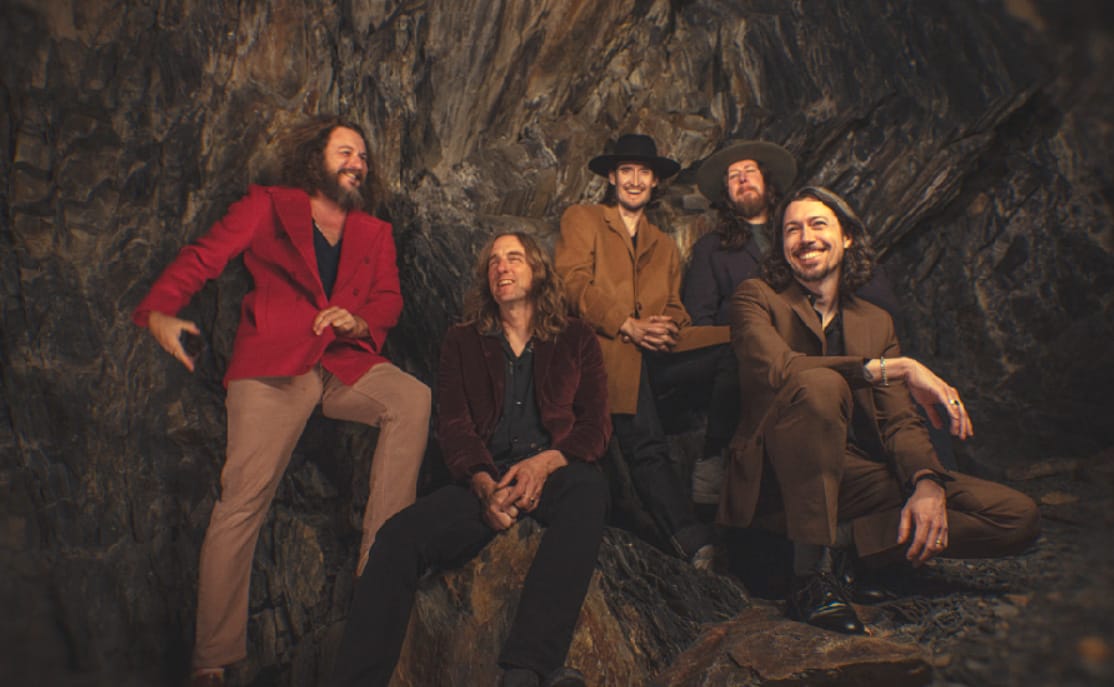
photo: Silvia Grav
***
My Morning Jacket were already two studio visits and an album’s worth of material into their latest effort when they decided to wipe the slate clean and start over again.
“This album was a massive adventure,” drummer Patrick Hallahan says of the unexpectedly long process that triumphantly culminated with is, My Morning Jacket’s 10th LP. “We all sat down about two years ago—we had gotten back together after taking a hiatus, made our self-titled album and gone on tour. And the band just became closer and healthier. It became what I’m calling the best era of the band—in terms of our interpersonal relationships, mental health, productivity, every aspect of it. It started this path of thinking, ‘OK, this is really something special, and we need to take care of it.’ We all said, ‘We’re going to swing for the fences on this one, and we’re not going to stop until it’s done.’”
The LP, which was released in late March on ATO, is more of a recentering than a return to form—the almost 30-year old ensemble’s most studio-centric album since the MySpace era and their shortest, punchiest release yet. It’s also the first time they truly opened up their circle of collaborators to a completely outside voice, producer Brendan O’ Brien, whose distinctive touch can be felt throughout the compact, 39-minute record.
“It was a revelation letting somebody in like that—I’d never really let anyone fully in because my own ego was too desperate to try to cling to all the control,” Jim James, My Morning Jacket’s founder and frontman, admits over Zoom, during a Tax Day tour stop in Arkansas. “We all felt that there’s so much music in the world. We were only going to put something out if it brings something good into the world, something fresh.”
However, the album James originally envisioned making was quite different. The five members of My Morning Jacket— James, Hallahan, bassist Tom Blankenship, keyboardist Bo Koster and guitarist Carl Broemel—first started work on the follow up to their 2021 self-titled record in 2023, at Valentine Recording Studios, with Louisville, Ky. producer/engineer Kevin Ratterman, a close friend of the group known for his time in Wax Fang as well as his association with Strand of Oaks and James’ solo outfit. They laid down some ideas between concert dates, but the sessions ultimately proved to be unfruitful and the musicians decided to change course.
“The goal was to do it live in this old analog recording studio—we did a bunch of recording, and we didn’t really vibe with it,” Koster says in April, shortly after the Jacket wrapped up a few days of rehearsals in Nashville while preparing for an extended tour. “So then we went to Sunset Sound, and we rerecorded some of those songs and recorded a bunch of new songs. We had what we thought was enough for a record. At that point, we all listened to it, and once we stepped away, we realized it was fine. But it just wasn’t our best effort for various reasons. We started talking with our manager and our publisher and we decided to look for a producer that might have an effect on the whole process.”
“In the previous gestations of the band, we would have just released whatever came from those two sessions,” Hallahan adds a day later, while checking in from the band’s f irst tour stop in Knoxville, Tenn. “We all felt like, ‘This is not swinging for the fences. It’s not feeling cohesive.’”
After batting around some ideas, the band members agreed that they needed to try something different and hired O’ Brien, the ‘90s hitmaker known for his work with Pearl Jam, Stone Temple Pilots and, later, Bruce Springsteen. It was a marked shift for James, who had produced or co produced every MMJ album since their 2001 sophomore set, At Dawn.
“Our band really succeeds when we get a chance to wrap our heads around something and then expand on it,” Hallahan says. “The proof is the live show. We make these albums and then we flesh out the songs live, and they become these other things. So the last time that we did any kind of major preproduction was for [2005’s] Z and [2008’s] Evil Urges. Bo and I were pushing to get back to that. We were saying, ‘Let’s flesh out these ideas and then go into the studio and build upon them when the mics are on and the tapes are rolling.’”
“The problem with people like that is that they tend to bring a pretty big ego into the room, and it can be really difficult to be around,” James says of his initial hesitation to work with a mega-producer. “But when I met Brendan, he had this egoless thing about him. All he cares about is the music. It’s not about his legend; it’s not about him telling you stories of all the famous people he knows.”
“When Brendan O’Brien walks in, his ego is not in the room at all,” Hallahan says, echoing his bandmate’s thoughts. “His legacy speaks for itself. But you want to do well for Brendan. He doesn’t give a damn about anything except what’s coming out of those speakers. It doesn’t matter if you’re Pearl Jam or if you’re an up-and-coming artist. He will treat you the same.”
In the past, the band would take James’ demos and flesh them out on the floor in the studio, sometimes resulting in upward of 75 takes per song. This go around, Hallahan says that he and Blankenship spent time with James working out “150 of the 700 ideas” he had to see what stuck at the outset of the process. They then met with a mix of producers, and one of the things that appealed to James, in particular, is that O’Brien possesses the “ears of the everyman.”
“That phrase should be on his business card,” Hallahan says. “We have no shortage of creative ideas. We didn’t need another person to come in and explore. He saw everybody’s potential and brought the best out of them. Jim let go of the steering wheel, and that took doing a lot of work on himself for many years. He felt like he had a lot to prove to the world in years past—he wanted to do the whole thing and prove that he could be the producer, the engineer, the songwriter and the singer. Very few people can do all of that and him working on himself, and having the self-love and the self-confidence to focus on the performance and not running this whole session, really freed him up to focus on what he does best—singing, playing and offering input when it was needed.”
“You get into periods of your life where the energy’s stagnant or you’re stuck in a place,” James admits. “I hadn’t really fought a lot of the demons that I needed to fight in order to get over my own need to try and control every single fucking aspect of everything. And once I began to try and find my own happiness outside of the band or outside of those things, I realized I wanted to give some of the control away and see what comes of it. I’m working on building love from myself that no one can take away—that is not determined by the success or failure of my rock-and-roll band. Whereas, in the past, I was searching for it externally and riding the rollercoaster. I still have hopes that we are going to make the greatest album of our career, but my entire self-worth isn’t based on that anymore.”
That being said, James and O’Brien didn’t exactly hit it off right away. James is famously guarded with his new music and kept his cards close to the vest when they first met, unsure if they were going to work together.
“ I was trying to vibe with him on an ego level because most of the people I’ve worked with are buddies—equals or contemporaries— and, when we are working, a lot of times we’re not even really talking music,” he admits. “When I met Brendan, we didn’t have a lot in common and he just wanted to hear songs, and I wasn’t ready to play my songs for anybody yet.”
He credits his publisher, Jamie Cerreta, for encouraging him to give O’Brien a second chance. And once the producer heard the material that My Morning Jacket had been developing, he quickly signed on.
“We realized we needed somebody that we looked up to, not that we didn’t look up to other producers that we’ve worked for, but somebody that could carry a big stick, someone that could take more control away from us and see what happens,” Koster says. “Most of the producers that worked with us were trying not to get in Jim’s way—they respected Jim as an artist and respected what he’s done. But I think Jim and the band were ready to give over the reins to somebody.”
When My Morning Jacket eventually congregated with O’Brien at LA’s Henson Recording Studios, they offered up over 120 demos, collected during the past 20 years—ranging from voice memos James recorded on his iPhone to more fleshed out sketches. James had earmarked some tracks for solo projects while “Half a Lifetime” had been kicking around since Z and was in consideration for a reissue of that LP. Everyone had their opinions, but the group decided to go with O’Brien’s picks for what to work on. A few songs from their previous sessions made the cut—the almost swampy “River Road,” the hooky “Squid Ink” and “Die for It,” which contains a righteous guitar solo, though the group had been unable to crack the code on the latter cut until O’Brien entered the picture. “It was the same with ‘Squid Ink,’” Koster says. “It was a bit longer and then we punched it up and made it as hooky as possible.”
Inspired by the process, Jim also wrote the groovy “Everyday Magic,” which is driven by an ‘80s-inspired dance beat, and the more romantic, piano-enhanced “Time Waited” during the sessions.
“We just said, ‘If it’s not an immediate yes, we’re not even bothering with it.’ And then Brendan came in and further distilled that down,” Hallahan explains of the song selection process. “We ended up with an intentionally song-oriented album. Instead of waiting for the inspiration to hit, we went Brill Building on it. We really trimmed the fat down. It’s the shortest album we’ve ever made. There’s only one song that’s almost five minutes.”
“We put it through that filter to make the songs more concise,” Koster adds. “Brendan’s focus is the song, the delivery and understandability. And so that’s the record we made, and we’re really proud of it.”
James remained zen throughout the process. “I realized, for my precious little ego, that my happiness wasn’t fluctuating if [O’Brien] didn’t like a song,” he says. “Before, I’d be all bummed out and think, ‘He didn’t like that song, that means it sucks and I suck.’ I realized he might not like song X, but he really likes song A, B, and C. I felt the universe speak and I wanted to take this ride with him.”
He relished letting go a bit, focusing on delivering a powerful performance instead of what mics to use or where to trim a specific section of a song. In certain ways, the album feels like a spiritual sibling to Z, which also used the studio as an instrument.
“We’ve always had our feet in a lot of different areas,” Koster says. “We like weird music, we like avant-garde music. We always wanted to capture a very organic and live sound in the studio, going back to It Still Moves, Z and Circuital, which we recorded on a Mackie mixer in the middle of a church. We did The Waterfall in Stinson Beach, Calif., in a living room. We’ve always been in the room together—the sound’s bleeding and stuff like that. But at the same time, there’s an element to Jim’s songwriting that appeals to the everyman and we all like music that is song-focused—from The Beatles to Marvin Gaye to Rage Against the Machine. There’s always been a lot of things pulling us in different directions and, when we decided to work with Brendan, one thing that was appealing to Jim was making the songs as essential as possible—only put what is absolutely essential in each song. If Brendan wasn’t involved, we could have still done that, but his ears and his filter are very focused toward that. In the ‘90s, everything he made like that was for the radio. We’d go into the control room and everything would sound fucking awesome and punchy, and I felt like he still respected our sound. It still sounds like a Jacket record, but through his filter.”
***
My Morning Jacket officially formed in Kentucky circa 1998, as a vehicle for James’ music, but the band as it is known today really started to take shape a few years later. Bassist Blankenship joined as My Morning Jacket were preparing to release their 1999 debut album, The Tennessee Fire. Hallahan—James’ childhood friend—signed on in 2002, and they brought in Koster and Broemel in 2004, after early members Johnny Quaid and Danny Cash stepped away. Z is the first studio document of what would become the definitive My Morning Jacket lineup.
“That period of time, there was a lot of uncertainty,” Hallahan says. “I thought that was gonna be the last album the band ever put out. When Johnny and Danny left the band, Jim wanted it to be a power trio, and I hammered him—there’s no way that these soundscapes could happen with three of us. It wouldn’t have that twinkle. I wasn’t the only one saying that to him, apparently, and we convinced him to have an audition in Los Angeles. When we auditioned with Bo and Carl, it was just that special thing, like, ‘Holy shit. This is easy.’ I could immediately see the lights, like in a desert oasis. But going into Z, as in the last letter of the alphabet, I was like, ‘That’s it.’ Jim was in a really dark place. I didn’t know if the band would keep going with these guys, but I knew that they were a perfect fit—the right guys at the right time.”
The drummer says that it took about six months of the band playing together on the road for things to start gelling, citing the group’s famed 2004 Bonnaroo appearance during a thunderstorm as the moment they truly coalesced.
“Without crossing some hardships, you don’t get to the next phase of depth,” he says. “There’s a lot of lore around that show, but Bonnaroo was where we realized that these guys were as crazy as we were and willing to go the distance in the moment. It’s like, ‘Will they follow you into the fire?’ The door opened, and they weren’t just following—they were arm in arm. The chemistry was instant, but the personal stuff and the closeness of it came throughout that next year.”
James also notes that the Jacket’s 2004 Bonnaroo set was a pivotal moment for the band, though it took some time for their new lineup to feel permanent.
“You never know how someone is going to turn out,” James says. “We could’ve really loved Carl and Bo in the beginning, but they could have been horrible drug addicts or something could have gone terribly wrong and it could have not worked out. But over and over again, they showed that they were so dedicated, committed, brilliant and funny. Once we were done doing Z, and we had a couple crucial moments, there was a feeling like, ‘This is great.’”
Powered by Z and their commanding live show, My Morning Jacket grew into a defining American band, with James taking the lead in the studio. They headlined New York’s Madison Square Garden twice and—at a time when music genres were just starting to blur with streaming and festivals on the ascent—became harbingers of a new indie-jam world. Their almost annual pilgrimages to Bonnaroo and marquee spots at other big events like Coachella, Lollapalooza and Austin City Limits all felt like true happenings.
But, as is often the case with a band f illed with big personalities, they hit a few roadblocks along the way, both stylistically and in terms of their interpersonal relations, which culminated with My Morning Jacket going on hiatus in 2018. James focused on his solo career and released an album with a Louisville orchestra while the other members of My Morning Jacket worked both together and separately. The quintet regrouped for four shows in 2019, but then the pandemic hit, and the band remained off the road until August 2021.
And, as they began inching back into the live-music world, the five musicians had a newfound appreciation for their shared project.
“Throughout the last 25 years, we’ve all been through our individual ups and downs,” Koster says. “We’ve always been supportive of one another, but we’ve all grown up and gotten a little wiser. That’s helped us be a little bit more focused and Jim has been able to see things through a different lens. It’s been helpful to the process. The first tour after the pandemic was pretty special. I remember, by the end of it, we all looked at each other and were like, ‘Man, I feel great.’ We’ve definitely felt drained in the past by touring because it can be a grind, but ever since then we’ve been in a good place, and we’ve been marching on.”
James has also spent a lot of time working on his mental health and sobriety recently; he says that he found a therapist he connects with and has started doing EMDR treatment to “heal a lot of old trauma and outdated ways of living.”
“I came to terms with my alcoholism and let myself stop drinking—I’ve been alcohol sober for almost three years now. I also have done various psychedelic therapies— ayahuasca and ketamine therapy. That has been profoundly healing. When you go with the flow of the universe versus going with your ego’s flow, it’s beautiful. Your ego’s flow is this desperate, fear-based, controlling thing. We’re so trapped in the illusion of it,” he says, before naturally shifting into the third person. “I felt I was trapped in it my entire life. I say that with compassion for myself too because I know that Jim was always trying as hard as he could, and I’m really proud of all the things that Jim made over the years and all the things that we’ve made as a band. But I’ve just realized that the future can be so much more beautiful and open once Jim lets himself flow with the universe, rather than desperately clinging to his own fears.”
The other members of My Morning Jacket have spent time working on themselves, too; Hallahan believes it’s been a silver lining of the post-COVID era.
“The timing was just right for this mindset,” Hallahan says. “In response to the pandemic, and the chaos in society in general right now, there’s this renaissance of mental wellness. It’s cool to see that as the adverse response to all this trauma. It’s like, ‘I’m going to get better at this so that, hopefully, all this gets better by proxy.’ I stopped drinking alcohol in 2021, Jim stopped in ‘23 and Tom stopped in ‘19. All those decisions, they really do advise good decision-making going forward. Just mixed with the fact that the five of us have such a strong, special chemistry, we don’t miss a beat when it comes time to sit down and play. It’s like meeting an old friend. When we get together, it’s like no time has passed and, after the hiatus, that really informed how special this bond is. We guard it very closely. We don’t know why, but something special happens when the five of us step into a room together.”
“I’m done with illusions and dreams,” James says in a matter-of-fact manner. “I’m done with getting caught up in the fantasy because the only thing that you really ever dictate is time spent in reality.”
James’ wellness journey has had a positive effect on My Morning Jacket’s live shows too; in recent years, Koster has taken on the role of setlist curator, investing considerable time and energy into making each show unique.
“It goes back to Jim’s metamorphosis, in the sense that he used to start the setlists and I don’t think he had a ton of bandwidth to spend on the setlist every night because he had all this other stuff going on being the frontman of the band—vocal warmups, the majority of the press, all this shit,” Koster says. “It was always a collaborative process. They would start it up, and they used to have this thing called K.D.M.—the ‘Koster Demolition Method.’ They’d put a setlist together, and then I would be like, ‘Come on, let’s fuck it up. We’re playing all these songs all the time. Let’s switch it up.’ Patrick was always saying that, too. Eventually, they got tired of us saying that and, at one point, Jim said I should work on the setlists.”
During a drive up to Santa Barbara, Calif., Koster made his pitch: “I was like, ‘I think this is gonna be more fun for us if we switch it up. It’s gonna feel fresh for the fans—let’s treat the setlist like it’s art, make creative setlists.’ And that’s what we’ve done. We’ve come up with some cool ideas, like a ‘Cobra’ sandwich or placing a song between part one and part two of another song. A couple of years ago, we started a show by playing Z backward in Chicago. It was cool to start a show with ‘Dondante’ and then feel the crowd’s energy when they realized, ‘Oh, shit! I think they’re playing Z backward.’”
For many years, James was resistant to playing some of My Morning Jacket’s earliest material. But as he has continued to work on himself, he’s welcomed those tunes back into rotation.
“Everything’s game in the catalog, whereas, before, there were a lot of songs in the doghouse and understandably because, for Jim, its reading your old poetry from 25 years ago—he’s reading these lyrics that his 22-year-old self wrote, and he feels kind of cringy about it,” Koster explains. “He doesn’t want to dive into some of those old feelings, emotionally, night after night. It was emotionally taxing for him, but he’s come around to honoring the old Jim, honoring the 22-year-old Jim and how he felt back then. He has a different perspective on it now, so he’s enjoying playing all the old songs.”
“I can’t imagine reading poetry that I wrote in high school in front of people on a nightly basis,” Hallahan says. “It’s like, ‘That guy is in me, but I don’t see the world through that guy’s view anymore.’ Jim was having some really hard times and didn’t want to sing that guy’s music. But he’s learned to love all versions of himself through the course of the work he’s done, and it’s opened up a lot of possibilities. So it’s been really nice because there’s over 25 years of music, and it’s so liberating to just say, ‘We’re going to come to your town, and we’re not going to repeat a song.’ We are going into the void together.”
***
In April, My Morning Jacket hosted a new incarnation of their One Big Holiday festival, moving the destination event to Florida for the first time. On the show’s final night, they also surprised fans by opening with a fitting take on the Bob Weir classic “One More Saturday Night,” which they debuted at MusiCares’ annual Grammy Week gala in January. Hallahan says the group likes to jam on the Europe ‘72 version of the cut on the bus, calling it a song they identify with.
“Bobby Weir has been such a sweetheart to us over the years, and we’ve gotten to play with him a couple of times. We’re just kindred spirits,” he says. “Picking a Bobby song was the way to go. We really look up to that band—they just did it their own way and were fearless in their exploration. They have a fanbase that would die for them. We’re on our own path, but we salute bands like the Grateful Dead that foster community because that’s what it’s all about. At the end of the day, when we get off these screens, concerts and restaurants are the only places left where we can go to be human—the community is a very important part of that.”
As they have continued to recommit themselves to My Morning Jacket, the five musicians have leaned into their roles as elder statesmen in their scene. James notes that he still enjoys producing younger acts and, on a single day at One Big Holiday, the band welcomed the Louisville indie-folk acts Bendigo Fletcher and Maggie Halfman, New York bassist Karina Rykman and members of the Connecticut jamband Eggy, among others, to the stage.
This is also the first time since their salad days that My Morning Jacket have toured heavily for four consecutive years and they have no intension of stopping anytime soon. This fall, they plan to “address” the 20th anniversary of Z—and thus the 20th anniversary of this iteration of the quintet—during their theater tour.
“There was a newness to the band at that point,” Koster says of that kaleidoscopic record, which busted preconceived notions of what a My Morning Jacket album could sound like. “It was inevitable that we were going to stretch out, and it was inevitable that we were going to try different styles because that’s just who we are as people. That’s who Jim is as a person. If you listen back to the early records, it’s not just a Southern-rock thing. ‘They Ran’ is a soul song. ‘Cobra’ is this weird electro-funk art piece. The songs that Jim wrote for Z were a little more exploratory in that sense, and Carl and I were lucky to be there for it and help him. Ever since then, we’ve kept trying to explore different avenues. On The Waterfall, ‘Spring’ was such a weird song—we played each part individually, and Jim went home and stitched them together like a collage. We did six different versions. We’re always searching for new sounds and fresh ways of saying things while staying true to who we are.”
James also hopes to revisit some of the ideas that didn’t fit onto is down the road.
“Brendan’s not a big jazz improv guy. He’s not a big jam guy,” James says. “It was cool taking this ride with him, but we have so many psychedelic or improv [tunes], and I would love to find the right producer to work on them with.”
Despite being more song driven, the material on is has already gotten its sea legs live and the band performed all 10 tracks in concert soon after the record dropped. Confident in their approach, they have no problem testing out new numbers live as well, even if those ideas end up dying on the vine.
“We played some of the previous album’s songs live, just to try them out and see how they felt, see how people reacted. And it definitely proved to be like, ‘Wow, these aren’t up to snuff.’ So there are live recordings of songs that will probably never hit an album,” Koster says of the material they jettisoned before linking up with O’Brien. “We’re more open to that stuff now too, and it is nice to be able to offer something that no one’s heard before. It’s like a comedian working their jokes out on a crowd. That’s been kind of liberating.”
And, more than anything, James believes that the time he’s spent on his mental health has helped him work more efficiently with his band.
“ I was a terrible communicator for most of my life—I held it all in and I thought I could solve it all myself. We all really suffered,” James admits. “The band almost ended a couple times because I was not doing well. I didn’t know how to deal with my alcoholism and my depression. But the more that we learn to love ourselves, the better we can be to the world. A lot of us skip that part and there’s this illusion that it’s selfish to want to take care of yourself. But the more you take care of yourself, the better servant you can be to the world because then you’re not acting from a place of fear or anger. I’ve been able to find some of these pathways, and it helps me be a better leader. It takes a lifetime—it’s not like I’ve got it figured out by any means—but I feel like I’m on the path, which really feels good.”