***
Brian Weitz’s life almost went in an entirely different direction. Just over 20 years ago, the Baltimore-bred musician was pursuing a career in environmental policy in Washington, D.C., with a particular focus on the intersection of ocean policy and climate change. When his fellowship ended, Weitz decided to temporarily live out a childhood dream touring and recording with his high school friends David Portner, better known as Avey Tare, and Noah Lennox, who releases music as Panda Bear. The experimental combo they had started a few years earlier, Animal Collective, had started to gain some traction and grown to include Weitz on samplers and electronics as well as another old friend from Baltimore, Josh “Deakin” Dibb. Things took off from there and, instead of returning to government work, Weitz, under the moniker Geologist, has spent the past two decades releasing a mix of LPs, soundtracks and creative visual projects with his old friends.
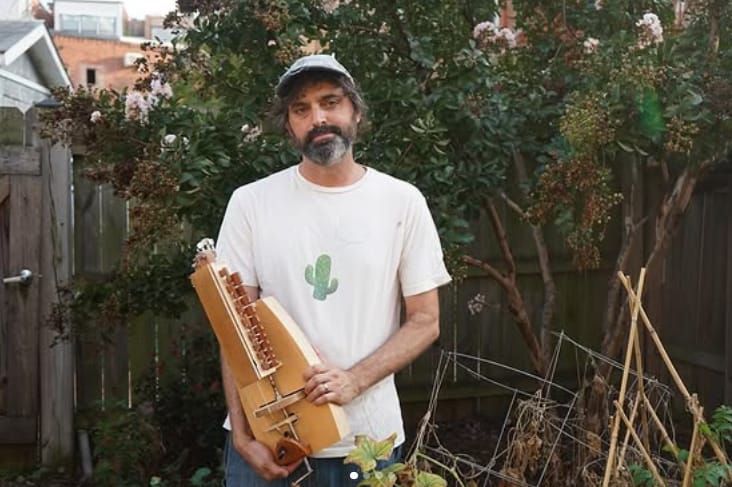
Animal Collective’s lineup is famously elastic, with members often shifting roles or sitting out full projects altogether, allowing the four musicians to pursue a range of outside endeavors. However, up until now, Weitz has yet to release a full-length album of his own. That all changed after Portner encouraged him to work up a live set for some support dates and, following a trip to Asheville, N.C., Weitz completed the first Geologist solo record, Can I Get a Pack of Camel Lights?, which will be released on Drag City on Jan. 30. Inspired by his growing interests in the hurdy gurdy, a viola-like stringed instrument that resembles a keyboard, Can I Get a Pack of Camel Lights? is a mix of freeform improvisation and more refined songcraft, featuring contributions from Weitz’s son Merrick on guitar, Avey Tare on bass, and drummers Emma Garau, Alianna Kalaba (FACS, Cat Power) and Ryan Oslance (The Dead Tongues, Indigo De Souza). Between Animal Collective commitments, Geologist will also support the record on the road in the coming months.
Shortly before the LP’s release, Weitz discussed his decision to drop a solo LP at this point in time, his deep working relationship with John Cale and Animal Collective’s missed connections with the members of the Grateful Dead.
Over 25 years after Animal Collective originally coalesced and following several more low-eye recordings under your name, Can I Get a Pack of Camel Lights? is your first proper full-length release. At what point did you decide the time was right to make a solo LP?
I’ve been putting out solo stuff for almost 10 years now, just in a little bit more of a lackadaisical way. For the first 15ish years of the band, the only person who really did solo stuff was Noah [Lennox], Panda Bear. Avey Tare [Dave Portner] is the primary songwriter in Animal Collective. So, for him, Animal Collective was almost just the vehicle for his songs. It was really in the second decade when Noah—because of the success of the record Pitch Person happening at the same time as the success of Merryweather and Strawberry Jam—said to us, “Guys, I can’t do both projects at once.” Prior to that, his solo stuff had always been on a much smaller scale and something for him to do when he was alone in Lisbon—and then it really became on equal footing with Animal Collective.
So going into the 2010s and ‘20s, he asked that we not do solo things and Animal Collective things at the same time, and the other guys were like, “OK, that’s cool, we’ll just do some solo stuff.” I’ve never really been a songwriter, and I wasn’t really planning on Animal Clutching being my career anyway, even if, at that point, I didn’t have kids. I thought maybe I would go back to doing environmental policy, but it still seemed like the band wanted to continue on. So every time we took a break for people to do solo records, I basically just had more kids. I could be a stay-at-home dad because my wife’s a schoolteacher.
And then it happened that another break came up, and I was not having any more kids, and it was actually Dave, Avey Tare, who encouraged me to make some music. He and I had been doing some free SoundCloud releases that I’m not sure how many of our fans knew about. At one point, he asked me to go on tour with him, but I didn’t get that it was to play a few shows. He was like, “Do you wanna come on the road with me for a few shows?” This would have been in 2017, and I thought he was asking me to sell t-shirts or to drive him or something. But he was really encouraging and said, “The stuff you’ve been doing for the film soundtracks we do, and the visual projects we do, has been really cool.” He had seen me do one solo ambient modular synthesizer set that he liked and he was like, “You can do it! Just write 30 minutes worth of music and come out with me on the road,” so I did that. And then he asked me to do that another time and Noah had asked me to do the same thing. Basically, all of that was pre-COVID, and I just put out all of that out as limited-edition cassettes, and they were usually recordings of the live sets that I did, which allowed me to not think about things so much. I could keep it low stakes—rather than really put myself out there.
Then I made this other record that was sort of a birthday present for a friend [Doug Shaw] that came out last year. It’s called A Shaw Deal,and I just sampled my friend’s Instagram and made a record out of it. Drag City put it out too, but they billed it as both of our names. [The record is credited to Geologist and D.S.] And, at some point in 2023, Dave asked me to do another tour with him. I’d been playing hurdy gurdy, at that point, for a few years in Animal Collective, and I really wanted to play it solo. So that was the genesis of writing this record—to have a set that I could play live. And after I did that tour, I felt really good about it and I listened back to a live recording that a sound guy had made and I thought, “Well, this will be the tape that I put out of this music.” But as I was listening back to that, I was hearing things that I wanted to be different because I was still improvising a lot, and I was like, “There’s something worth keeping, but I could have done that better.” It just got in my head—I was hearing things that I wanted to change. So I said, “Maybe I should take this more seriously than I’ve taken my solo stuff up to this point and actually try rather than just putting out like a low-stakes, live documentation of it.”
You mentioned the hurdy gurdy being a primary inspiration for this set of music. When did you gravitate toward that instrument?
I was really into a guitar player named Keiji Haino, a Japanese guitar player who’s been active since the ‘70s. He came to New York in 1998 to play a three-night residency at Tonic, and I was doing college radio in New York City at the time, so I promoted the shows in exchange for free tickets. And I saw him play a hurdy gurdy—just one of the nights he played hurdy gurdy—and he plays very atonal drone music when he plays it. For the last 20 years, I was just a fan of his. The open drone of a hurdy gurdy is basically 1/5, so it’s similar to things that Tony Conrad was doing and John Cale was doing both in and out of The Velvet Underground in the ‘60s. So even though it was a different instrument, it was an interval I was very attached to. And then Animal Collective started playing with John Cale—he’s featured on a record of ours, and we played on his records, and we helped him out with the Velvet Underground performances he does. He’ll play the first record in full, or sometimes and we help him out with his solo performances, and I was always recreating that drone but on a synthesizer.
Then, Animal Collective was working on the new batch of material that became the last two records we did, Time Skiffs and Isn’t It Now? Because we’ve been playing with John and I had this modular synthesizer patch, I just took it into these Animal Collective songs. Then, one day, Dave was playing me a hurdy gurdy record by a different player from France who does both some experimental stuff and classic medieval French dance music on the hurdy gurdy. And I was like, “These are basically the sounds I’m trying to fake on the synthesizer, so why don’t I actually just get a hurdy gurdy and see if I enjoy playing it? It’s been 20 years of me being obsessed with this sound, so maybe I should give it a shot.”
There’s another composer, her name’s Ellen Fullman, and she plays something called a long string instrument. I’m actually going to see her do it in a couple of weeks, but she puts wires up across entire performance spaces and just walks with rosin on her hands and bows them with her hands. And so that was another composer who did similar things to the way the hurdy gurdy sounds. That’s what I started doing. But again, in Animal Collective, I started to branch out and write what sounded like melodic guitar solos a little bit. But, generally, I’m just providing the drone in the same way that John provided the drone behind Velvet Underground songs or something.
Let’s stick with John Cale for a second. He has been a huge influence on your music, both in and out of Animal Collective, and in many ways, he laid the groundwork for the experimental scene you traffic in. What have been your takeaways from working so closely with him?
It’s so valuable to me, even though we don’t get to do it as often as I’d like to. I’d say there were three things—number one, he’s incredibly generous. The reason we invited him to play on an Animal Collective record, Painting with…, is that I had a sample of a stringed instrument playing a 1/5 drone, and it wasn’t fitting in the song. It just sounded outside of the mix a little bit because it was a sample, so we said, “Well, if we like that sound, we should see if John wants to do it on the record because he lives in LA, he’s [also on Domino Records and Dave’s sister does projections for his live concerts.” So we had a contact. And when he showed up, we asked him how much he wanted to be paid, and he said, “Nothing, but now you owe me a favor.” It wasn’t in a threatening, Godfather way either. It was like, “We don’t need to exchange money, so I’m gonna ask you for a favor, and then you can ask me for a favor,” and it’s gone on like that three or four times at least since then. Very little, if any, money has ever exchanged hands, and we have only exchanged money when someone has said, “I need a hotel room to do that thing you’re asking me to do.”
It’s that generosity, that sense of community that’s stuck with me—even though you might think that somebody from the ‘60s would have a different way of thinking about things, that’s always meant something to me. I try to do the same thing. Sometimes I can’t afford to not ask for a day rate or something, but if I can trade someone something instead, then I will. So that’s my relationship with him musically, in terms of the music business—that there almost is no business involved.
The other two things are that, when he did come in to replace that sample, he actually couldn’t play the drone—it was in a key where you can’t make that work. The interval I was playing, and the key of the song was in, you can’t do it on the viola. It’s too unnatural for your hands. So he just brought in a different sample, and he played it on the record, but I noticed that he kept his sampler in gate mode the entire session. I thought that, because he was an older guy, maybe he didn’t know that you didn’t have to do that—that you could just hit the loop button and hit stop when we said stop. And it would have been an easier performance for him. So I told him that and he said, “No, that’s intentional. Even with electronic instruments and electronic music, you have to have a physical interaction and there has to be intention in your playing. So I keep my sampler in this mode because the act of keeping my hand on the pad is the same as sustaining a drone.”
He was saying that, if you’re on a live instrument, you have to be present and it is the same thing with a sampler. I’m often on stage with Animal Collective playing a lot of things at once, so I can’t just keep one finger on a sample pad for a loop to go. But I do think about that a lot in terms of when I’m able to be present with my electronics—how to be hyper present and physically interact with them. It’s been an inspiration. If I’m playing this drone and I’m faking it with a modular synthesizer, when I would do it with John, I would make it so that I had to have a finger on a trigger pad on my modular. I would have to open up the volume envelope to let the sounds out of the synthesizer—I made it so that it was controlled by a finger touch pad to honor that stuff, but then I thought, “I’ll just get a hurdy gurdy. I want to experience that more as someone who’s been so focused on loops and electronics. I want to physically interact with something where I have to be more present.”
And the other thing is, I don’t have the best ear. If someone is playing 1/5 above or a 5th below, a lot of musicians find that really easy. It’s the Star Wars interval or the “Twinkle Twinkle,” interval. But if I have an oscillator, and he tells me, “Tune that up 1/5,” my brain kind of almost loses where the starting point is very quickly. So I said to him one time, “Just tell me when I get there because I’ve already lost it,” and he teased me about it, but he said something that stuck with me. He was like, “You can stop there.” And I said, “Are you sure? That sounds really wrong to me.”
And he said, “I don’t know if it’s right, but it doesn’t matter because we made the choice and we’re gonna present it to people that way.” It’s like, even if it’s wrong, they’re gonna assume it’s right and their brains are gonna make it right and their brains will make sense of it because it was presented to them that way. And so, it just made me feel a little less precious about musicianship, especially from someone like him, because he does care about things being proper and in tune sometimes, but then he’ll decide, “I don’t care if it’s right or wrong. The audience is just gonna have to accept that that’s what I’m presenting to them.” I found that really inspiring.
Also, the dude's like in his 80s, and he’s in better shape than everybody. When we’re in the room with him, you just look at him and are like, “That guy goes to the gym.”
Shifting back to your solo album, once you decided to revisit the recordings from the live show in the studio, what was the process like of fleshing out this material?
In the fall of 2023, when I did the opening set, it was just the modular backing tracks when I played it live. That’s all I envisioned it being, but then I listened back to a live recording of this show in Miami, and I decided to put it out. But when I was listening back, I was also hearing other instruments, and I was like, “If I played drums, I would add a drum part here or there—or a bassline would help accentuate the changes over there.” And there were improvised phrases where I wish I had repeated something, or I wished something else didn’t come after it.
I had to put it to bed for a little bit because we got a documentary soundtrack gig that I needed to take for work, so I didn’t listen to or interact with the album for four months while we were on that project. Then, in the spring of 2024, I called my friend Adam McDaniel, who is a producer who owns a studio in Asheville, North Carolina, called Drop of Sun. Dave’s lived down there for a long time, and Adam’s wife and my wife were college roommates. So we’ve been going to Asheville forever, even before Dave lived there. I just knew it was the right community where I could ask for favors to find people to help us out. I’m not the strongest musician myself, and I’m not Mozart—I can’t hear the parts exactly in my head—but I have a vague sense of the direction I want things to be in. And I just knew that I had so many friends down there that would be generous with their time. Nobody ever came in for more than a few hours at a time, and Adam helped source people locally.
I also spent time with the tracks writing all this new stuff. Some of the tracks are still me improvising, but on “Sonora,” the last track, when I would play that live, I just improvised in the key of the song, whereas, once I got to the studio, now that it’s written, even when I play it live, I can play it the same way every time. I actually have the confidence to write something.
I write my parts in Animal Collective, and I write some countermelodic things to the main melody in Animal Collective, but I always have that root structure of the main melody that the songwriters have presented me. And this was the first time where I was like, “There’s just a drone and I have to write a melody.”
And I stole little bits here and there from these different guitar players, which is pretty obvious. I was going to write a drone record when Dave asked me to open for him. I felt like this was my homage to Keiji Haino, Jim O’Rourke, Tony Conrad and all these guys that played hurdy gurdy—extended drones—but I just felt embarrassed and sad as I was working on it. I was like, “There’s nothing original about this. I’m not offering any new thoughts. I’m literally just ripping people off and, if I’m gonna take from my influences, at least I should make it fun.”
I’ve been listening to this podcast called You Don’t Know Mojack. These two Canadian guys go through the SST Records catalog, and every podcast episode number corresponds to the SST catalog number. And so I was listening to that, revisiting a bunch of SST records and Black Flag records—specifically their instrumental record, The Process of Weeding Out—so that was in my head. And then I was listening to this band Always August, who were like kind of a hippie, Grateful Dead-influenced band.
So I was just listening to a lot of spindly guitar soloing through those records. I just made a drum patch on my modular and said, “I’m gonna put the hurdy gurdy through a distortion pedal today, and I’m gonna pretend like I’m 15 years old again playing like air guitar to Pavement songs or Sonic Youth songs.” That’s how the record was written—me just trying to connect with a version of myself that wished I was always a better guitar player and could solo on guitar instead of just playing bar chords. Since the hurdy gurdy is laid out like a monophonic synthesizer, it’s basically a keyboard. In the nerdiest way possible, it has allowed me to live out some kind of teenage guitar hero dreams.
A number of musicians appear on Can I Get a Pack of Camel Lights?, including your son Merrick. Can you talk a bit about some of the album’s contributors?
Dave was down there and plays on it. When we made Time Skiffs, we were all deciding what we wanted to do and said, “What instruments are you feeling inspired to play.” And he was like, “I just wanna play the bass.” We almost never have a bass guitar on our records, but he had played it a little bit on his solo record, Cows on Hourglass Pond, and he really loved it and he writes really melodic basslines, too.
For the songs he would actually write for Time Skiffs, he wrote the chord progressions that he showed to the rest of us, but then he was like, “Somebody else can figure out how to voice those chords in any way you want. I’m just gonna write a bass line—that’s what I wanna play over my own songs.”
So I was very familiar with his bass playing. I play bass on a lot of the tracks, but I’m just playing the root note because that’s pretty much all I can do on a bass, but the tracks where the baseline needs to actually do a certain thing to take the song forward or to interact with the drums—or where it has to do something melodically and wind through my ambience—I asked him to play on the record. I knew he had the melodic sensibility and also, because we have played together for 30 years at this point, we have a lot of touch points so I could say to him, “Well, for this song, I want something in this style but bring yourself into it.” He’s on two tracks and he also was the first person to ever hear these songs other than me—he heard them every night for two weeks while we were on tour. He’d say things like, “For this one, can you write something that’s a little like this and for this one can you write something that’s a little like that?”
He didn’t totally make it through the songs because he hadn’t heard them in four months either, but he gave me a lot of options to choose from, a lot of phrases to choose from, and they are some of my favorite parts on the album. The baseline on the song “Tonic” is Dave, and that’s one of my favorite things on the record. I feel like it really makes the song—the drummer played first and then the way he locked in with her performance was great.
Merrick, my son, was not supposed to play on “Government Jobs,” but I didn’t really know what I wanted to do with that song. I wasn’t even sure if it was going to make it on the record, but there was a Pavement instrumental on one of their early EPs that I was referencing to somebody. I was like, “I just really like this beat I made.” I thought it was great—and if I could just give the beat to a hip-hop person, I would, but I don’t really have those kinds of connections. And I didn’t know if somebody could rap over it, so I decided that I’m just gonna play some shitty bar chords on top of it on this broken acoustic guitar that my wife got to keep around the house. When I was listening to the beat, I actually just picked it up because my hands were restless. I wanted it to sound like this crappy, 4-track type of thing.
But then, as I was driving down to Asheville to track, my son came home from school and called me to tell me that I had left the guitar at home. He was like, “Are you just going to play those bar chords?” And when I said yes, he was like, “I’ll just play them for you.” And then he ended up not sending them to me in time. When I went down to mix the record, it was during his spring break, so I was like, “Just come with me.”
My family came down in the car to do the mixing—again, we’re very close with Adam McDaniel and his wife, and they are like family to my family. We visit them once or twice a year anyway.
He came into the studio and played it really quickly because, even though I could have played it myself, it was so generous that he had offered to play those bar chords. At that point, he’d only been playing guitar for a couple of months—he taught himself guitar from YouTube. So I wanted him to have the confidence of saying, “I can play that guitar part,” and I wanted to let him see it through.
Speaking of the song “Government Jobs,” when you announced that track, you mentioned that not only did you have a government job when you were younger, but it was also a job you enjoyed, which might surprise some fans. What made you decide to switch career paths?
I had a fellowship. I have a degree in environmental policy, and I was always focused on the ocean and atmosphere—the intersection of ocean policy and climate change was my sweet spot. The ocean is a carbon sink, so it absorbs carbon dioxide, and it makes it more acidic, which is bad for coral reefs. So there were a lot of intersection points between the ocean and the atmosphere that I worked on in grad school. I got a fellowship with the Senate Subcommittee on Maritime and Fisheries for the Democratic staff. The fellowship was only for a year and then you would have to reapply for a job somewhere either in the Senate or you could go work for NOAA, which was the National Oceanographic and Atmospheric Administration Agency. If you got the fellowship, it was very easy to just continue working in ocean policy in D.C., which was my plan. That was my life. My career goal was not necessarily to be in D.C, but the career path is that you put in your time in the agency offices in D.C. and then you get a field post in a sweet spot like Seattle or Hawaii.
So that was my life plan and I liked it. I didn’t like working in the part of the government that bumped up against politics, but I could have easily just gone to work on the agency side of things, where you’re a little away from that. So I was happy. And then, during that year that I had the fellowship, the Animal Collective record Sung Tongs came out, and I was going up to New York on the weekends, just to visit my friends, because almost all my friends were still in New York. We wrote the record Feels, and we were looking for a time to record it. So when the fellowship had an end date, I kept working on that. That was a presidential election year and one of the senators I worked for was John Kerry, who was running for president at the time. So there was not a lot of work to do—he was running for president, he wasn’t trying to write legislation about ocean policy, so I got to go on tour more than I should have because the Senate was always in recess and there was nothing to do.
I toured with the band for half of the touring that we did that year—I just wanted to finish that record at least. The day that my paycheck was gonna stop and I would have had to reapply for a different job or apply within my same office to stay on as a salaried employee instead of a fellowship employee, I just was like, “I’m gonna go to Seattle for a month and record this album and then, when I get back in April, I’ll talk to all my colleagues about working again.” But while we were in the studio, our agent called and was like, “In late April, early May, do you guys wanna do a tour of college campuses?” We’re like, “Sure, and then we have to finish mixing the record in May.” Then, after we finished the record, we got a European tour and some festival dates in August, and I had never toured Europe, and I was like, “I wanna do that with my friends—this once-in-a-lifetime opportunity.” Then we got an offer to go to Japan and all these things I couldn’t say no to. I was only 25, 26, and it just never stopped.
And here we are now, and I’m relying on my wife to get by—thank God my wife is a teacher and has health care. The band doesn’t really make that much money anymore, and luckily, I have savings and she has health care, but I’m really just hanging on. Sometimes, when I talk to my friends who were working on ocean policy in D.C. back then, I’ll hear how they’ve all gone to do different things and are living in Hawaii or somewhere. It’s like, “Where’s so and so,” and someone will say, “They’re the executive director of a small nonprofit in Half Moon Bay, California and they live right on the water,” and I’m just like, “They all did the thing we all said we were gonna do.” And here I am in my little studio, still making my weird sounds.
My solo career doesn’t make me any money; if anything, it costs me money, and I’m always hanging on to the next era of Animal Collective, and I have no idea how long that’ll last. There are some days I look at my friends, they’re like, “Dude, I’m almost ready to hit my guaranteed pension.”
They’re government jobs that suck and government jobs that don’t. I do a lot of volunteer harm reduction work in D.C., and I see the people who work in that field—they are social workers who are, every day, trying to get somebody to the next day. So there are these government jobs where you are trying to help people, but you don’t make much money, and it’s a depressing part of the world to interact with on a daily basis, but people do it. At the same time, I’ve spent 20 years with my high school band, traveling the world. How could I be more fortunate?
So while the other path would have been fine and I am sure I have the moral center to have done some good work and not gone into the evil side lobbying, there are times when I feel like I dodged a bullet.
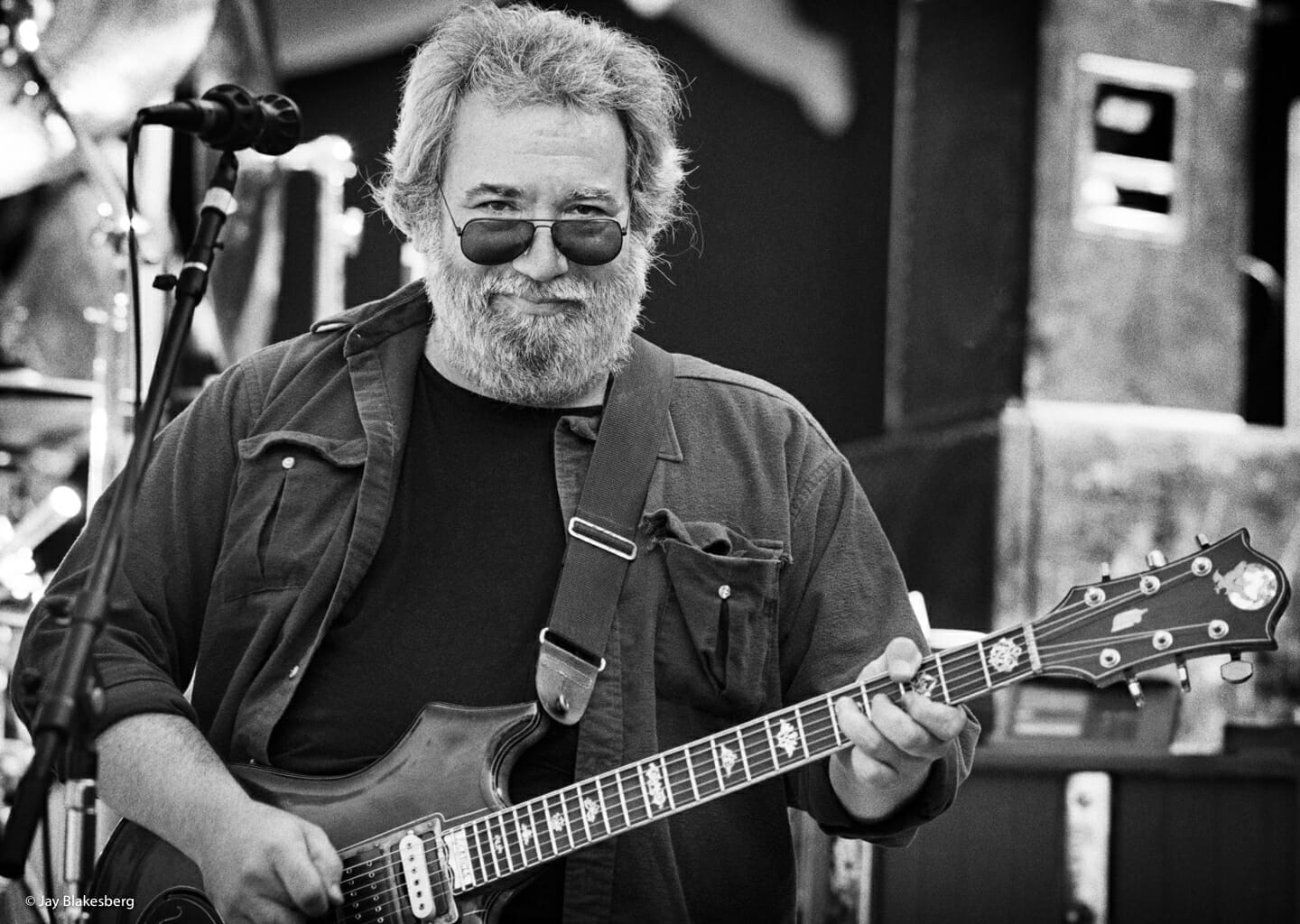
Shifting gears, when you and Dave first met, one of the things you first bonded over was the Grateful Dead—he was even wearing a Dead shirt the first time you crossed paths in high school. Animal Collective also became the first group to officially license a sample of a Dead song when you released “What Would I Want Sky,” which contains a bit of “Unbroken Chain,” in 2009. Did you ever have the chance to meet Bob Weir before he passed a few days ago?
I never met Bob—we actually never even met Phil. That was all through intermediary emails. We always wanted to meet them, and there was always some talk, at Bonnaroo or something, of a SuperJam with them if those guys were already there—or, at least, we wanted to say hello to them and talk about the sampling of that track. But it never happened.
Dave played on a Mickey Hart record [RAMU], so he and Mickey know each other, but we never met any of the other guys. One time, Mexican Summer was talking to us about maybe, if we could work it out with the record labels, putting together some sort of jam session with Animal Collective and the surviving members of the Dead. They put out a series of those records—the Congos and Sun Ra did one.
But I did see the Dead in ‘94, and I remember my favorite part of the set that night had to do with Bob. I was excited about “China Cat Rider” because, being 15, you don’t know the whole catalog that well, and I knew the pairing of that song and “I Know You Rider” from Europe ‘72. But what I was really excited about was “The Other One” because I did have a few tapes from ‘68 at that point already. And they played “The Other One” coming out of “Space” and into “Wharf Rat.’ I remember telling my friends that was a rare segue, even though I actually think they probably did it more than I think they did in the ‘80s and the ‘90. But I thought it was something that hadn’t happened in a long time, and I was like, “I can’t believe we got to see that.” That was the best part of the set. But, now that I have the Sirius Grateful Dead channel in my car, I’m like, “That wasn’t that rare what I saw.” But seeing “The Other One” in 1994 was still really special to me. I don’t know if I’d say that’s my favorite composition of Bob’s, but it’s up there for me—the top few for sure.
I think about Bob [being 16 when he met Jerry Garcia]. Like I said, I’m still playing music with the same guys I started playing music with when I was 15. And, despite what I just said about working in government and knowing that I could still be happy doing that, there’s a point where you make music with someone as a teenager and you feel like, “Are we crazy or could this work for the rest of our lives?” That was his experience—he took the leap and, at 17, dropped out of the straight world, and he put his money where his mouth was. We were a little older than that [when we officially formed Animal Collective and started playing music professionally], but we were pretty close.
I have friends who played with him. The band White Magic, who are no longer together, was a project of Mira Billott’s that included my friend Doug Shaw, who I made that record with last year. He got to play with Bob, and said Bob was the most down-to-earth, humorous dude—he would play with anyone in the room. He didn’t carry himself like he was anything special. So I’m sad I never got to have that with any of the guys, though there is still time for the drummers.
When Phil passed, we realized we never had the opportunity to play with him—those long talks of this thing being destined to happen one day never happened and we never had that conversation. It’s very sad. I was always even curious if he remembered that we sampled his song, but we always wanted to tell him, firsthand, “You don’t understand what it was like to get that email.”