***
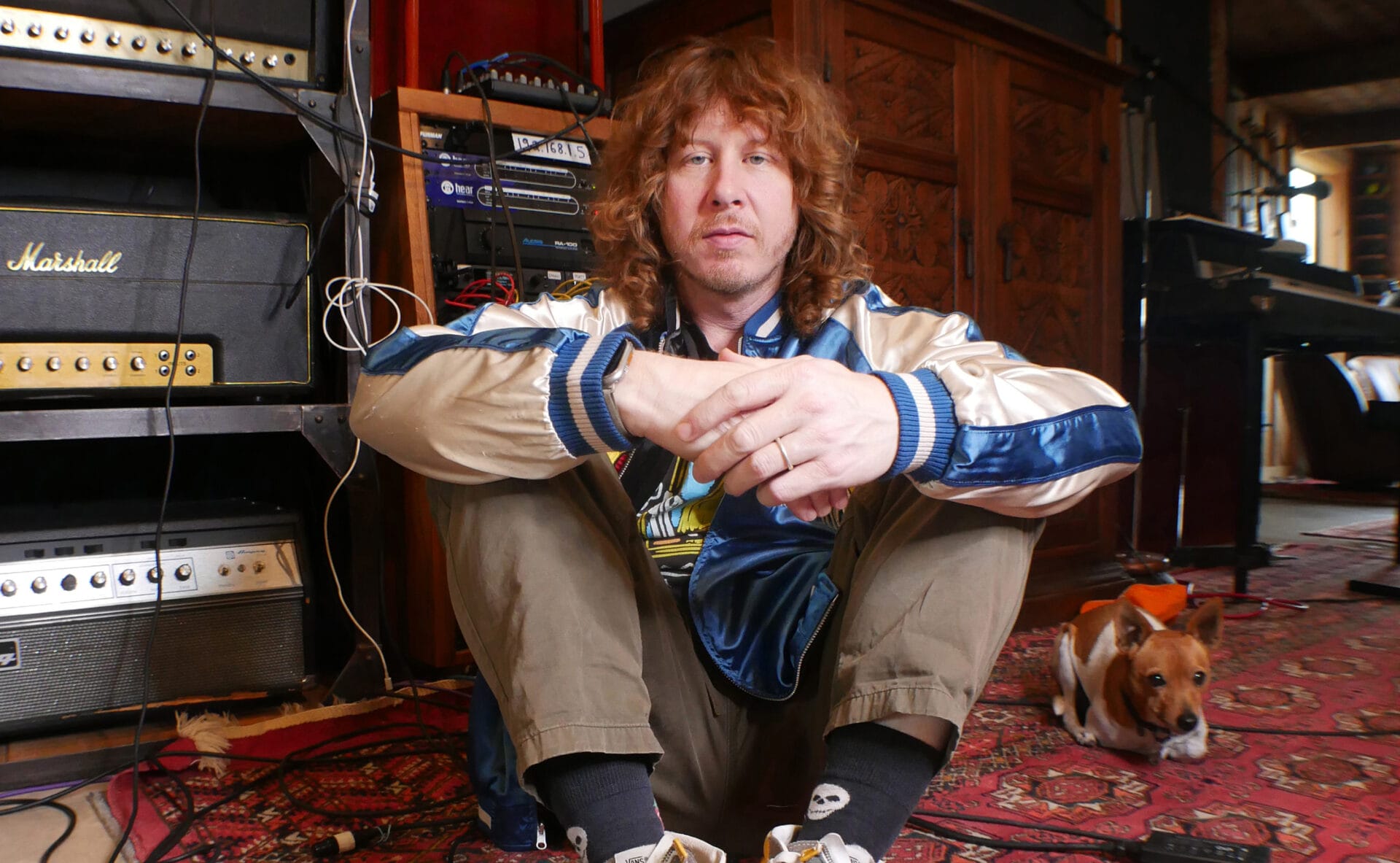
On May 30, 2006, Ben Kweller’s life changed forever. A few weeks before the singer songwriter turned 25, he became a father. Time stood still—all the years of touring, recording, writing, rambling and rock-and rolling had led to this moment. He and his wife, Liz, had already picked their son’s name: Jaxon Wolf Kweller.
“That’s right,” says Kweller today with a smile, speaking from a tour stop in Roanoke, Va. “Jaxon. With a fucking X. It sounded so heavy metal.”
But after the couple—adolescent sweethearts who met in 1998, when Kweller was a teenage next-big-thing— brought their infant son home to their New York City apartment, something didn’t feel right. That night, Liz woke up Ben. She was crying.
“She said. ‘He’s not a Jaxon Wolf. He’s too sweet for that name. We need to call the hospital and do something,’” remembers Kweller.
Quickly, and with certainty, they found a name that fit—Dorian, after Liz’s mother. His middle name became Zev, the Hebrew word for wolf, reflecting the people into which the boy was born.
“My middle name is Lev, which means heart in Hebrew,” says Kweller. “So together, Dorian and I were the heart of a wolf.”
On Feb. 27, 2023, Kweller’s life changed forever once again. As Dorian was driving home, he was tragically killed in a freak car accident. Everything Kweller knew, his whole framework of reality, melted down to nothing.
In the 16 years and nine months that passed between those two days, Kweller released four beloved solo albums; welcomed a second son, Judah; brought his growing family out on the road; launched his own record label; wrote songs for Ed Sheeran; took an extended break from music to focus on fatherhood and relocated to a ranch in Dripping Springs, Texas. His proudest accomplishment, though, may have been the one that came most naturally: He watched his boys begin to make music themselves.
When Dorian died in 2023, he was weeks away from touring as his father’s opening act. Under the moniker ZEV, Dorian had been steadily writing, recording and releasing songs that spanned from spacey hip-hop to jangly pop-rock—and his fanbase was growing far beyond his rural Texas high school thanks to TikTok, Instagram and other platforms that he helped his dad navigate for his own career.
Now, two years later, Kweller has released Cover the Mirrors, his seventh album and easily his rawest, most gorgeous collection of songs to date. To call Cover the Mirrors a record about Dorian’s death would be true but limiting. Kweller wrote these songs as his heart churned relentlessly, uncontrollably, through disbelief, depression, agony, gratitude, acceptance, love and even joy. And in this way, it feels similar to all of his other records—written in the direct, honest and vulnerable voice that’s allowed fans to feel like they’ve known him for years.
“The further I’ve gone with my music, the more people have told me: ‘Dude, your songs have helped get me through a divorce,’ or they’ve said, ‘Your songs have been there as I fell in love or this or that.’ I think that’s the real, sacred gift that I’ve been given, the best side effect of making music,” he says. “I could have never predicted what happened to Dorian, that I would go through such a tragedy. But I’m here, squarely in this situation. And if anyone’s helped, or comforted, through this music, then my God, man, I’m blessed even more.”
**
If there ever was a musician to earn the label “rock-and-roll lifer,” then it would be 44-year-old Ben Kweller.
Growing up mostly in Texas, Kweller was only 7 when his guitarist dad—who toured with Nils Lofgren in the 1960s— pulled a drum set out of the attic and taught him to play. Kweller remembers waiting for his father to get home from work so they could jam to The Hollies, The Beatles and Hendrix’s “Little Wing.”
Within a year, he’d switched to guitar and piano and started writing songs. He learned two chords—E and A—and was off and running, writing about “girls and love because that’s what The Beatles sang about,” he says with a laugh. “But hearing ‘Smells Like Teen Spirit’ on the radio in 1991 was my version of my dad hearing The Beatles on Ed Sullivan in ‘63. If The Beatles made me start to write songs, then Nirvana made me start a band.”
He didn’t wait long. Kweller formed Radish when he was still in middle school, playing scrappy, guitar-blazing rock tunes. In the post-Nirvana grunge explosion, labels were hungry for the next Kurt Cobain. And Kweller was pushed up to the plate, with Radish signing to Mercury Records when he was just 15.
“My mom likes to say that I didn’t blow up overnight. I started writing songs when I was 8, so it was a good seven years before I landed a record deal,” he says with a grin. “My parents wanted me to take the decision seriously, dropping out of school to tour, and I’d say: ‘Mom, I’ve been waiting my whole life for this.’”
But by 1998, Kweller’s lifelong ambition fell apart; the label “didn’t hear a hit” in Radish’s ambitious double album, and he left the band and moved to New York City. Before he could legally drink, Kweller had already been swallowed and spit out by the profit-driven record industry—and no amount of wining or dining could call him back to that circus.
Instead, he self-released solo cassette tapes, including the endearingly lo-fi Freak Out, It’s Ben Kweller. And, by 2001, he was happily one of the first artists signed to ATO Records, Dave Matthews’ independent label, vowing to do things his way for the rest of time—or at least for as long as rock-and-roll remained fun.
His official solo debut, Sha Sha, dropped in 2002, and his destiny was cemented— the album was filled with clever, catchy, loose rock songs that were equally earnest and playful. “A broken branch I’d be/ If you weren’t grown to me,” he sang. “Oh, you are, you are, you are/ My family tree.” His fans gathered around him and, years later, remain by his side.
***
In the days after Dorian’s death, everything slowed to a complete halt. He and Liz realized they had no idea what to do next—this experience was utterly new and unknown.
“When something like this happens, you are lost. Liz said: ‘Ben, we should probably call the rabbi,’” Kweller remembers. “You realize how important these humans are to guide you through. They are literally doing God’s work.”
In Jewish tradition, when someone dies, their family sits shiva—a word derived from the Hebrew for “seven,” representing a week of focused and devoted mourning. During shiva, families cover the mirrors in their homes to avoid the distraction of their appearance and tear their clothing to symbolize their heartbreak. But shiva is not a journey of isolation—families open their doors to friends and community, who hold mourners back from the abyss of bearing their grief alone.
Kweller remembers that week as if it was a fever dream. “There was no time,” he says, starkly.
Friends and family poured into their home in Dripping Springs. And a mix of bandmates, musicians, actors and artists kept the Kwellers company in person or on the phone.
When shiva ended, a daunting next chapter began. The unthinkable realization that Dorian Zev Kweller was not coming back set in like a fog. Liz began studying 19th-century mystical Jewish texts about allowing light back into the soul. And Kweller, predictably, began writing songs. He remembers falling asleep in Dorian’s bed, warm and safe inside the cocoon of his son’s things—books, clothing and his laptop, filled with half-finished songs. Kweller poured through Dorian’s music, crawling back inside his most cherished memories— hearing Dorian in his room creating.
“I remember showing Dorian an E chord and an A chord—the same ones I learned first. And he did the same fucking thing I did when I was a kid: He wrote his first song, ‘Parachute.’ And it sounds just like Radish,” says Kweller, still astonished, singing Dorian’s words: “That young boy with no parachute/ Jumpin’ out of that plane.”
One of Dorian’s unfinished songs stuck with Kweller. “Trapped,” a lovesick ode to a girl with “cut-up clothes and a baggy style.” Dorian had actually enlisted his dad to help him work on “Trapped” a few months before his death, but he never got past the first chorus. He relistened to voice memos of Dorian singing and tapping out a beat.
“It was such a good song, and it just wasn’t done,” says Kweller. “I would walk over to Dorian’s grave and talk to him, like, ‘Dude, send me some songs, send me your ideas.’ And one day, I just sat down to work on ‘Trapped,’ and it flowed right out.”
A new reality began to take shape. Kweller opened for Ed Sheeran (announcing the run as “the gingers are going on tour”); he spoke openly about the immense grief he was moving through online, in the press and with fans. Kweller’s friends and bandmates watched him in the depths of despair, but he never lost his center. Christopher Mintz-Plasse, Kweller’s longtime bassist and the actor who played McLovin in Superbad, remembers seeing his bandleader at Dorian’s memorial.
“Dorian’s songs were playing, and I remember seeing Ben smiling—these songs filled him with so much joy and love. He looked at me, and…,” Mintz-Plasse says, as he reenacts Kweller playing air-bass with his hands. “Even on his worst day, he was still Ben in that moment, like, ‘Check out this sick bassline my son wrote.’”
Kweller began to focus his songwriting as an album came into view. But he stayed true to his grieving process, even when it took him to unexpected places. As he sat to write “Oh Dorian,” what came out was, he says, “This real upbeat, happy, Crosby, Stills & Nash-type acoustic thing. I was like, ‘Wait, what the fuck?’”
He wrote about a “crystal child, double Gemini.” The lyrics continue, “Summer smile, a breezy laugh, long hair waves in the wind/ Nothing like bein’ by his side/ Watch him glow and radiate,” before he hits the chorus: “Oh, Dorian, where did you go?/ Please let me know.”
“As I was writing these lyrics, they were all in the past tense. But I made the turn: We’re going present tense on this,” says Kweller. “Now, he’s not dead, he’s not even my son. He’s this cool motherfucker I know that moved away, and my God, if I ever get out to California again, I’m gonna look him up and we’re gonna hang out.”
He pauses and reflects: “You pick your battles when writing music. You sit down to write this perfect, emotional song, but you channel what’s true in that moment. On this album, especially, I had to just go with the flow because I was so, so lost.”
Kweller also dusted off older songs for Cover the Mirrors. He’d been tooling with the slow, creeping “Depression” for a while, but it became an obvious album pick, with lines like, “Maybe I just haven’t waited long enough for everything to be OK/ I used to pretend that I was strong and tough, but I can’t even get through the day.” He invited actor, musician and longtime friend Jason Schwartzman to add harmonies and synthesizers, creating a hazy song that wafts like smoke before building to its climax—Kweller and Schwartzman chanting, “A new day’s coming for me.”
“Ben is ebullient, always bouncing. He’s fearless in his friendships. I’ve known him all these years, but when I heard ‘Depression,’ it was describing a Ben I’d never seen,” Schwartzman says. “In these songs, he’s figuring out his grief in real time. He’s not just looking at it and sitting with it. It was like a cooking class, where the mystery ingredient is grief. It was like, ‘Here’s what we’re cooking with today.’”
Kweller originally wrote “Don’t Cave” as a country tune, but for Cover the Mirrors, he recast it as a soaring rock anthem, its chorus a request, a promise, a commandment: “Don’t cave/ Don’t give in when your heart aches/ Don’t let the bridge between us break/ Your heart is much stronger than you think.”
“I’m talking to myself. I’m talking to Liz. I’m talking to Judah,” he says. “This is for the moments when we don’t know what to say, and we just hold each other and cry.”
Kweller cut Cover the Mirrors in his home studio. Liz and Judah weighed in on every song. With drummer Ryan Dean and Mintz-Plasse on bass, the Kweller family built the album together. Kweller invited Waxahatchee, MJ Lenderman and The Flaming Lips to add their own touches. Some songs are hushed, acoustic meditations. Others are big, roaring rockers. They are all unmistakably Ben Kweller. And in April 2025, he took them on the road.
Every night, Kweller brings a different type of shiva to life—a shared prayer of pain and joy, sung together. On stage, Kweller even tells the story of co-creating “Trapped” with Dorian during his life and after.
“I get up on stage and hear the crowd singing every word. I have this blanket of Ben around me at every show,” says Mintz Plasse. “And I feel so safe up there.”
“The energy transmission as we play these shows, it’s reciprocal,” Dean adds. “It’s sacred, and it’s deeply healing.