Behind The Scenes at the Energy Curfew Music Hour: The Process of Chasing Ants
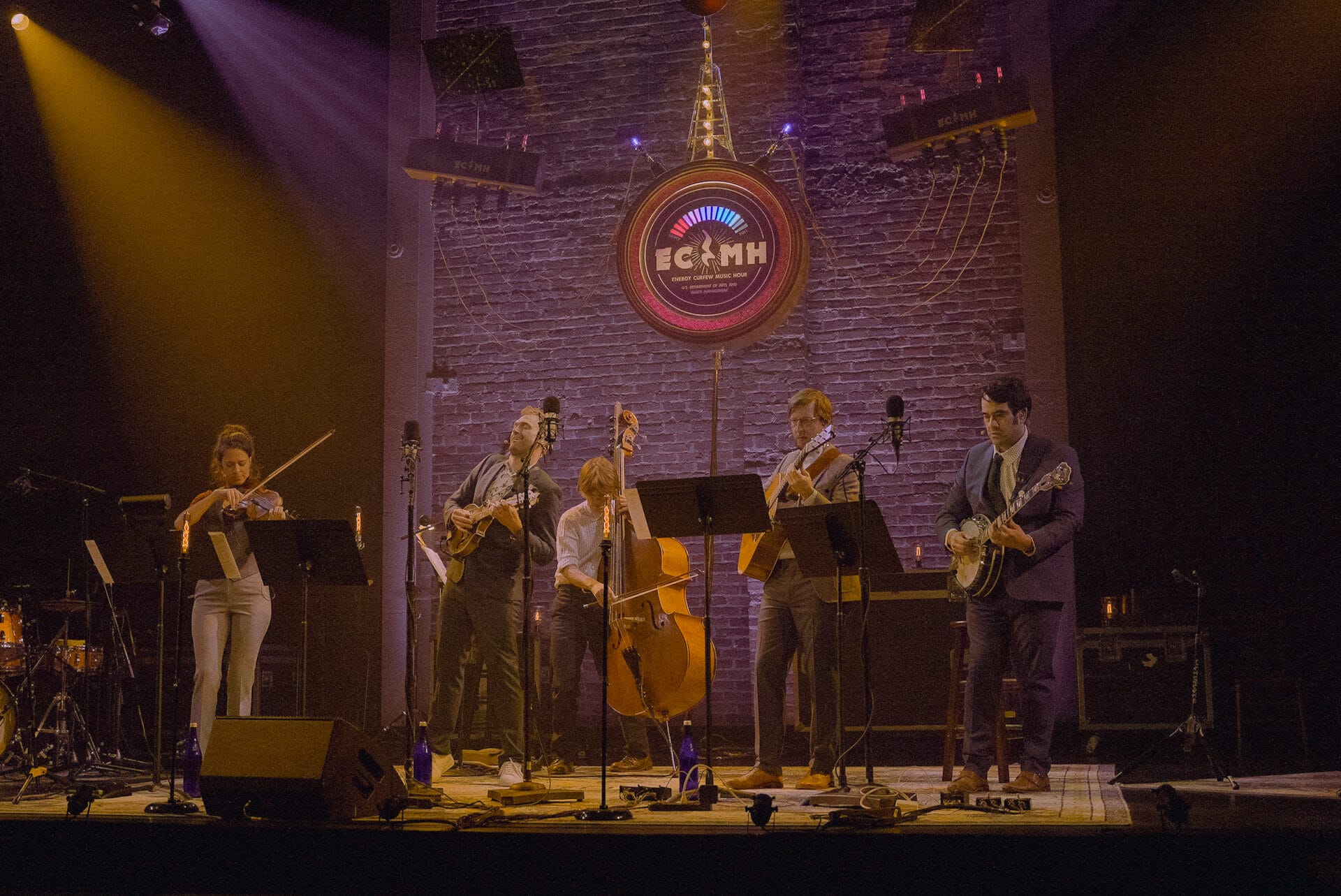
Season two of The Energy Curfew Music Hour debuted in October on Audible. Here, during a quiet moment in late December, we look back to April when one of the episodes came together.
***

“After taking a crack at what we thought this thing was during Season 1, it was fun to make some changes for Season 2,” Chris Thile says, while describing his mindset going into the latest installment of his musical variety show, The Energy Curfew Music Hour. “With this season, we wanted to thread the frame of the show a little bit more completely through the episodes. When we have a guest who is into playing along, getting them involved is so fun. Even though we’re only lightly dipping our toe into the frame every episode, we wanted to make sure we did it a little bit each episode to get people laughing about it all.”
A spiritual successor to Live From Here, the rebranded version of A Prairie Home Companion, Thile hosted on public radio for several years before the pandemic. The Energy Curfew Music Hour is set in a fantastical near-future world where energy must be rationed and music can be played exclusively on acoustic instruments. Much like Live From Here, each episode Thile—this time with his long-running band Punch Brothers—welcomes a cross-genre mix of guests into that slightly surreal world, recording the program live in front of an intimate audience at New York’s cozy Minetta Lane Theatre and releasing the results into the world several months later via Audible.
This season, which dropped in late October, those guests included Billy Strings, Jesca Hoop, Shawn Mendes, Cécile McLorin Salvant & Sullivan Fortner, Jacob Collier, Tune-Yards, Sara Bareilles, Meshell Ndegeocello, I’m With Here and Amos Lee, as well as violin wiz/songwriter/vocalist Andrew Bird and drummer Nate Smith, who shared the bill during the final installment to be recorded in April.
A natural extension of Thile’s wry banter on stage with Punch Brothers, each episode also boasts a mix of tongue-in-cheek ads and accessibly high-brow comedic sketches which often serve as a form of social commentary and sometimes even involve the guest players that Thile and the current Punch Brothers lineup—new fiddler/violinist Brittany Haas, banjo player Noam “Pickles” Pikelny, guitarist Chris “Critter” Eldridge and bassist Paul Kowert— augment each episode. Energy Curfew is also very much a collaboration with Thile’s wife, actress Claire Coffee, who co-created the program and is responsible for much of the writing and creative direction, and comedian Greg Hess, a veteran of Live From Here and frequent podcaster.
“I’m a longtime Nickel Creek fan and have been aware of Chris’ work for many years,” Hess says. “And then, when I moved to Los Angeles, I was lucky enough to be a part of a show that plays at Largo at the Coronet that’s called the ‘Improvised Shakespeare Company.’ Through the circuitous relationships of Largo, I eventually met [former Punch Brothers fiddler] Gabe Witcher and Noam and made my way to Joey Ryan and Milk Carton Kids—they were working, at that time, on what became Live From Here and looking for writer-performers. Joey introduced Chris to my partner, Holly Laurent, and I as possible candidates to write and perform on the show, and we did that for a few seasons, and it was fantastic. So then, when Chris was putting together this new show, Noam, Chris and Claire came to me and asked if I’d want to step back in.”
Hess explains that the banjo player “did the lion’s share of all the comedy writing for the first season” and was looking to add another dedicated comedic voice. “I just jumped at the chance,” he adds. “I knew it would be a similar challenge to Live From Here on the writing side because, when I came to this project, I knew there was something special when it came to Noem and Chris’ dynamic. When I thought about writing comedy for the show, I was really excited about it. Live From Here was such a spectacular, amazing experience, but there were a lot of challenges with that show. You were taking over the mantle of this long-running previous show. It had a very specific tone. I think Chris did a great job of trying to update that show for a public-radio audience. But they wanted to experiment more, and this was the perfect platform to do it. And so, Energy Curfew, to me, seemed like a natural extension, without some of the limitations of doing a public radio show.”
Thile likens the creative process to both putting together a narrative, fictional show and curating a variety event. “I love the idea that people could kind of interact with the story as they see fit and then let their imaginations run wild with it,” he says. “Do they want to play along or do they really just want this to be a musical variety show for them? So we want to really let people have their own relationship with it and not dictate it too much. [With the guests], it’s just about seeing who I can think of—who Claire can think of and who the band can think of and seeing who wants to do it/whose schedules line up.”
Here, Thile and Hess walk through how the Bird and Smith episode came to life.
Wednesday, April 9
9 am: Work Call
10 am: Punch Brothers Off Stage Rehearsal
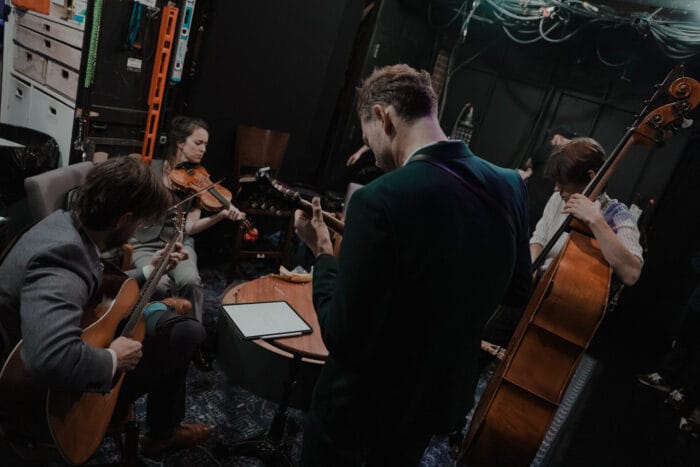
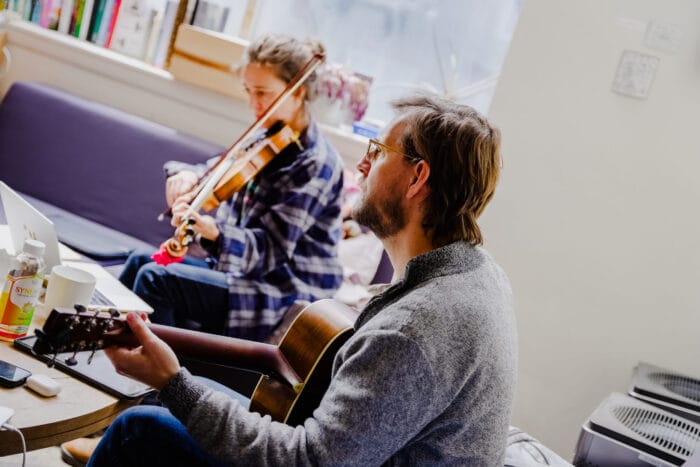
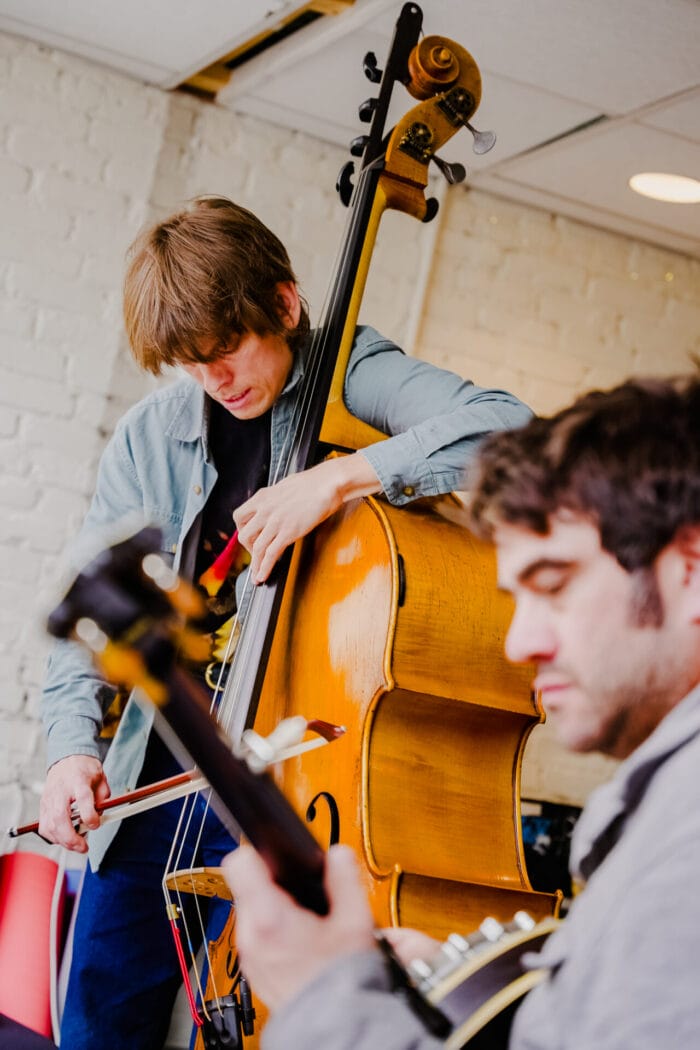
The five members of Punch Brothers put together the song of the week, an original composition created for each episode, in an upstairs space at Minetta Lane Theatre while their creative team continues to hone and refine a few sketch ideas that had been marinating. Hess works out of an adjacent office where he can clearly hear the rehearsals as they take place. The room is filled with instruments and locally sourced coffee and deli-style lunch orders.
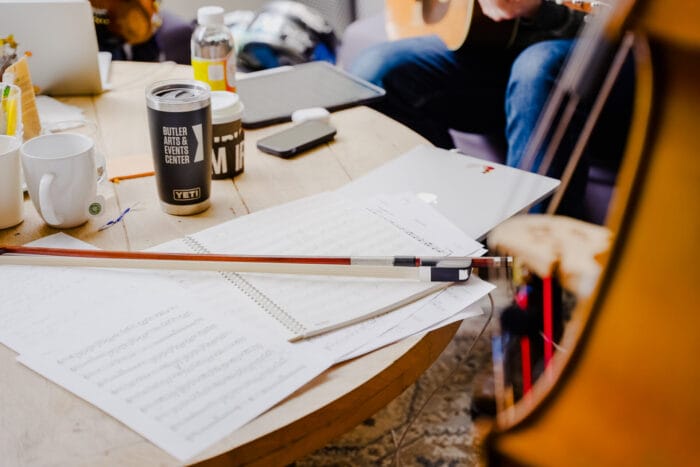
Chris Thile: [The song of the week] is this E-flat, E-B minor kind of jig. That started as a kernel that Brittany had. She played me a little bit of a phrase that she had been kicking around in her head, and I latched on to it a little bit, and then she and I started expanding it from there and taking it to the very non-idiomatic key of E-flat minor. I just wondered, “What would happen if it had a certain feeling in a more idiomatic key?”—meaning something that really lays on the string instruments well. And so, just moving it down a half step takes everybody out of the patterns that their bodies are used to, that their hands are used to. And that’s the kind of little change that I like. You’d be surprised how something that simple can yield some big results because it’ll take people out of thinking that this is an Irish-y jig. You have a tendency to make derivative choices when you’re in that brain. And so, to me, it was like, “This is an easy trick to get yourself thinking outside of the box—just take the exact same music and move it down a half step, and all of a sudden, your mind and your heart and soul get back into the creative process instead of letting your body do it.”
Your body’s not the best music writer. The rest of you is—whether you want to think of it as your heart or your soul or your mind. That’s always better for writing than your body. I’m always trying to get that back front and center. I want the musicians around me to be writing their songs with their imaginations, not their hands or their instruments. I remember making that choice early on with this song and then starting to chase very irregular phrase lengths.
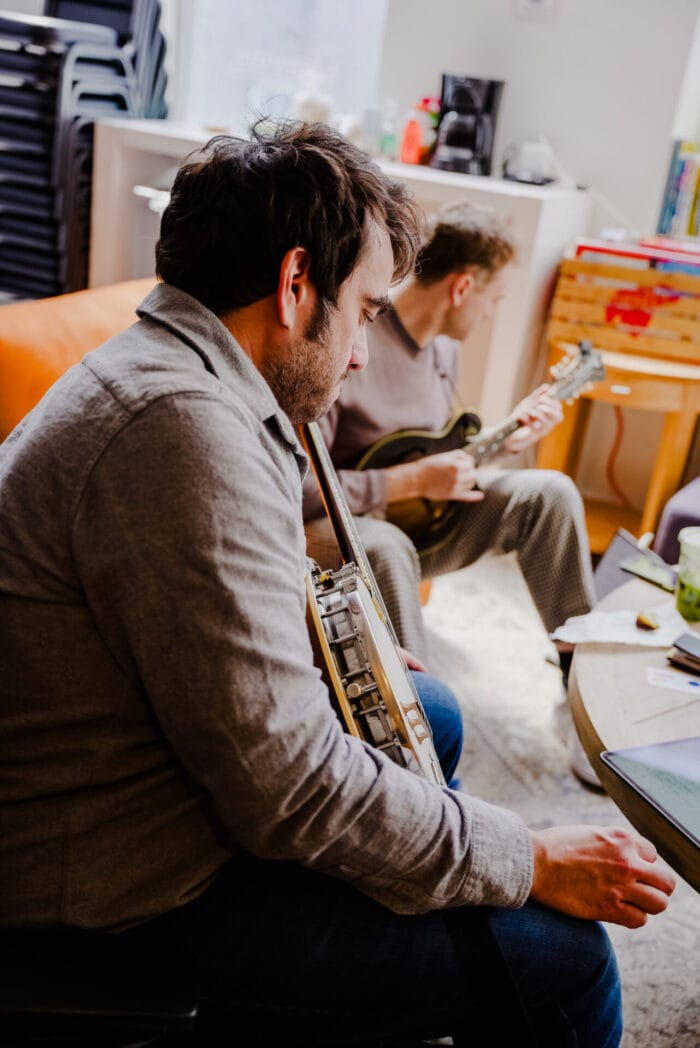
Greg Hess: What am I doing when they’re trying to figure out what time signature this new complicated piece of music should be? The process has evolved over the season, and I think we hit our stride in generating a bunch of pitches before we would come in—Noam and I would just generate a bunch of ideas that were everything from fake ads to walk-on bits to misdirects where you think it’s an ad, but it ends up being a sketch. We are always sending long text messages back and forth. I think some of our favorite stuff even came together after rehearsals. After this one particular rehearsal, Noam and I just went to go get a drink across the street, and we’re making each other laugh with an idea called “Shirt Share,” which was a fractionally owned shirt company for the upscale virtuoso metrosexual. We were just laughing about how it would be very funny to interrupt one of Chris’ introductions of a piece of classical music with a new idea that Noam for this shirt share.
12 pm: Crew Call
2 pm: Lunch Break
3 pm: Punch Brothers On Stage Rehearsal
Punch Brothers continue to write the song of the week on stage at Minetta, in front of their creative team, tightening its structure into a fully formed composition. They also work through early drafts of the week’s sketches, but they eventually decide to give the song of the week some extra love instead of fully jumping into the program’s variety-show elements.
CT: We’re in a little bit of a four-square rut right now, as far as human beings who are writing music. So much music is made on computers and the various music production software types that exist love it when things are in four-bar phrases and in a consistent tempo. And so, it’s pushing our creative thought that way, in a way that it has never really gone before. If you go back and listen to some old Jimmie Rogers and try to figure out what the hell lengths those phrases are, you’ll find that they’re not four bars—the lengths are just what they need it to be. When you go back and listen to old-timey songs, they are crooked. So that’s the thing that we’re thinking a lot about in Punch Brothers these days—it’s not weird to be weird. In fact, to me, it’s weird that everything is in four-bar phrases right now and that walking around in the world is suddenly looking like Minecraft. Everything is square for the first time in the history of humanity, and everything is in time. God, even in the concert hall, a lot of times, people are playing to click tracks.
It’s a really strange moment and a serious opportunity for people who love the physical act of making music to provide an alternative. So there is a little bit of an act of rebellion going on with Punch Brothers’ co-compositions right now. However, I wouldn’t say it’s all a negative reaction to what exists; it’s actually a real positive reaction. It’s us saying, “We’re just human beings trying to make music here and asking, ‘What does that mean?’” We don’t want to let the machines around us tell us what that means.
GH: I was just so excited to be able to come in and truly pitch what I thought seemed like a funny idea for this particular group of people, who happens to have a really natural comedic talent in Noam and a really natural emcee for those comedic moments in Chris. Chris is a natural enthusiast, and Noam plays the curmudgeon so well—the straight man to Chris’ enthusiasm. That is such a goldmine for comedy because we could set up a lot of different scenarios within that dynamic, and it always works.
7:45 pm: Mic Check
8 pm: Rehearsal Ends
Thursday, April 10
9 am: Work Call
10 am: Punch Brothers Off Stage Rehearsal
Punch Brothers finetune the song of the week a bit more, trying to break barriers between known genres while still using notable references points to help inch their way into its complicated compositional structure. They also discuss the show’s setlist and flow. Warning that it can feel like watching paint dry, they get into the minutiae of each tune’s twists and sonic changes.
CT: It is fun to have a reference like, “Critter, play a driving jig.” But my instinct is always gonna be, instantly, to turn that into something new, rather than an Irish jig that happens to be written by five Americans. The goal, to me, is always, “Can we take a prompt like that and turn it into something new, something that no one’s ever heard before?” Of course, “new for newness sake” is nothing. It has to be new and good, and another thing about being in a band that I love is that we don’t stop until all five of us think it’s new and good. I love having five sets of ears.
GH: We have to ask ourselves, “Can we make each other laugh with this?” And then, if we could with the pitch, we had to ask, “Can we write it down and execute it in the live setting?” So once things moved from that pitch stage to the script stage, we had, essentially, a couple of days to beat it out, write it, put it up on its feet a few times, and then do it live. So my role in these in-between times is to do a lot of rewriting, punch-ups, cuts and things like that. And then Claire is the one who, once we had all the scripts in, kind of shapes it into what the running order of what the show would be.
1 pm: Crew Call
1:30 pm: Punch Brothers On Stage Rehearsal
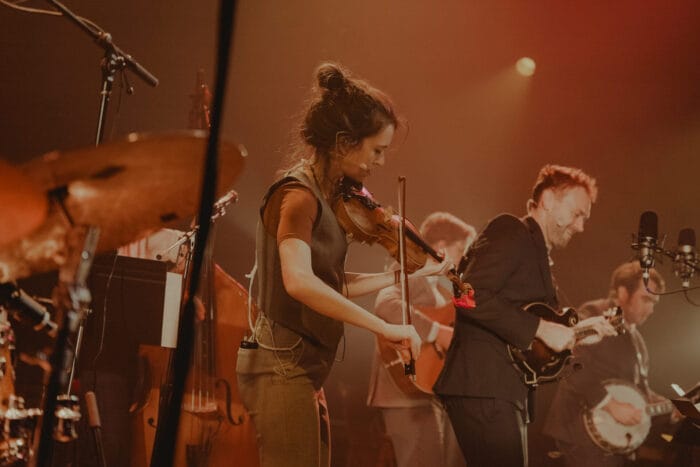
The band talks through the week’s core sketch, “The Fall,” a play on the season it will be when this episode eventually airs in October.
GH: “The Fall” came from this idea I was just thinking about: What are some other twists on the [season] fall? It’s a very smart audience, and Noam is Jewish and likes to point out, “I don’t understand what you’re talking about when it comes to things like original sin.” And so, we just thought it would be a very funny idea to tease that idea and turn it into a twist on the idea of fall. Chris comes from a religious background, and it was a way to put my religious studies major to good use, which I’ve never really gotten to do before. So the pitch just came out of, “Hey, what if we set it up as Chris saying something like, ‘I’ve asked Noam to share his thoughts on the fall,’” and, for some reason, Noam’s character within the show assumed that he was talking about the fall of man and original sin, and we use the next five minutes to expound on that from the Jewish perspective.
CT: The sketches usually begin with Claire, Gregg, Pickles and me talking about some ideas. The four of us would put our heads together on the writing aspects, and then Greg, Pickles and Claire would, thankfully, take the lead. I’d get in there, of course, particularly on the music-oriented sketches and the little opening monologue, but most of that stuff, especially the really funny stuff, was them. Greg was going hard in the room on the writing while we were going hard on the music stuff, and Greg and Claire were figuring out how it all fits together while we were working on the music. But, while there’s some certainty and pre-gaming that happens, it’s fun for it to be as reactive to the comedy as we are to the music. There’s also a great deal of musical pre-gaming that happens, but, when people get in the room, it’s fun to just see what’s up and really write about the feeling of the episode as it’s all coming together.
5 pm: Mic Check
5:15 pm: Break
6 pm: Company Call: Nate Smith.
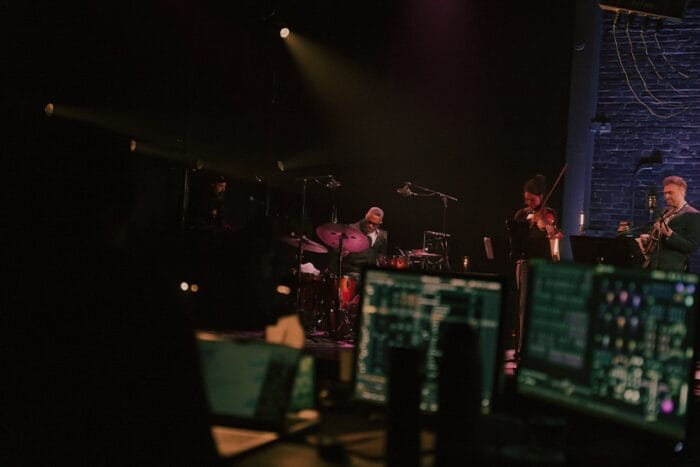
The noted drummer arrives, sets up his kit on stage and makes sure the house volume is properly balanced when he meshes with Punch Brothers’ trademark string instruments and largely acoustic presentation.
CT: Nate is one of the greatest living rhythm players, and, of course, Punch doesn’t have a drummer, so there’s just an instant contrast going on. He was one of the first full-kit moments on the show and it shocked me when he came in on that first Punch Brothers song, “Me and Us,” at the top of the show [during rehearsal]. I was like, “Whoa!” There was this delicious experimentation in the room and that’s continued throughout the course of the show. Then we get to combine him and Andrew. It’s always fun when the guests are up for playing with each other. I love that.
6:15 pm: Punch Brothers with Nate Smith On Stage Rehearsal
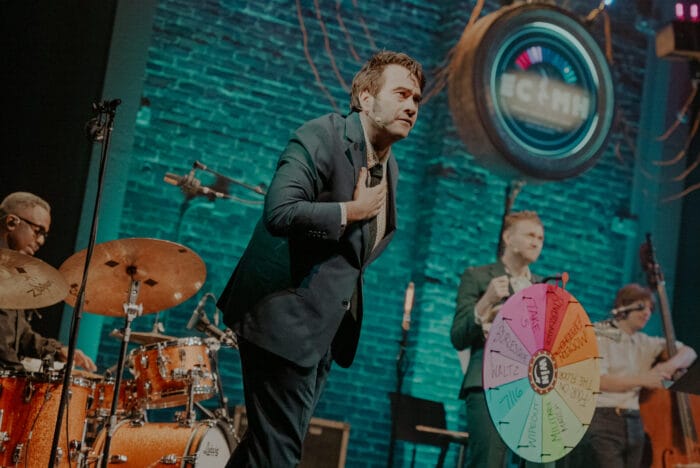
Smith and Punch Brothers bat around an inventive skit where they engage in a “drum off,” playing different percussive beats as determined by a spinning wheel—only Thile is playing a mandolin throughout the gag.
7:30 pm: Company Call: Andrew Bird
Bird flies in for his rehearsal—usually a guest of his stature would come in a bit earlier in the process, but given his deep history with Thile, they are able to dive right in.
7:30 pm: Company Call: Andrew Bird
Bird flies in for his rehearsal—usually a guest of his stature would come in a bit earlier in the process, but given his deep history with Thile, they are able to dive right in.
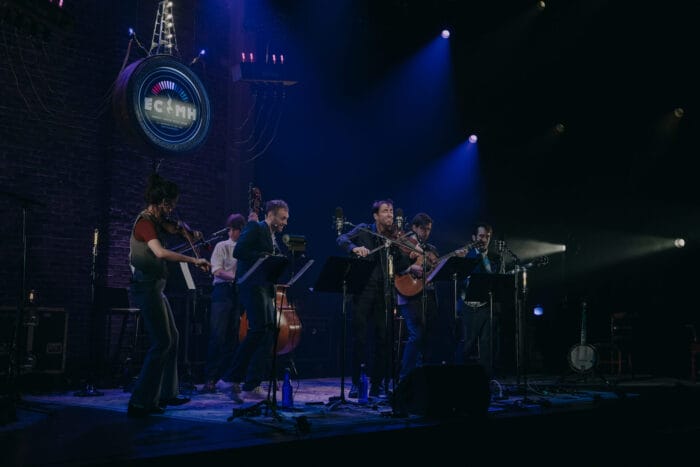
Despite having already called his Uber from the stage, Smith happily cancels his ride and sticks around to jam with Bird and Punch Brothers for the show’s all-company bookend moments.
CT: [When choosing guests,] it really boils down to who’s awesome and wants to do it and supporting the myriad things they do that are awesome. Personally, I just eat it up, so when Nate could work it into his schedule to come by, it was just like, “Hell yes, we’ll figure out exactly what that means when we get there.” I love him as a writer and non-musicians sometimes forget that drummers are musicians too—they are composters and harmonists and, just because they’re back there playing an instrument that we don’t recognize as being a tone producer, that doesn’t mean that those musicians don’t have a profound understanding of melody and harmony. And Nate’s a great example of that. He’s a brilliant composer, and I wanted to make sure we weren’t just saying, “We have a guest drummer this show.”
We’re bringing in another incredible musician. Having him do the solo drum piece was exquisite. We wanted to experience the width and breadth of Nate. That’s not possible in an hour-long variety show, of course, but we wanted to show what he is capable of. All of us love the way he plays, love the way he thinks, love making music with him.
8:30 pm: Release: Nate Smith
The drummer dips out and Punch Brothers explore possible ways to augment Bird on his original cuts. During the changeover, Thile, Claire and their team use a rare moment of downtime, all together in the same room, to firm up some of the always busy musician’s other live commitments later in the year.
CT: Andrew is a real embarrassment of riches. The whole season was an embarrassment of riches, just in terms of who said yes, but Andrew is a particularly natural fit for the show. His music is so evocative, it’s so theatrical. It double-bounced the frame of the show. And it is really neat that he has been looking back at Mysterious Production of Eggs, which, in a way, was the record that announced him to the world as a solo force. So it’s been fun to go back to that record, which was mostly him overdubbing himself. Certainly, I think there are some other instruments—some other musicians—on it, but it’s a lot of him and one thing that’s so fun, for us in Punch Brothers, is to be the backing band for a great creative like Andrew—like Nate Smith, like Sara Bareilles and so forth.
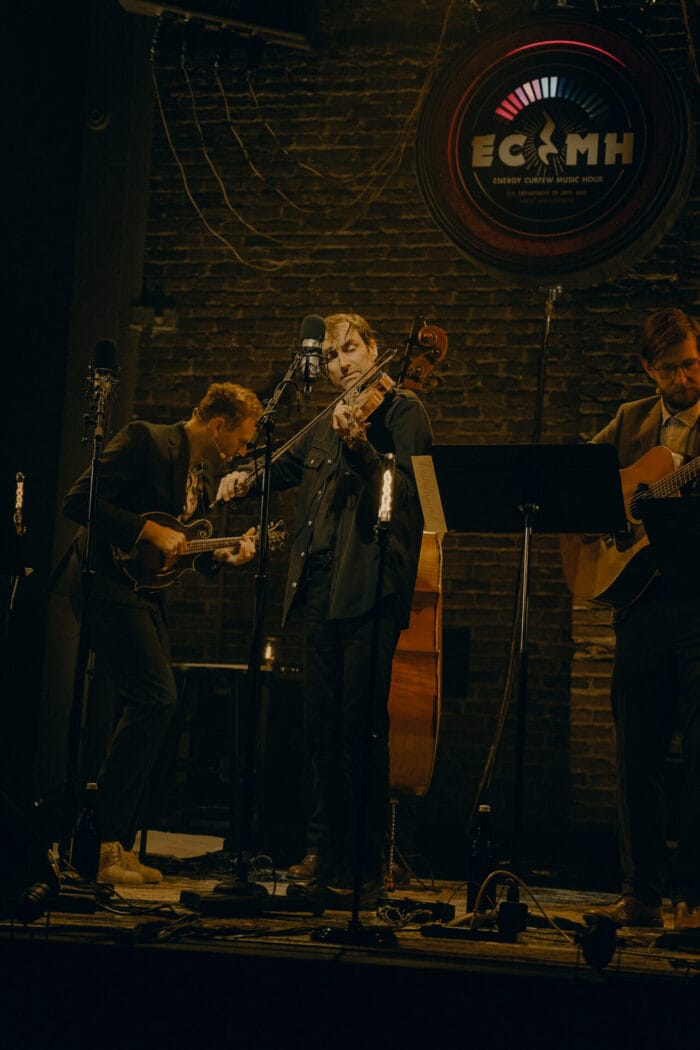
Friday, April 11
10 am: Punch Brothers Off Stage Rehearsal
Punch Brothers have a final run through of their segments in the venue’s upstairs rehearsal space while illuminated by the morning light creeping in through the historic Greenwich Village building’s windows.

CT: One fun thing about working on a song together is that there is this little vernacular. This trill turned up as we were teasing out that rangy melodic line. It was a fun moment, and it was really ornamental, and I love doing things like this. I remember reading Charles Rosen’s The Classical Style and he zeroed in on that—this moment in a heightened string quartet where the accompaniment figure, what you would absolutely analyze as being an accompaniment figure in the cello, sort of magically turns into the primary, melodic gesture happening. As far as I know, that had never happened in music until that moment in this Haydn quartet. And that really stuck with me. I love little metamorphoses like that. Something like that just encapsulates my obsessions as a composer and as a co-composer—seeing growth, seeing change and trying to represent that as an artist is one of my primary obsessions, and I think one of our primary obsessions as a band. It becomes the sort of structural linchpin of this alternate section in the middle.
There is a moment when we are turning on this tricky, flashy, rhythmic moment that happens in the actual ostinato, over which the bridge is built. That was a fun moment for me in the writing room, and it’s nice being with a group of people who can recognize that it’s a thing. It’s just nice to be with a group of individuals who are up for the quite arduous process of chasing ants.
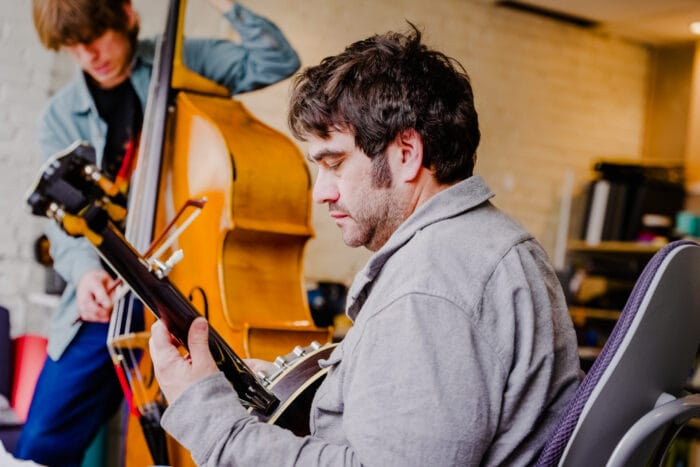
11:45 am: Company Call: Nate Smith and Andrew Bird
12:00 pm: On Stage Rehearsal: Punch Brothers, Nate Smith and Andrew Bird
12:00 pm: On Stage Rehearsal: Punch Brothers, Nate Smith and Andrew Bird energyCurfew-12
The evening’s guests return for another take at the week’s musical skits, with Claire providing in-the-moment feedback on where to trim some vignettes and how to tighten bits that seem to be running a little too long. Punch Brothers ask a few crew members and other onlookers to participate in an improv-comedy game that will rope in the live audience later that night.
GH: With “The Wheel,” we had a couple of days to come up with an improv sketch. Improvisation, coming from a sketch-comedy background, is something we like to play with. Something that we did a little bit on Live from Here, but I always want to find new ways to do in Energy Curfew, is add an element of musical improvisation in the comedy as well. Obviously, these guys are such deft improvisers, and there’s also an element of audience participation. Sometimes music shows can be one direction, or at least the reciprocity is coming from the audience, but they’re not actually active participants in what’s happening on stage. We did a couple of gags this year, one being when we had Jacob Collier do this “choose your own adventure” improv game, and we wanted to do that with Nate Smith—just to show that, though this is all made up, these guys are that good. We can give them some challenges, and they’ll be able to do something with it.
2:50 pm: Out of IEM/Microphones
3 pm: Cast Break and Crew Preset
3:30 pm: Dress Rehearsal
Punch Brothers stage a full-on dress rehearsal for an invite-only crowd. After the program ends, the band decides that “The Fall” is still too long and they cut a sizable portion of the segment just over an hour before doors.

GH: The dress rehearsal, obviously, is an amazing peek into what an audience might do, even though you can’t always trust how the dress rehearsal is going to go. But you get a pretty good sense of, “Oh, that hit and that didn’t.” For a lot of this stuff, you just don’t want to overstay your welcome with a joke, and our job in those moments is to come in with a funny idea, heighten it to a place that’s unexpected, give the audience some twist on it and then get out before it becomes boring or tiresome to them. That’s where I think, as the creative team, we really can come together and actually have such alignment in those moments where it’s just like, “They get it, let’s get out of it.” “The Fall” was a good example of that. Once we did it in dress, we went back and just, honestly, shortened it because we all felt like, once they understood the joke, we didn’t want to beat a dead horse. And that was a good example of how, from dress to the final product, things just get tighter.
And a shout out to Chris and the Punch Brothers, too. They’re so versatile at, essentially, scoring a sketch, and music is such a powerful tool in telling people how to feel. That sketch had such an ominous scoring underneath it, and it did wonders for the final product. As a writer, it’s so fun to come in with a piece of material and then have these amazing musicians be able to essentially score it within a few hours.
5 pm: Out of IEM/Microphones // Strike Tech Table
5:30 pm: Break
6:30 pm: Crew Call
7:15 pm: House Open
7:30 pm: Company Call: Punch Brothers, Nate Smith and Andrew Bird
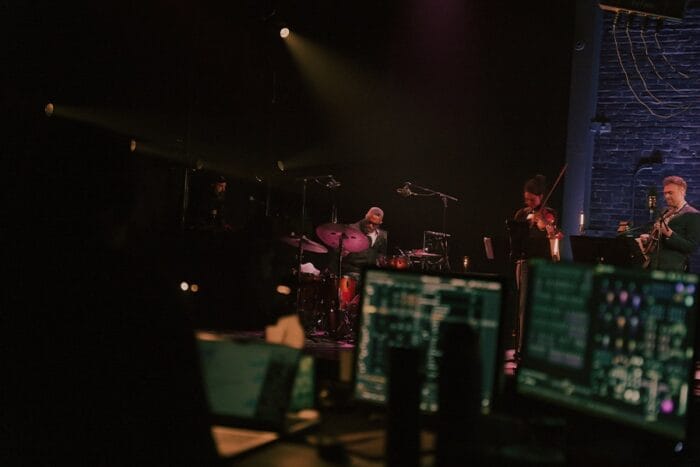
8 pm: Season 2, Episode 6 Episode Taping
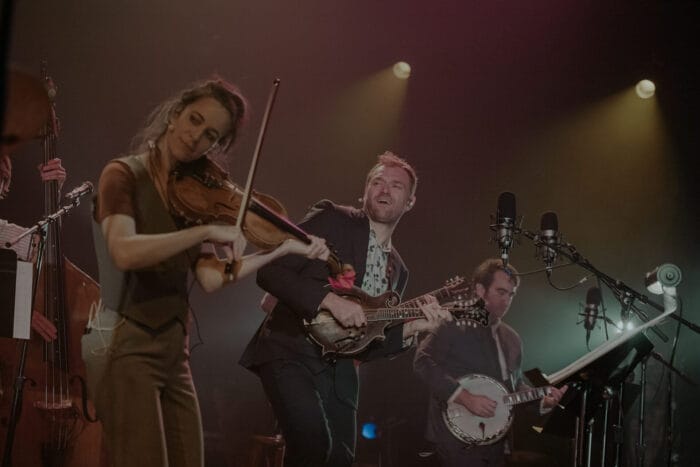
The program goes off without a hitch, with Bird opening up about some of the struggles he overcame to record Mysterious Production of Eggs while discussing the record’s 20th anniversary with Thile. The brief interview makes the case that Thile would be an affable late-night host in another life, and Bird offers note-perfect, string-band enhanced takes on “Opposite Day” and “Pulaski at Night.”
GH: The improvisation in this show and, in any variety setting, gives it the “you-had-to-be-there quality.” You can write and write and get things as precise as you want, but part of the joy of going to a live-music show is saying, “Oh, my god, they played this song that I haven’t heard in forever, and somebody took a solo that I’ve never heard before.” And I think we are adding the element of having people say, “Oh, I went to Energy Curfew, and Jacob Collier improvised based on two mashed-up styles that we thought of, and they made him try this.” We want to essentially draw things out of the hat. It gives it that elevated quality of “you had to be there,” rather than just being a show that you essentially could watch on TV.
9:30 pm: Post-Show Wrap Party for Company, Crew and Guests
The band and their guests mingle at the venue over drinks for an official post-party before slipping out to have sushi together at a nearby spot.
GH: I can’t think of anything off the top of my head that we scrapped because of the crossover from live to recorded media, but I would say that something I used to think about way more, and maybe to a detriment, when I was on Live from Here is that this has to play both for the live broadcast and the room equally. With this iteration of Energy Curfew, I’ve really enjoyed just fully leaning into if something plays well in the room. You’re gonna feel that in some way in your headphones on the way to work, when you’re listening to it as a piece of audio. Having come from a lot of podcasting and having done a lot of audio comedy, I think you get that live feeling when you listen to a live concert. You can listen to the energy that is being generated in the room, so this year I let myself off the hook a little bit to just say, “Let’s lean into whatever’s feeling fun on stage for this audience.” And the hope is that the person listening on their headphones, ultimately, will feel that too. And I think we were successful with that.
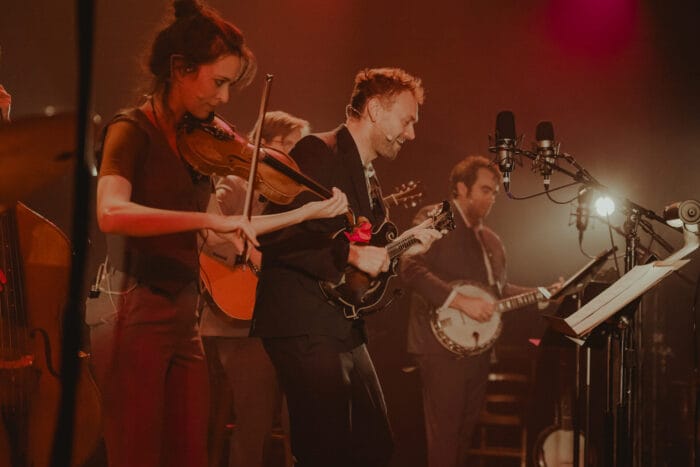
CT: [The way the band makes music] reminds me of the reason we stay in romantic relationships. Yes, of course, there are beautiful things that we all miss about the beginning of a romantic relationship, and some people miss it so much that they can’t actually knuckle down and get to, in my mind, the deeper stuff that comes later. I sort of stay in these collaborations for a long time. Nickel Creek’s still going, and I’ll never let Punch Brothers go, as long as these guys can suffer to have me. But, I’m never bailing on it—I’ll tell you that. It’s just so delicious. And, of course, we have a beautiful moment right now where we have a new band member. So we are sort of getting to have our cake and eat it too, in terms of deepening an existing relationship and experiencing the fireworks of a new one. With Brittany, there was just some instant compatibility, in terms of language, that was remarkable and that was part of the reason that we begged her to join the band.