photo: Jay Blakesberg
***
“I remember, when i was a kid, there were some friends who, when we’d play with toys, it was a total flow,” Zach Gill begins. “Other friends, you wouldn’t see them for a while, and you’d get together, and the mood was off. They’d be like, ‘You can’t play with that.’ So, you would go to the other room, and there would be more boundaries.
The same thing can happen with musicians on stage. There’s this act of play and trust. We’ve known each other for a long time, so it makes trusting easier. But if you haven’t seen someone in a while everybody changes every moment–you still separate and come together,” Zach Gill quips with a knowing grin, weaving the song title off his band, ALO’s latest studio work, Frames, into his metaphorical group reflection.
Bassist Steve Adams picks up on Gill’s reference, echoing his bandmate’s thoughts: “We all live in different parts of the state. At one point, Zach, Dan and I were in college together. We had a garage where we could practice and write songs. It was easy for us to be on the same page. When you’re that close together, living and breathing the same thing, many themes happen naturally. Your connections are already there. But for us, since we moved away from each other—Ezra’s in Sacramento, Lebo’s in San Francisco, Zach’s in Santa Barbara and I’m in Oakland—it takes an effort for us to all get together. So, when we get together, we have to recalibrate. It’s validating for us to find things we connect on and work through the differences during our time away.
“It can be a little painful at times. But you push through and find glimmers of hope and joy and realize each step is a little closer to something,” Adams says, corroborating his bandmate’s position.
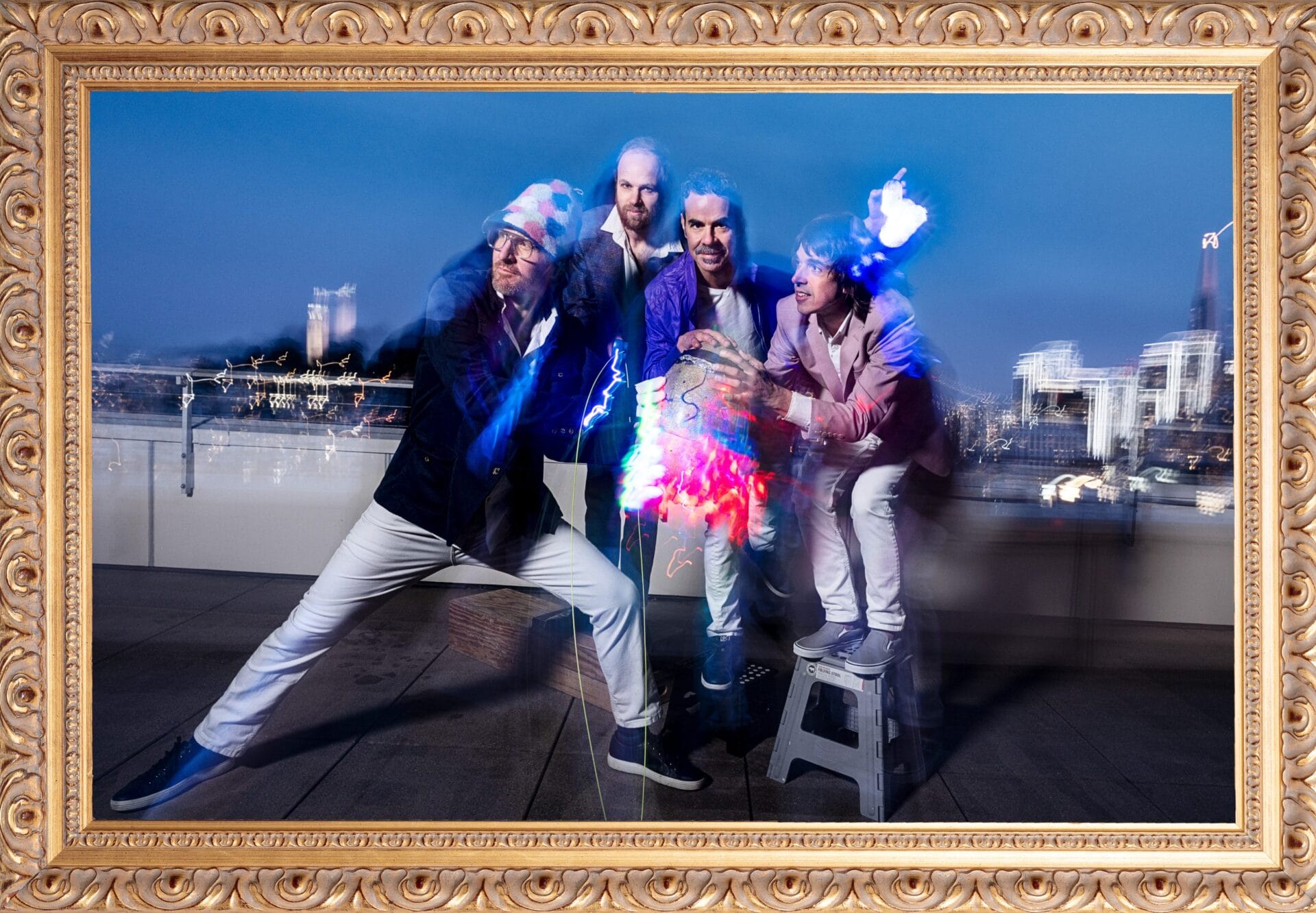
Shaking off the dust was just phase one during the long-standing California outfit’s most recent album cycle. Like Gill’s adolescent analogy, he notes that the process of reuniting with bassist Adams, guitarist Dan “Lebo” Lebowitz and their current drummer Ezra Lipp required time to fortify their connections—not just by making music but also conversing and finding the pathways that unveiled their commonalities.
“With ALO, our process is 90% talking and hanging out and 10% working on music. When Erza first joined the band, we’d be talking, and he’d be like, ‘When are we going to work on the music?’ For this group, that’s the key thing—to get on the same page,” Lebowitz says. “When we’re on the same page, anything can happen. We’ve been together so long and there’s such a deep well to pull from, but if we’re not on the same page, then there’s no bucket.”
ALO’s strength resides in their musical chemistry, a sense of understanding each other’s independent brawn as a catalyst for collective stamina. By carving out space and finding the time to reconvene, the four-piece rectified the mode of their latest offering into songs that presented like a film contact sheet—individual moments that give context to a larger story, congruency surfacing with the sanctity of friendship.
“The priority is to be connected, and the hope is that, if we’re connected, the music will just flow,” Adams affirms, referencing a handful of preliminary sessions that surfaced as the post-mortem of their previous effort, 2023’s Silver Saturdays, which was also their first to feature Lipp.
The band deliberately converged at Lebowitz’s Bay Area residence, bringing 20 tracks and, ultimately, whittling the list down to half, which surfaced as Frames. As Lebowitz explains, “Traditionally, Zach has been the main song contributor on a record. On this album, we only had so many songs, so we split it up—two, two, two and four to Zach.”
“It gets into interesting territory [when you have four songwriters], and you’re deciding what makes the cut,” Gill muses in response.
“You’re constantly balancing all the ideas—the songs, the energies—and you’re looking for themes,” Adams adds, before segueing into topics that emerged as tropes during the writing process. “Occasions was the prompt, but what became the theme, in the end, was frames.”
Lipp flags the kismet arrival of the concept: “There are a few parallel themes that go between all four of us as writers that we all brought in at the same time. It’s this connective, thematic, lyrical tissue that I find interesting because we didn’t intentionally set out to have all this overlap, but you can find it if you look at the space between frames.”
“I always liked the thought that consciousness and ideas are like flowers blooming,” Gill says. “You see it all the time throughout history—people have similar ideas in totally different parts of the world. [It’s like how] you see sourgrass all over the place.”
Lipp references the hundredth monkey effect as a conversational capstone for Gill’s figurative elucidation. In the wake of their mutual discovery, the band offers a respite from the erroneous state of affairs. Frames is packed with precise moments, emotions and junctures that are liberated from the bounds of social media’s dystopian grid; the descriptive hot-chested tug of the heartstrings on the LP’s de facto ballad “Warmth of the Night,” the pursuit and outcome of optimism throughout “Blank Canvas” and the constant source of joy conveyed by “Friends.”
Adams delineates how Lebo’s selections span the emotional spectrum, striking catharsis on “Warmth of the Night” while embracing pop-disco panache on “Space Between Frames.”
“Separated, Come Together” is more rocking, prompted by occasions, it leans into the general spirit of the preceding motif, rather than a solitary event.
Lipp’s “Rescue Our Demons” represents the alt-rock niche on a genre-laden belt encompassing electronic, folk, R&B, dance, and funk categories. And, it references evil spirits, as does Lebowitz’s previously mentioned number, another unexpected link that harkens back to Lipp’s prior comments on unforeseen consistencies.
The drummer’s contribution also served as one of the inspirations for Gill’s other mode of creative expression.
“I made a lot of paintings while making the album,” he says, when his bandmate calls upon his fallen silence amid the discussion’s rotational spurt through songs. “When everybody starts talking, I start drawing.”
“There was a room outside the studio with a big table where I set up my water colors,” he says, describing his makeshift art studio. “We record the songs, and then people would start combing through the details of their performance. That can take a while, and there’s a lot of waiting around, so drawing is good.”
“They all connect,” Adams adds, while holding up an abstracted personification of “Rescue Our Demons.”
“A Fanny Pack girl is jumping off a ledge,” Gill says of his stylized rendering on a large grain sheet, displaying an emboldened fiend.
***
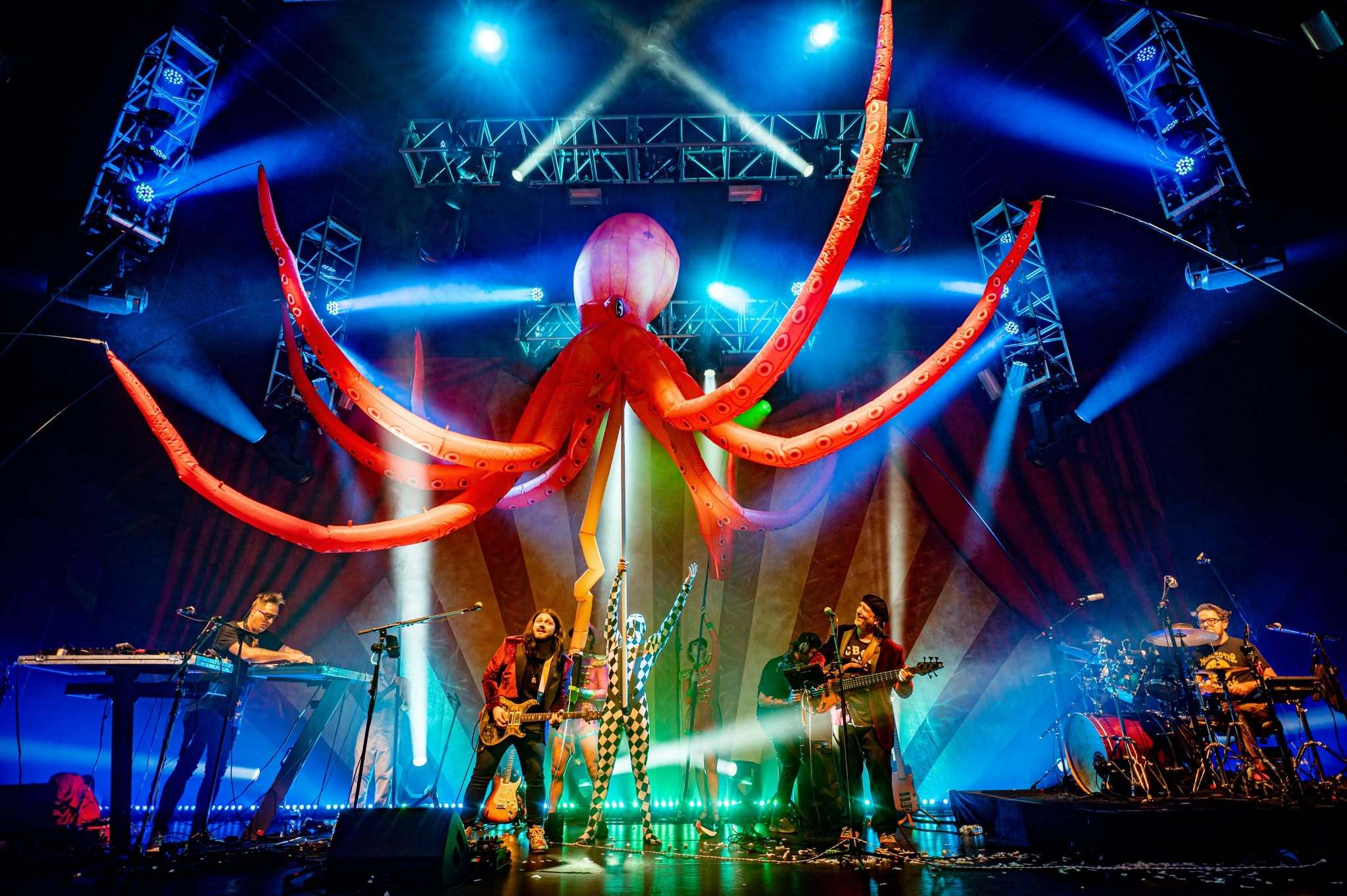
ALO’s creative threshold is amplified on stage, where the band is committed to showcasing each member’s individuality while maintaining an elevated level of reciprocity.
“A unique thing about our band is that it has evolved and continues to evolve,” Lipp says. “The live show, where we spend most of our time together, is dynamic, an exchange of energy during the night that is a little more fluid than with many bands, where the roles are more defined. If you go see Wilco, it’s like, ‘OK, Jeff Tweedy is the frontman, the band backs him, it’s all built around his songs and his gravitas.’ Whereas the four of us step in and out of having different roles on a given night.”
He adds, “It could be: Steve stepping out and taking the spotlight; Zach as the poet, ringleader and circus master; Lebo as guitar hero, dancing around the stage; Ezra coming from behind the drums and shining for a bit by doing a crazy dance or sharing his songs. It’s fluid. It’s not defined, but it provides an interesting show. It’s a unique characteristic of our band.”
“With a lot of bands, you have a lane, and we’re just crossing lanes the whole time. And sometimes, we crash. But on a perfect night, everyone’s crisscrossing lanes. It’s the mentality that we’re reaching for a high thing, and it’s a little complex. We’re willing to crash sometimes. There’s always the famous thing Steve Kimock told me once about Zero. He said, ‘Zero fans are interesting, they’re like NASCAR fans. They come for the crashes,’” Lebowitz says.
Despite their elevated status, it took time for the band to find their flow and justify the layout of the setlists and their consecrated effect.
“[To] balance our energies and intentions, we alternate writing the setlist. We go: Ezra, Steve, Lebo, Zach. We take turns every show. Every once in a while, someone will get a big show or a small one,” Adams says of their egalitarian approach.
“It’s cool to see people’s tendencies and how they want to express themselves, like what songs people might like the most,” he says. “It’s been a breakthrough for us, compared to the old way, where we’d all do it together and it was a total headache. We wouldn’t be done until two minutes before we went on stage.”
Adams describes the experience as “an exercise in passing the leadership baton,” before Gill adds with a laugh, “It just took us 30 years to be able to take turns.”
They’re quick to attest to the importance of the change-up night after night. “It’s an ethos of the jamband scene that we are a part of,” Lipp states. “The Grateful Dead set the precedent. They never played the same set every night, and we do a different set each night. We could play ‘Girl, I Want to Lay You Down’ [every night], but then fans probably wouldn’t come to four shows in a row. It’s part of the experience of having a big catalog that we want to circulate through. We want every show to be unique. It’s upon us to preserve our creative integrity and excitement. That does translate into good performances. It’s a balancing act we’re navigating consciously and unconsciously—to keep our passion for the songs. Sometimes with songs, you need to take a break from them, and when they resurface, it can make all the difference.”
Gill references the middle round model, providing fans with some of what they hope to see while offering the proper frequencies to delve into their ample repertoire.
“It makes me think we’re trying to do a service to music in general. I think that if you only play the hits, they become a service to the business,” he says. “I think music wants to be free, alive and growing. We’re all part of the organism of music; you want it to feel vital.”
***
Lebowitz, Adams and Gill first started playing together in 1989, when the budding musicians were still middle school students in Saratoga, Calif. They all matriculated to University of California, Santa Barbara, where Adams and Lebowitz were freshman roommates and continued making music under different names through college and after graduation, including Django, Magnum Family, LAG and Animal Liberation Orchestra & The Free Range Horns. The outcome of 30 years on the scene is the earned respect of a devoted following.
“The relationship between the band and crowd, I live for those moments when something comes from nothing. That gets back to the blank canvas idea. When you’re improvising, it could be nothing. The band might be playing and doing our thing, but it’s not just us. It’s the crowd that’s influencing it,” Lebowitz says. “I don’t know if the crowd knows how much they’re influencing the show. When they lean in and show some excitement, we lean in that direction and the other way around. You can tell when people aren’t feeling something, and you’re more likely as a band to lean in a different direction. That’s all part of the improvisation, the circular exchange of energy.”
And, the people come for the jams. Despite the brisk nature of the band’s studio outputs–the average track vacillates between three and five minutes–ALO is clever in fashioning instrumental pockets intended to inflate on stage.
Lebowitz equates the improvisational backbone of their tenure to their salad days of yesteryear, before ALO was Animal Liberation Orchestra or even Django.
“I have these fond memories of this activity we would fall into,” he says. “I was thinking back to when we were kids. It would be a crazy rainy day, and all the creeks and waterways would fill up; sometimes, they’d flood. But before they could cause problems, we’d go up to the tops of the hill and find a creek and make our way down. We weren’t on any trail, and we would improvise, singing the whole way down.”
He pauses and adds, “It wasn’t a leisure thing. It would be jumping from rock to rock, from side to side. If you stopped to plan your move, you would have just fallen into the water. But with that forward motion in you, moving from one thing to the next, it’s just like improvising. I realized it was the exact same mindset as when we’re on stage. You’re just moving forward, listening and expressing ideas. We were drawn to that mindset long before we knew that you could do that in a band situation.”