It’s the summer of 1966 and a suburban boy who’s just entered his teens is exercising his favorite pastime: looking at new records in the local department store. He mostly buys singles because that’s all he can afford on his allowance, but sometimes he can spring for an album. He’s already got Pet Sounds and the brand-new Blonde on Blonde and he’s saving up for the new Beatles album, which he read in a magazine they’re going to call Revolver. But on this day, he’s only got enough pocket change to buy one LP. It’s got to be a good one, a sure thing.
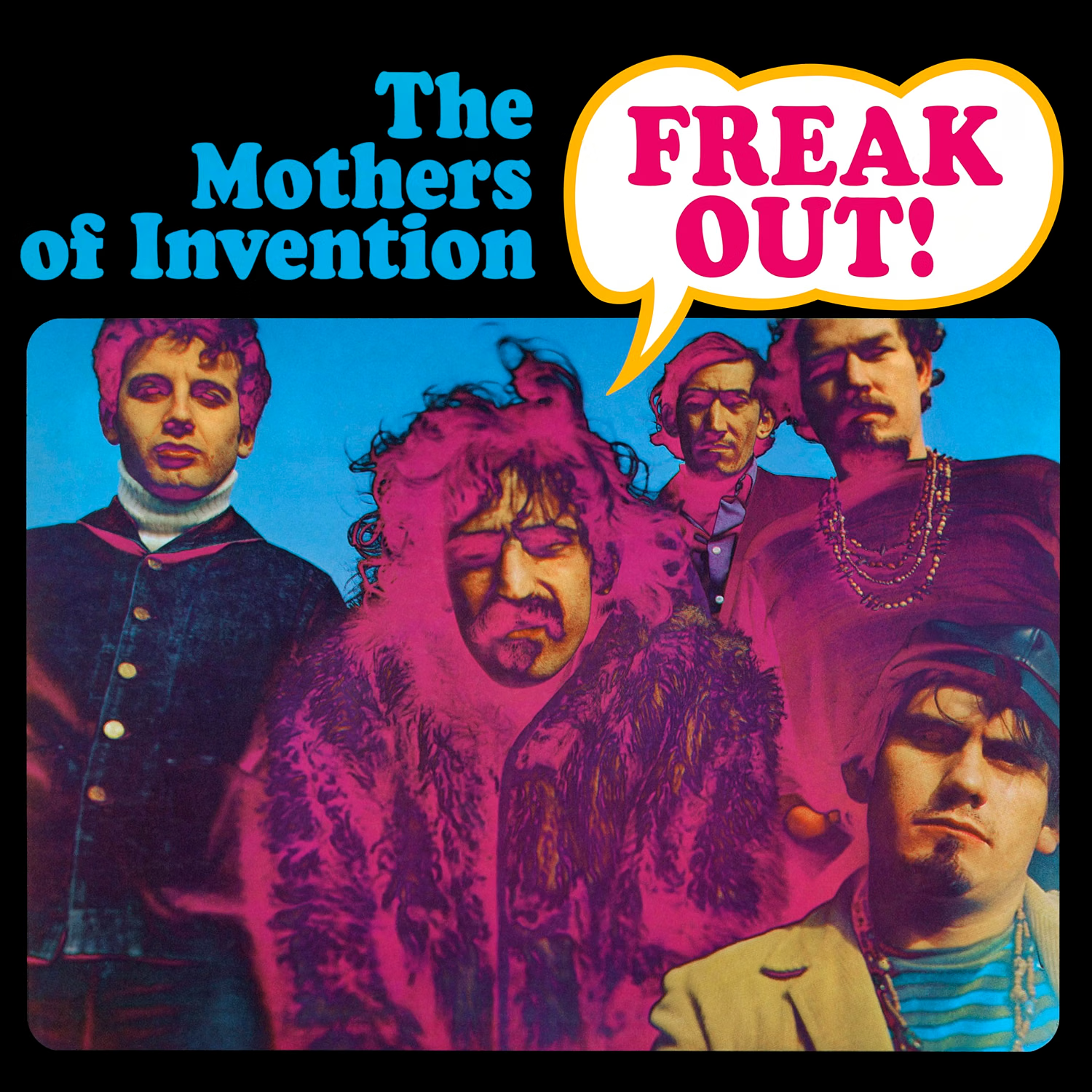
Flipping through the bins, he sees… something. Something very weird-looking. What the hell is this? The front cover shows five men bathed in striking colors in front of a sky-blue background. The one in the center, who is mostly drenched in bright pinkish-violet, appears to be all hair—way more of it than even the Beatles or the Stones—and a droopy mustache that no one has bothered to trim in a very long time. Truth be told, the guy looks kind of greasy. You might cross the street if you saw him approaching. And if you saw all five of them, you’d run.
Across the left side of the top of the cover is what appears to be the band’s name, The Mothers of Invention. Hmm, never heard of them, the East Coast kid thinks to himself; I wonder where they’re from. And then, on the right side, inside of a thought bubble pointing to the mustache guy’s head, it says, “FREAK OUT!”—all capital letters in light purple, that exclamation point giving it urgency. What does that even mean? He knows what a freak is—and that it’s not a nice thing to call somebody—but what does it mean to freak out? And why the punctuation? What’s so exciting about freaking out?
The boy turns the record over and looks at the back cover. The color scheme is the same, but the faces are a little clearer. They sure do look wild! None of the girls he knows would think they were cute. The boy’s mom would probably say they were ugly, like she did when she first saw the Rolling Stones. What country or state has bred guys who can get away with looking like this, anyway? Mybe they’re from some foreign country.
The guy with the mustache has another thought bubble coming out of his head on this side. This one says, “Suzy Creamcheese, what’s got into you?” Huh? Suzy Creamcheese? Who in the world is Suzy Creamcheese? Is she a band member? What kind of name is that? And what did get into her? Will we find out if we listen to the record? Not only that but there’s a short, typed blurb on top that actually says the band is crazy and they smell bad. “None of the kids at my school like these Mothers,” it continues. Ha, wasn’t the boy just thinking the same thing? Why would you put that right on your album cover anyway? Don’t you want people to buy it?
Now the boy has to get serious. Does he dare spend his limited funds on this mystery album? Can he not though, now that he’s seen it? It’s got two LPs in it—just like Blonde on Blonde—but the price is the same as a single album, so that’s a good thing. But what if it’s really awful? Maybe that’s why they’re practically giving it away. Then he’d be stuck with a crummy record. He could just hold onto his money till the album by that TV band the Monkees comes out. Or he can go ahead and buy this Freak Out! thing and, if it sucks, trade it to a kid at school for some ? and the Mysterians or Buckinghams 45s.
He takes it to the cashier. Here goes nothin’.
His world is never the same.
Freak Out!, the debut release by the Mothers of Invention, introduced the world to the music—and the mind (although they were inseparable)—of Frank Zappa. It wasn’t long before we kids who did not live in Los Angeles learned that they were from there (it figured), and were sort of popular there, although some people thought they were weirdos. The magazines that were hip enough to know about them said that they were, well, freaking out audiences when they performed live. They were like nothing else around: satirical and hilarious but serious too, outrageous and bold. Their music, it was said, was experimental (whatever that meant) and included influences from sophisticated genres like jazz and classical but also the kind of soulful R&B-based group harmony singing (not yet dubbed doo-wop) that was big in the ’50s. Some of their music was raunchy and crude but some was tender and sweet. It was all over the place. The boy didn’t think they would ever be on the cover of 16 Magazine, that was for certain.
Whatever else it was, it was daring. Sometimes they just let loose and played whatever came to their minds, but other songs were real tight, with every note seemingly choreographed, like a trained orchestra. This Zappa character, the lead guitarist—the one with the mustache—was a trained musician but, said those who knew, kind of nuts: he once (before all of the hair and the Mothers) went on television and “played” a bicycle. Now he had put together this band and despite being weirdos they could play the hell out of their instruments. Not in the way that the people who played on Beach Boys and Mamas & Papas records could play their instruments, more in a chaotic, fearless, uninhibited way, but with plenty of undeniable talent on display. Kind of like the Paul Butterfield Blues Band, but kind of not like them at all.
The song titles alone told us they were different. The opening track was called “Hungry Freaks Daddy.” There was that word again: freaks. But whose daddy were they talking about? Other songs had names like “Who Are the Brain Police?” (Brain Police?) and “The Return of the Son of the Monster Magnet” (Monster Magnet)? That one alone took up the entire fourth side of the double-album, kind of like “Sad Eyed Lady of the Lowlands” on the new Dylan album, but this one—which was where the Suzy Creamcheese person came in—was mostly crazy, screechy noises and loud guitars. It sounded like it came from outer space, or maybe just from maniacs, like a bunch of people who had no idea what a song was supposed to sound like went into a recording studio and went crazy for 12 minutes.
But then there were some tunes that had normal names, like “How Could I Be Such a Fool” and “You Didn’t Try to Call Me.” Those titles sounded like records we’d already been buying, about girls and stuff. With titles like that, they could’ve come out of the ’50s, like something by the Duprees or the Penguins. The songs were as normal as their titles. How could the same people who sang those normal songs also sing about brain police and monster magnets? (We didn’t know yet that “…Monster Magnet” didn’t really have lyrics, except repeating “cream cheese” a lot.)
This was one perplexing band.
As it turned out, these Mothers of Invention were actually really inventive. They were smart, and fun, and yeah, there was nothing else quite like them. Even later in the year and in ’67, as new bands like Cream and the Jimi Hendrix Experience came along, it was nothing as out-there and crazy as these guys from L.A.
But the teen in the department store didn’t know any of that until he got home with his new purchase. Before he ever heard a note, he got a first look at the inside of the album cover, which provided more insights and helped explain what he was about to hear, although the liner notes warned that one or two songs shouldn’t even be listened to at all. For one, called “Help , I’m a Rock,” it said that the song “has no commercial potential,” which turned out to be true. Wait, the band didn’t want you to listen to their music? Then, for “Hungry Freaks Daddy,” the notes insisted that the song had no message. They also suggested that you skip the senior prom and go to the library, which didn’t really have anything to do with the song—or did it?
There was also some biographical data on the people who made this album and a description of freaking out, which was kind of helpful but not really. Freaking out, we were informed, is “a process whereby an individual casts off outmoded and restricting standards of thinking, dress, and social etiquette in order to express creatively his relationship to his immediate environment and the social structure as a whole.” Okay, if they say so.
As for the other musicians in the Mothers of Invention, there was Ray Collins, who was the lead vocalist and played a bunch of instruments; Jim Black, the drummer; Roy Estrada, the bassist; and Elliott Ingber, who augmented Zappa on guitars. And there was a producer, Tom Wilson, who, it was later discovered by the teenage boy, had previously produced a bunch of jazz records by people he had not (yet) heard of, and Bob Dylan, whom he had heard of for the first time only a year earlier when he looked at the songwriting credit of the Byrds’ “Mr. Tambourine Man” and then Dylan’s own “Like a Rolling Stone.” How this Wilson guy went from that to these anarchic Mothers was something the boy would need to investigate.
The boy started to think that it probably didn’t matter who else was involved in making this album. It was all about this Zappa guy.
As a little time passed, the boy came to love this album: all of its bizarreness and its challenges and its mix of styles and nutty lyrics and mind-blowing guitar playing and vocals that weren’t like anyone else’s vocals. But whatever Freak Out! might have offered, it appeared that not a lot of people were taking these Mothers up on it. Originally released on the Verve Records label, known mostly for jazz, it only peaked at number 140 on the Billboard albums chart. Pretty dismal. The kid played the album for all of his friends; some of them liked it and bought their own copies and even memorized the songs and put big posters of Frank Zappa sitting on the toilet up on their walls. Others begged him never to play it again in their presence. None of them figured Zappa and his band would have much of a career if this was the sort of thing they insisted on doing.
They were wrong, of course. He did. Some of his other stuff was beyond great; some of it was puerile and had stupid lyrics. But one thing you had to admit was that Zappa never compromised and continued trying different things, even things he knew his fans might reject. One of his first albums, which he called Lumpy Gravy, was legit modern classical music; another pretended to be by a band called Ruben and the Jets and was all ’50s-style music. Freak Out! eventually became recognized, over time, as something pretty revolutionary, especially for its time. It opened up a whole new branch of rock music, one in which playing by the rules was overrated.


Which brings us back to that opening track, “Hungry Freaks Daddy,” which, despite Frank Zappa saying it had no message did have a message. In an era of protest songs, the propulsive, fuzzed-out rocker—you might call it psychedelic, even though you’d later learn that Zappa didn’t take drugs—went beyond most of the others in its rage and venom. Zappa didn’t mince words. Zappa had something to say about America’s education system, and then some:
“Mr. America, walk on by your schools that do not teach
Mr. America, walk on by the minds that won't be reached
Mr. America try to hide the emptiness that’s you inside
But once you find that the way you lied
And all the corny tricks you tried
Will not forestall the rising tide of hungry freaks daddy”
“Trouble Every Day” was another angry rant, this time targeting what certain parties in today’s world might label “fake news.” Just a small slice, recited over wailing guitars and a pounding rhythm, goes like this…
“You know I watched that rotten box
Until my head began to hurt
From checkin’ out the way
The newsmen say they get the dirt”
“Motherly Love” gave a different message altogether. This one starts off almost as an anthem:
“Motherly love
Is just the thing for you
You know your Mothers gonna love ya
Till ya don't know what to do”
But this is the Mothers of Invention we’re talking about, so…
“Nature's been good
To this here band
Don't ever think we're shy
Send us up some little groupies and we'll take their hands
And rock 'em till they sweat and cry”
“You’re Probably Wondering Why I’m Here” was—actually, no one knows what that one was.
“You're probably wondering
Why I'm here
And so am I
So am I”
“Help I’m a Rock” presents another scenario, finding our narrator lamenting his fate, that of being a rock. Simon & Garfunkel had sung “I Am a Rock,” but for the Mothers of Invention this was seemingly an unhappy state of being:
“I wish I was anything but a rock
Heck, I'd even like to be a policeman”
The very avant-garde “It Can’t Happen Here,” meanwhile, is pure Zappa, no longer concerned with being a rock now that regular American folks are entering the freak zone:
“Who could imagine that they would freak out somewhere in Kansas...
Kansas Kansas tototototodo
Kansas Kansas tototototodo
Kansas Kansas
Who could imagine that they would freak out in Minnesota...
Mimimimimimimi Minnesota, Minnesota, Minnesota
Who could imagine...”
All of these songs, it should be noted, were written by Zappa, who did not run a democratic organization. And Zappa, we quickly learned, was something of a composing genius, whether writing sophisticated arrangements or just mimicking the styles of his beloved ’50s radio hits. He might write pointed lyrics (see above) that really made you think or songs that didn’t want you to think at all. Whatever they were, they were inspired.
It wasn’t long before he and the Mothers—whose personnel changed regularly over the years they existed—developed a cult following and filled up auditoriums and ballrooms all over the place.
As we early adapters soon discovered, Mr. Zappa was a really interesting guy, a philosopher of sorts, with a magnificent mind—a true visionary. Even when his music lost its way, which it often did from about the mid-’70s until his 1993 death, he was always worth paying attention to. He always mattered.
So, now it’s been six decades since Freak Out!, and you know what that means: It’s Freak Out! 60th Anniversary Super Deluxe Edition time! It’s been a long time coming, this one, and the compilers have really gone to town with it: 105 tracks, 90 more than the original album. Five CDs if you buy that version (there’s also vinyl, of course, and digital, etc.) and a Blu-ray. Many of those 90 tracks have never been released before, both studio and live tracks. New mixes, demos, rehearsals, a hefty booklet with lotsa photos, the whole megillah—a real bondanza for the Zappa-o-phile.
The live stuff, not surprisingly, is the most fascinating, recorded at several different dates at San Francisco’s Fillmore Auditorium in 1966. Some of the live material is from Freak Out! Some is from later albums, like “Plastic People,” which sounded like “Louie Louie” gone haywire but was about, um, plastic people. They play the blues, including a 1957 Lightnin’ Slim cover called “I’m a Rollin’ Stone” which is most definitely not “Like a Rolling Stone.” Some of the material appears to be unique to this set. One track is just called “Mothers Rock Out” and that’s what it is. Fillmore audiences loved when bands rocked out, although Zappa, it would seem from some songs he’d put out a year later on We’re Only In it for the Money, wasn’t much of a fan of San Francisco hippies (but that’s another story for another time).
The original album tracks—both stereo and mono—have, of course, been remastered and sound crisp and punchy like remasters should. There are also “pre-master’ mixes, which provide some insights into how these recordings took shape. The sound quality of the bonus live material and studio tracks is way better than acceptable for 1966 tapes. It’s well worth checking out if you’re a committed Zappaholic but probably not if you never liked the guy.
Freak Out! was, if this is possible, both utterly of its time and way ahead of it. Frank Zappa and his motherly pals were putting forth ideas that no one else in music at that time had even thought to do, and they were doing it in a way that cast them far from the mainstream. That fringe existence was a place Zappa would remain comfortable for the rest of his eventful and prolific life. Even now, it’s remarkable to think that, in 1966, 60 years ago, he came up with some of this stuff and managed to get a legitimate record company to put it out there, understanding that its contents would be unlikely to get anywhere near the Top 10. Zappa would have a lot more to say after this, but never again would his music be as shocking and unforeseen as what was generated in this ridiculously rich, wholly unprecedented debut. Frank Zappa was a freak, in the most positive sense of the word. We were lucky to have him. It did happen here.