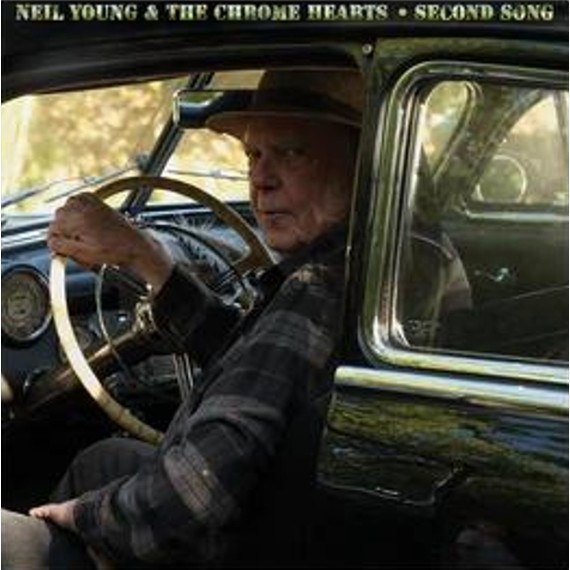
Has any major rock artist even approached Neil Young’s level of prolificacy? Depending on whose math you trust most, Second Song is either his 50th, 51st or 52nd studio album, his solo career beginning with his self-titled 1968 set and maintained regularly ever since. Toss in the various live recordings, compilations, etc., and the total bolts past a hundred. Whatever else he may be, Neil Young is no slacker.
Nor is he complacent. Young has consistently tested out new ideas (rockabilly, electronica) while faithfully returning to favored formats (folkish acoustic, blistering rock with Crazy Horse), producing a remarkably clunker-free discography that is still worth investigating even at this late date—if you can keep up with him.
Second Song is Young’s sophomore effort with the Chrome Hearts, a band whose personnel includes guitarist/vocalist Micah Nelson (a son of Willie), veteran Muscle Shoals keyboardist Spooner Oldham, along with bassist (mostly acoustic) Corey McCormick and drummer Anthony LoGerfo. The latter is also co-credited as an associate producer, while most of the heavy lifting in that department is shared by Young, Niko Bolas and Lou Adler, the very same towering figure —now 92 years old—who produced the Mamas and the Papas, Carole King’s Tapestry album and much more. Adler’s presence here is not coincidental—he is Young’s brother-in-law, married to Page Hannah, sister of Young’s wife Daryl Hannah—but his credentials speak for themselves. Adler also co-produced the album’s predecessor, 2025’s Talkin’ to the Trees, Young’s debut with the Chrome Hearts.


The familiar faces and largely organic focus keep Young as close as he allows himself to get to a comfort zone, and Second Song is determinedly more diary entry than diatribe. Where Talkin’ to the Trees was often irate and outspoken, Second Song is, save for a song or two, quietly reflective, more Harvest or Comes a Time than Rust Never Sleeps or Ragged Glory. That’s not to suggest that Young is repeating himself, but neither is he heading in any radical new direction.
So, what exactly have we here? Second Song’s seven songs (of which the title track is the fourth—got all that?), perhaps in the vein of Paul Simon’s most recent release, Seven Psalms, or Willie Nelson’s own recent work, are unmistakably the creation of a twilight-years artist taking stock of life, love and legacy. At 80, Neil Young is no longer young, musing on the ups and downs of being 20 on Sugar Mountain. His concerns have shifted; mortality stares him down; he needs to know where he stands. He wants us—those of us who still hang on to his words and music—to think about it too.
“The Foggy Edge of Time”—the title is unambiguous, no?—is the appropriate starting point for all this. Playing an upright piano—nostalgic by its very nature—Young opens wide on his back pages: “I was lookin’ back not lookin’ good” shatters any rose-colored glasses he might have donned. “There were bumps along the way,” he sings, then repeats the single word “alcohol” no fewer than six times to leave no doubt. It gets less treacherous, don’t worry; the narrator, “headin’ south to my destiny,” finds his way, starts to “live the way I wanted to,” where else but on the foggy edge of time?
It’s not all that heavy. “Earth Girl,” another piano- and keys-dominated feast of melody, is as pure a love song as Young has written: “You are the light of my life/Like a river that flows right through my heart” might sound corny coming from most artists, but Young’s reading, stripped of pretense, his instantly recognizable voice devoid of any signs of having caught up with the rest of him chronologically, leaves no doubt that he means it. And when he sings, in the album-closing “I’ll Love You Forever,” “I will idolize the way you comb your hair,” there’s not a trace of irony or snark to be found. True, Young wrote the song in the early ’60s and cut it with his then-band the Squires, when that sort of lyric was all over the Top 40, but do you think he would have remade it as an octogenarian if he didn’t still mean it? “Casting Me Away from You,” another song dating to 1964, prior even to his tenure with Buffalo Springfield, somehow feels at home here with its country lilt, Farfisa organ and angsty tale of fractured romance.
For those Young-o-philes who crave something more substantial, the title track has got you covered. At 11-plus minutes, it’s the album’s longest track, outweighing the seven-minute “Day After Day” and the nine-plus “Soon I Might Be Going,” the former a slice of classic Youngian acoustic, the latter the most topical, and personal, and heated, tune of the bunch. “Second Song,” written (as was everything else here) by Young and recorded quickly and without fuss, flirts more openly with nostalgia, trading in the opening track’s “foggy edge of time” for “the smokey leaves of time.” (Is there a difference? You be the judge.) There’s dread too: It’s not long before he’s “drifting in a sea of darkness.”
“I need to talk to someone…as old as I am,” Young sings as the song unfolds, the same man who penned the words “Old man, look at my life, I’m a lot like you were” more than five decades ago. Does he not realize he’s been doing that all along—and will continue doing so long after he’s gone?