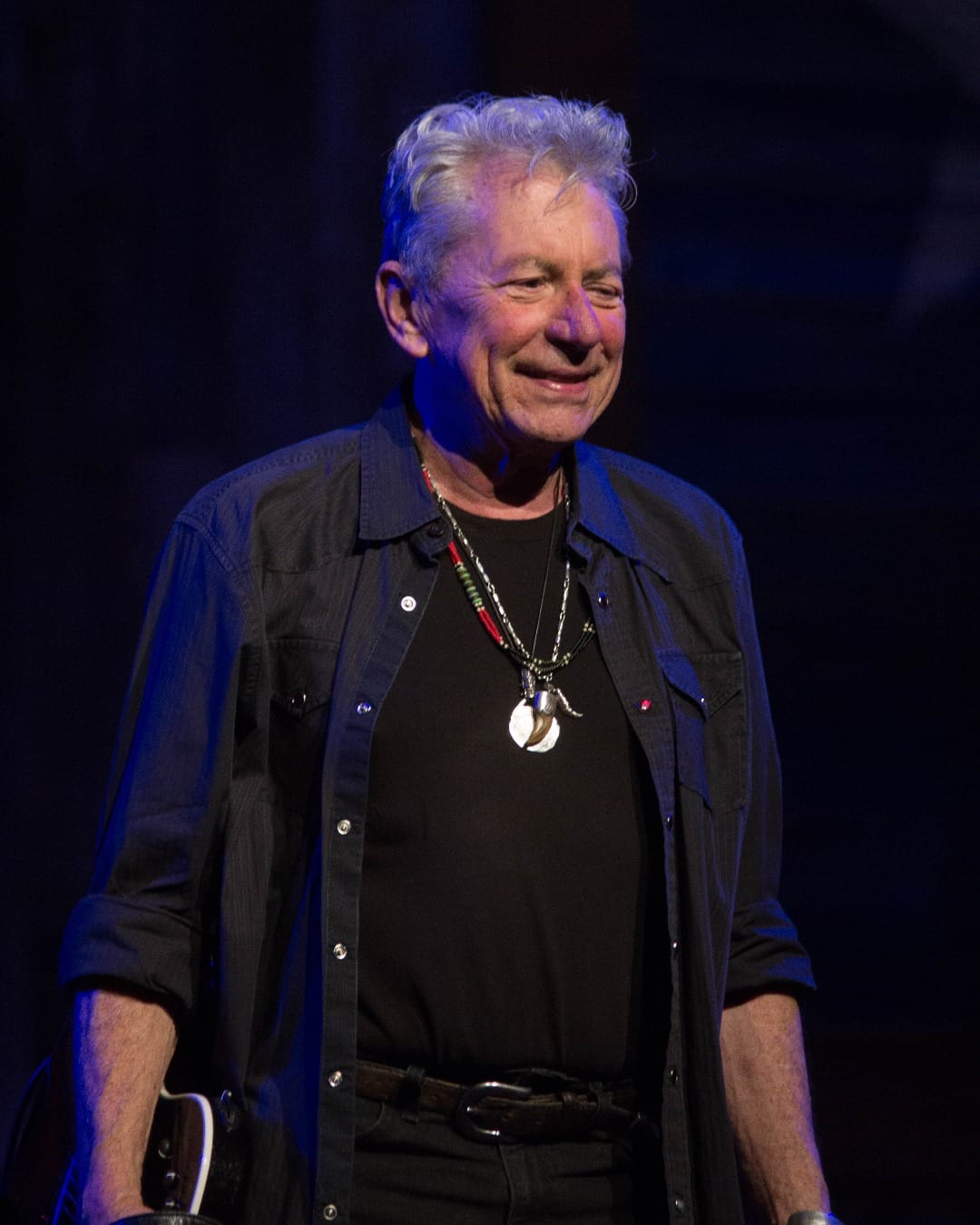
"Joe Ely 2017" by Republic Country Club is licensed under CC BY 2.0.
Joe Ely, the celebrated singer-songwriter who played a vital role in the progressive country renaissance of the 1970s, died on Monday. Through a lifetime of traveling and storytelling, the West Texas legend blazed a trail beyond the polished Nashville sound, looking to the music’s past to guarantee its future and laying the foundation for Americana. He was 78.
“Legendary songwriter, singer, and raconteur Joe Ely died today from complications of Lewy Body Dementia, Parkinson’s and pneumonia,” an announcement posted to Ely’s social channels confirmed. “His beloved wife Sharon and daughter Marie were at his side at their home in Taos, New Mexico.”
Born in Amarillo on February 9, 1947 to Earle and Margaret Ely, Earle Rewell Ely Jr. soon moved to the vast, dusty horizon of Lubbock, where Buddy Holly and Waylon Jennings were raised, and where Ely spent his teenage years riding a motorcycle down Monterey High School’s halls and playing guitar at local haunts. He met contemporaries Jimmie Dale Gilmore and Butch Hancock before he was expelled and took to the road, following in Woody Guthrie's footsteps and hopping trains across the country.
In 1971, Ely returned to Lubbock to form The Flatlanders with Gilmore and Hancock, a guitar-and-vocals trio rooted in the rich musical culture and hypnotic landscapes of their hometown. The Flatlanders headed up to Nashville to cut their debut album, All American Music, which diverged so significantly from country’s mainstream that it was sold solely as an eight-track tape at a handful of truck stops around Tennessee to fulfill contractual obligations. The group parted ways to pursue individual paths in 1973, each earning solo success in the years that followed.
Ely released his self-titled solo debut with MCA in 1977, then struck again in 1978 with Honky Tonk Masquerade. Like his album with The Flatlanders, Ely’s solo material distilled an eclectic wealth of American folk styles into a singular expression of his musical upbringing, blending Holly’s rock and roll with Jennings’ country and imbuing the combination with hints of blues, honky-tonk, Tejano music and more. This sound, both novel and a reflection of the early music industry’s genre agnosticism, served as a canvas for stories of everyday romance in salt-of-the-earth lives, picked up in whistle stops through his travels. With steady releases over the next five decades, both on MCA and as an independent, he became affectionately known as the Lord of the Highway.
As Ely accrued a passionate fan following in the burgeoning alternative country scene, remaining under the radar of the mainstream, The Flatlanders’ lost album cropped up again as a limited vinyl reissue in Britain, then finally reached a broader audience stateside through Rounder Records’ repackaging of the 1972 project as More a Legend Than a Band. By that point, all three members were influential solo artists, and rumors of an obscure early collaboration had circulated widely. Ely, Gilmore and Hancock reunited to contribute to the soundtrack for 1998’s The Horse Whisperer, then in 2002 released their sophomore album Now Again. The trio frequently toured and recorded in the next wo decades, most recently issuing Treasure of Love in 2021.
Ely’s travels and reputation led to many high-profile friends and collaborators, including Bruce Springsteen, Uncle Tupelo, the Chieftains, Lyle Lovett, John Hiatt and Joe Cocker (he contributed the Spanish backing vocals on the Clash’s “Should I Stay or Should I Go”). His major awards and honors include a place in the Austin Music Awards Hall of Fame and a Grammy Award for Best Mexican/Mexican-American Album, earned for his part in genre-bending supergroup Los Super Seven’s 1998 debut.
Ely is survived by his wife, Sharon Ely, and his daughter, Maria Elena Ely, named after Buddy Holly’s widow, María Elena Holly.
“I had teachers tell me I wouldn’t make it to 21 when I was going to high school, so I beat the odds, you know?” Ely told Lone Star Music Magazine in 2011. “I’ve traveled millions of miles, zigging and zagging in every kind of vehicle known to man, trying to get from one place to another to create some more music… So in the end you kind of add up all the life experiences that you’ve had, from threats to just running into weird coincidences constantly, and then you think, ‘Wow, I made it through all that. So I can take a breath of air, and then go from there.’”