Tom Hamilton: Family Bands, Weir Pranks and The ‘Vampire’ Diaries
photo: Bob Sweeney
***
“I live most of my life with my head down, traveling towards a goal,” Tom Hamilton observes, while musing on the process that led him to record his new album, I’m Your Vampire. “A lot of my life just kind of happens to me while I keep going. It’s very dissociative in a lot of ways. Then after some amount of time, it gets to the point where the pot is going to boil over and I have to tend to it. I need to reflect and process what I’ve gone through. So in order to do something with it, I turn it into music.”
In this instance, that synthesis led Hamilton to countenance the failing health of his father, among other considerations.
“My old man getting sick did a number on me as far as the looking-within thing,” he acknowledges. “Really looking at my childhood and looking at everything through the lens of my relationship with my dad obviously comes with a lot of other stuff too.
“I realized some things about myself, but that’s the point of music and art. It’s the fucking human condition. There’s never a point where it’s like, ‘Oh yeah, I’ve got this figured out.’ It’s a struggle for everybody and art is supposed to help us understand it or get through it. But my feeling is if I’m going to step up to the plate, at least I can take a big ass swing.”
Hamilton has been aiming for the fences for much of his life. The guitarist was still in his teens when he first began touring with the innovative indie electronica band Brothers Past. After that group dissolved in the mid-2000s, he began focusing his energies on an Americana project, American Babies, releasing four albums between 2008 and 2016, while connecting with audiences via his emotive singing and literate songcraft. Two years later he launched Ghost Light with Holly Bowling, Raina Mullen, Steve Lyons and Scotty Zwang, recording three albums over the ensuing five years. Meanwhile, he pushed improvisational bounds as a member of Joe Russo’s Almost Dead and Bill Kreutzmann’s Billy & the Kids.
For Hamilton’s first official release as a solo artist, he drew together some of the musicians who had worked with him on those projects, including Brothers Past keyboard player Tom McKee, latter-day Ghost Light bassist Taylor Shell and Hamilton’s longtime songwriting partner Peter Tramo.
The I’m Your Vampire recording sessions were preceded by an extended period during which Hamilton and Tramp developed the material, at times jettisoning musical instruments altogether. He explains, “Peter lives full time in South Dakota and it took a little extra energy to get the ball rolling creatively. Ghost Light broke up. My dad got sick. Me and Pete were both coming out of the absolute worst kinds of relationships. Then Pete’s dad also got sick. So we were living these parallel lives from 1500 miles away.
“Finally the moment finally arrived where I said, “Alright man, I think it’s time to get back at it.’ So he came to Philly where I have a studio. We went in every day. We did six days a week and we just talked. We caught up on life. We talked about those relationships. We talked about what happened in COVID. We talked about our dads. We talked about our moms. We got into it all. Sometimes we wrote music, sometimes we didn’t. I think February 6th was the day we started, and we didn’t have a song that we kept until June.”
The ensuing studio work echoed Hamilton’s approach to the songwriting. “Like I was saying, when Pete and I started in February, there was a lot of talking before we got anything done,” he offers. “It was the same thing with recording the players. There were a lot of things I wanted them to consider when we were playing this stuff. It was like I was trying to describe the taste of water to these guys and I might as well have been trying to count to infinity while they put up with my vague, esoteric prompts, descriptions and requests. I feel like that could be annoying but to have folks who weren’t annoyed by that and actually leaned into it with me, created a real intimacy. The prevailing thing in making this record was the intimacy shared by everyone who played on it.
“Some shit really went down and that’s what we were looking to capture. For me, the whole record was kind of like that, because there’s a lot in there. There’s grief, there’s frustration, there’s love and there’s fear. It’s hard to be vulnerable, man.”
Your relationship with your father informed some of the ideas on this album. How do you think your upbringing shaped your musical attitude?
My brother Jim, who’s five years older than me, started playing drums when he was six. When I was growing up in the Hamilton household, he was playing drums and he got to the point when he was 11 that there weren’t any kids in the neighborhood who were good enough to play with him. So my dad put together a band of his buddies and my brother was the drummer.
My dad had my brother when he was 19, so they weren’t that far apart in age. My whole childhood, there was always a band. They were practicing in my basement or they were playing bar gigs around town. They were a cover band, they weren’t playing original music or anything like that.
My old man was doing it for my brother, just to help him get better. I saw all of this and I took it as that’s just what you did. It’s a vocation. It was never about chicks or drugs or money or any of that stuff. It was never about being famous or anything like that. This is just what you did in your community. There are people who play music and there are people who listen to music.
So it was always a thing that was just going on. I started playing guitar when I was about 10, and when I got to be around 11 or 12, my brother wanted to have his own thing. You rebel against your parents, so my brother stopped playing with my dad. He wanted to start his own band and he needed a Bobby, basically. So he told me, “Hey man, all these Dead tapes that we have, just listen to the left speaker and that’s Bob. Learn what he’s doing.”
We never made a big deal about it, that’s just what we all did. We played music. I’ve always been creative anyway. Before I got really hooked into playing music, I was into art and drawing things or making my own comic books. I just like making shit. It’s how I get through the world. Well here we are all these years later, and I still just like making shit. It’s how I get through the world. Nothing’s changed.
Since you just mentioned listening for the Bobby parts, can you describe what it was like eventually making music with him?
I played with Phil first and maybe Billy after that, then from there it was Bob. This was after Furthur wrapped and before Dead & Company. Billy & the Kids was going and it was going pretty good. The talk at the time was that there was a possibility that Bob would join Billy & the Kids basically, and we would be the next project that Bob focused on. It ended up being a band called Los Muertos, and it was me, Bob, Bill, Jeff [Chimenti] and [Dave] Schools, which was a sick band. Then, during the early parts of that whole thing coming together, the Dead & Company thing came about.
I’m pretty sure my first time playing with Bob was an acoustic thing at LOCKN’, doing a VIP set. I’d come to learn after the fact that what happened was the most Bob thing ever. It had been arranged so we could meet and this would be the initial time playing together, so he could check me out. We got together before this acoustic set, we ran six or seven tunes, and then when we got up to do it, he just started playing “Bird Song,” which was not one of the songs we practiced. We played a 45 minute “Bird Song” and then we walked off. I thought it was fucking hilarious. It was like, “Dude, if you think you’re going to throw a curve ball at me and it’s going to be ‘Bird Song,’ we’re totally fine.” [Laughs.] But it was very cool. We played great.
Afterwards, Bob seemed to have a good time and [Matt] Busch was just like, “You passed the test. Bob fucks with people all the time like that.”
From there, we kind of just kept going. That turned into a sit-in with JRAD, then a sit-in with Billy & the Kids, and we just kept playing together. He sat in with American Babies and I sat in with Wolf Bros a bunch over the years. It was fucking cool, man. It was fun.
I remember hearing that Bobby sat in with American Babies and thinking it was both unexpected and awesome.
It’s fucking hilarious. He didn’t need to do that. But I told him, “Hey, I’m at Sweetwater, man. Do you want to come hang?” He was like, “Yeah, sure.” I think he was always down to hang, down to clown, and a part of me genuinely thinks that he did like hanging out. I think maybe he found me entertaining.
It was always cool. Anytime our pads crossed, it was a very positive experience. When we did that Los Muertos band, it was basically the first Playing in the Sand in Mexico, but it was called Los Muertos. We did a three day festival together, and it was great. It was just a very cool thing. He was the easiest hang.
I saw him in so many different settings over the years and no matter the context, he was always Bobby.
I’ve been saying this since he passed when people ask me about him. It’s not like I was this guy’s fucking best bud. I don’t even know if friend is an appropriate word. It was just like we played together a bunch but it was always a great experience.
I would never say I was friends with Bob Weir. He just let me into a very small corner of his life and it was fucking fun. It was very cool and he was funny and charming. I love telling a story. I’m a long-form story guy and man, he was the best at it. The guy could tell a story. He could control a room and get the laugh. It was all the things I like about people. He was all of those things.
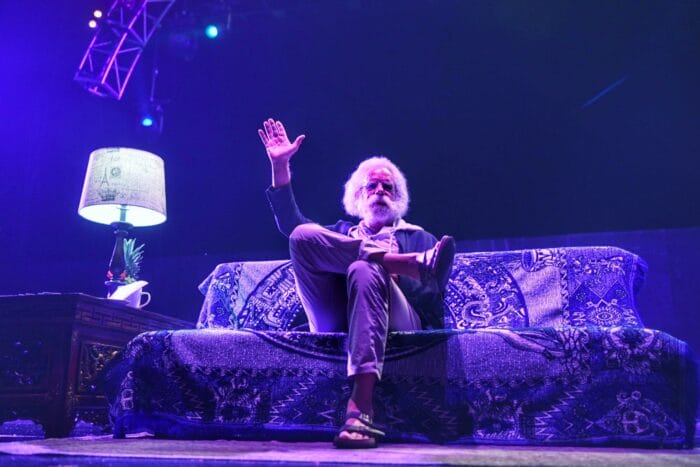
Since you mentioned LOCKN’, it reminds me of the night when JRAD was performing and Bobby made a cameo appearance in the middle of your set via the turntable stage, in which he was just sitting on a couch. What are your memories of that?
Here’s what I remember. Bob was playing LOCKN’ but not the night that we were, so we didn’t expect him to be there. Then we did our first set and at set break, we saw that Busch was there and we were like, “Hey, we didn’t know you guys were coming in early.” Then Joe and I asked, “Where’s Bob?” We were told he was on the bus and we said, “Let’s go see if we can get him to come play.”
So we went over to his bus, spent some time with him, and then we were like, “Dude, come hang.” But he told us, “I haven’t warmed up at all. ” It was basically like, “You guys are halfway through your show and by the time I get warmed up, your thing’s going to be over.” So he told us, “It’s not going to happen tonight.” Then we started busting his balls and he basically said, “You little pups go run around and play your fast set and I’ll catch you later.”
[As LOCKN’ promoter Peter Shapiro writes in The Music Never Stops: “Joe had wanted to do something fun with the turntable. At one point, he had suggested, ‘Just turn us mid-song, and then keep turning us back and forth.’ However, while Joe and Tom were chatting with Bobby on the bus, I noticed a couch and had another idea. Just before they started their second set, I told Joe I was going to try to get Bobby to sit on the couch and then rotate him in front of the audience while they were still playing.”]
So we went out and played. I think I joked about the stage turn and Bob standing there with no instrument, just waving like the Queen of fucking England, but we didn’t know anything about the set they had built or what was happening. I still don’t know where they got the couch, the end table or any of that shit. We were just playing and we had no clue exactly what was taking place until after the show because we were on the other side of it.
But that’s what made Bobby Bobby. Who else would fucking do that? Anyone else who’s an icon of American culture would probably be like, “No, I’m not fucking doing it. You guys are idiots. Fuck off” But no, he was down because he’s a funny, cool guy.
I have one JRAD question for you. When the band started out, you certainly were familiar with the music. So was Joe, through Furthur, even though he didn’t grow up on the Grateful Dead. The three other guys didn’t quite have that background, which I think contributed to the energy and some of the unexpected paths you took. To what extent has it been a challenge to keep things fresh now that everyone knows the repertoire?
There might be some challenge with the keeping it fresh thing, but we’re really just a bunch of guys who like to hang out when we can. A JRAD show is five dudes who like hanging out together, getting on stage and then hanging out there. When we go backstage we do exactly what we’ve been doing on stage, just with movie quotes instead of Grateful Dead songs.
There was never any intention put forth with any of it, ever. There was never a mission statement, there was never a plan. That’s just what we do because we’re goofy guys who like to fuck off and that’s what JRAD does.
The assignment hasn’t changed. The assignment is the same—”Let’s just go out there and see what happens.” That’s it. That’s all it is. It’s devastatingly simple. Like, “Okay, I’m going to try to make somebody laugh and they’re going to try to do something back and we’re just going to keep poking each other, having fun and just trying to find new spaces in music.” That is the assignment no matter who we’re playing with. That’s what we all do. Let’s go. If you’re going to do it, fucking do it. That’s still how it is. It’s been 12 years and there’s no difference.
Peter Tramo has been a steady collaborator for some time now. How did that come about?
We grew up in the same neighborhood in West Philly. We both grew up in Overbrook, but he lived down the hill and I lived up the hill, which was how the neighborhood was split. He might as well have lived in Egypt because it was just two different places when you’re little.
We were basically the same dude in our respective parts of the neighborhood. We were the artists, we were the quieter kids, and we both left Overbrook pretty much as soon as we could and went to find our paths in music.
Then about 15 years ago, we ran into each other. I went to look at a new venue in Philly and when I was on the tour of it, somebody was like, “Oh yeah, and there’s also a recording studio in this building. It’s over here and the guy that owns it is named Pete Tramo.” I was like, “Wait, Pete Tramo? I know that guy.”
I hadn’t seen him in probably 10 years or more. So I just went into the studio. It was a really cool, small, vibey place and we did the dance of “What have you been doing? What are you listening to? Who do you know?” I had the songs for Knives & Teeth [American Babies’ 2013 album] ready to go and I was looking to make a record. So I was like, “This is a cool studio, man, and I’m trying to make a record.” And he said, “Oh, well, make it here.” So we did and that was it. That consummated our friendship and we’ve been inseparable since. We’ve had three studios together and we’ve made four records.
You began playing with Tom McKee during your Brothers Past days. Then you went off in different directions. Now he’s both on the album and in your band. Can you talk about that relationship?
We started playing together in ‘98, I think. We had a good run with Brothers Past, although towards the end of that, our relationship was not in a great place. The last few years of that band, we didn’t really talk at all. Then after X amount of time, we reconnected. I feel like it was probably right before COVID or maybe during it. He reached out, invited me to lunch and apologized for how things were. So we worked on our friendship and we got it back online. Then during COVID, I put a band together of folks who lived around me, so I had people to play with. It was Tom McKee, my brother Jim and a few other guys.
We made a couple records that we released and it was a really fun process. The band was called MORE! When Ghost Light ended I was looking for the next thing, and MORE! was an incredible fucking band. I think it’s one of the best things I’ve ever been a part of. But half those guys had kids and stuff like that. So it wasn’t a viable touring thing.
Then Tom and I talked and it was like, “Look, man, I’m doing this thing. I want to make this record and this is my next chapter of my creative life. If you want to try it out and see how it would be to work together again in a full-time fashion, I’m down to try.” So that’s what we’ve been doing and it’s been really nice.
When it comes to your studio work, has become easier for you to execute on your intent over time?
No, because my intent has changed with me. I don’t know what caused this, but there’s something inside of me where I can’t keep doing the same thing. I can’t make the same record over and over. I can’t write the same song over and over. When things get to be routine or mundane, I short circuit. So I’m always trying to be more ambitious and find different intentions with every record. It’s like, “Well, I don’t know how to do this, so I’m going to go do it and figure out what my version of it is.”
I’ve never made a record the way that I made this record before, where I was entrusting so much into other people’s hands. On a lot of those Babies records, I played everything. If I had a specific thing I wanted, I just did it. I wanted this to be more organic and I wanted outside information and I wanted it to sound differently and just be different.
This was very much about just capturing all of us together, asking people to let go of the rigidness of what a studio can feel like and just say, “Listen, we all need to be open to something bigger than us to do this.”
I’ve been purposefully setting harder goals because the thing that I don’t necessarily love is when artists just make the same record over and over. You look at David Bowie, and no one would ever accuse that guy of making the same record over and over. It wasn’t the same person. Even like a band like Pink Floyd, where it’s the same crew, they still somehow managed to make all of those records very different from each other. I think that just comes from a bit of self-policing.
When it comes to making these records, most of what’s going on is I’m trying to figure out “Who am I now?”
Track By Track: I’m Your Vampire
Don’t Give Up On Me
The way I work with Pete is the two of us will bat the ball back and forth. With Don’t Give Up On Me” I think he brought in the chords of that chorus. I brought in the verse music and then he started singing the melody of the verse over what I played.
It’s a lot of that. If I write the music to something, he’ll write the vocal melody to it, and if he writes the music to something, I’ll write the vocal melodies to it. He’s the yin to my yang. He’s so important because I wouldn’t think of half the shit he does and he wouldn’t think of the shit that I do. That’s the thing that makes it great. I also trust him 100%, which is a huge thing.
It was between this one and “Kissing” for the number one spot. It’s amazing how different the record is if you open it with “Kissing.”
One consideration in opening with “Don’t Give Up” was the idea of “Listen, I’m going to talk about my life for a little while and I’m not going to sugarcoat it. This is what you’re walking into.” It’s an intense song and I wanted to set the tone.
With “Don’t Give Up” another one of the bigger things for me was how the song starts. The bass is like a buzzsaw. I loved the idea of putting the needle down and the first thing you hear is that bassline. It sets a mood. I think when the groove kicks in—the way that whole thing starts—that to me is the opening credits of a movie I’m excited to watch.
The Octave Below
There’s a lot of anger in this song.
Musically, with the riff, it was one of those tunes I wrote during COVID. Then, lyrically, it’s looking at these people like Matt Gaetz and Stephen Miller who think they’re above the law. I mean, to some extent it turns out they are, and I’m just pissed off in the song.
When I close my eyes, the song takes place in Hell and it’s somebody giving a tour. It’s kind of like that show Westworld where people go to murder for fun. Just the depravity of it all. It’s like, “Hey, welcome to Dante’s Fifth Circle of Hell.” And to these people, it’s a playground.
There’s not necessarily a narrative that connects all these songs. It’s not a concept record. It’s just the things that I’ve experienced in my life over the last few years, and politics is unavoidable right now. I’m just saying my thing the way I want to say it. This is the stuff that comes through people’s music all the time. I think “2 + 2 = 5” by Radiohead is just as much of a protest song as “The Times They Are a-Changin’.”
Kissing With Our Eyes Closed
Pete and I started in early February and it took us about four months to come up with something. If I wasn’t on tour during that time, we were in the studio working. There was a lot of self-editing.
I mean, we wrote songs, but they were dog shit. It was like, “Oh, that sounds just like the last thing we made” or “That sounds just like a different band” or whatever.
Then we wrote “Kissing with Our Eyes Closed” in like 15 minutes.
I had been sitting on some of those verses for a while. I knew those words were going to be on this record somewhere but we suddenly had the whole song plotted out. Sometimes it just hits you like that.
Then once the vision of that song came into focus, that gave us a North Star. From there, at least we weren’t throwing darts in the dark. It was like, “Okay, we have a general idea.” Then I was able to go back to the pile of songs I wrote during COVID and be like, “Okay, does anything in here seem like it could fit?” From there I could I get a little bit sweeter or a little bit darker and feel good about all of it.
It’s because of “Kissing” that a song like “Daddy Daddy” works for me on this record. Even “Running in Place” fits better because of “Kissing.” Those are the more happier-sounding songs I guess, with more romantic, positive views. Whereas with something like “Wrecking Crew” which is like a fucking sledgehammer, it also made that feel okay to have something that can kind of devastate the way that one does.
Running in Place
I originally recorded this for Knives & Teeth but I felt as though I never got it right. I never really played it live. It never did what I wanted to do.
Then when I was doing this record and I had the band that I had coming into my studio to track, I thought to myself, “I’d love to see what these guys do with this song.”
I tried not to give too much direction and just see what happened. I changed the key and there’s a lot less to it but what you hear on that recording is the band playing it live with the live vocal. That’s pretty much how it went in the room. We captured a moment and it’s a moment I’m proud of and I want people to hear.
Walking Backwards
That was another one that came together super quick. I got home one night from the studio and picked up a guitar in my living room that had a capo on it super high up. Then I sat down and played the progression of the song. It just fell out into my hands. I super quick grabbed my phone and made a voice memo of it.
The next day I brought it to Pete and I was like, “I got this thing. I think if we don’t just make it a sad boy acoustic song, it could be a cool tune.” So I played it for him and he was like, “Dude, do it again.” I played it again and he just started singing, “Too late, feels like we’re walking backwards…”
I was like, “Oh, that’s it. ” I wrote that down and we recorded it. I probably have it on my phone somewhere in a voice memo.
The fun thing about this record is I have so many voice memos with the moment where we’re coming up with a song because we would play a lot. Then I would hit record on my phone and just leave it.
So you could listen back and hear us going, “Whoa, wait, what was that? What’d you just say?” Then we would chase down these ideas and that’s basically how “Walking Backwards” came about. I played the music for him, he said what he said and I was like, “This is it. We just wrote the song. That’s the fingerprint of the tune.”
From there, it was chasing it down. That took time because the hard work on it was crafting the rest of the lyrics. It was a challenge to start with the end and reverse engineer the meaning of those words. But once we get the scent, like a hound dog, it’s a foregone conclusion that we’re going to be able to get there.
Wrecking Crew
I was watching Once Upon A Time In Hollywood during COVID and there’s a whole storyline in there about Sharon Tate going to see the movie, The Wrecking Crew. I remember seeing the poster in the movie and I was like, “Oh, that’s a cool title, ‘Wrecking Crew.’” I didn’t want it call it “The Wrecking Crew” because The Wrecking Crew is that group of musicians.
So I wrote that down in my notes and later on, once I had that chorus thing, it was like, “Okay, well, what does that mean?” So I kind of turned it back around and that’s the way the song unfolded.
The chorus and the bridge were separate ideas that I wrote during COVID—just voice memo ideas on my phone. There were a bunch of different versions of demos that came out of all that. Eventually we kind of put three different ideas together and I was like, “Okay, this all makes sense.”
When the verse thing started out, it wasn’t minor, it was major and it was a happier-sounding riff, but I needed something for this crazy tune that I was writing. So I thought, “Well, what if I just make this minor and then see what happens?”
When I taught it to the band, I said “I want this to feel like you’re floating in the ocean. You’re floating in pitch dark and in the distance, you hear a buoy.” That’s where the drum is fading in.
Daddy Daddy
This one came together while Pete and I were working on something else. It was a slog where we were just banging our heads against the wall, trying to get an idea for what we wanted it to do. Then we came in one day and while we were getting started, I picked up the guitar and played that opening riff. We kind of just looked at each other like, “Oh, what the fuck is that?” Within a half an hour, the whole song was laid out and I had the vocal melody for the verse.
It came together real quickly but there are times when that happens and it’s not something worth keeping. At first we’ll be like, “Wow, dude, this is sick.” Then we realize it came together so quick because it’s another song. We’ll be like, “Somebody else wrote that tune 15 years ago. No wonder we fucking just sailed through it.”
But that’s the gut check thing. As we go, we’re like, “Wait, is this something else? No. Okay. Let’s go to the next step.” Then it’s like, “Okay, is this something else? Nope. Okay, keep going. ” Then we kind of just go down the road that way.
With this one, I feel like the original demo is like what’s on the record except I’m the one playing all the instruments, so it sounds like everybody on it is drunk. I’m not an in-practice drummer, so everything’s janky.
Basically the process that Pete and I have is we’ll write this stuff and fully demo most things with a drum groove, a rhythm section feel and all that. Then once we have four or five tunes, I’ll be like, “Okay, I think we’re ready to book a session and get some people in here.”
Then we’ll send those demos out to whoever’s coming in and tell them, “Alright, learn this as it is.” That’s the starting point, but after we all get in the room it turns into best ball golf. I’m like, “Alright, if there’s a better idea, let’s hear it.” If not, we just stick with what we had on the demo.
Haven’t Used My Voice In So Long
The song began during week two of COVID where it became clear what was happening. That’s when I realized, “This is not a temporary thing, this is a hunker down situation.” We were locked down and I had a little production studio room in the house I was living in at the time, so I was like, “Well, I guess this is the universe telling me it’s time to start working on original new music.”
The first thing that came out was this ambient drone that I made. Then I just kind of started riffing, “Haven’t used my voice in so long…” It was like a meditation, almost. I mean somewhere there’s a recording of me doing that for like an hour.
So that’s where the germ of it started and then all of those sections of that tune were sections of other things that I had separately. I went through the stack of ideas that are always sitting in my phone and I arranged all those parts together.
The version on the record is the second time we ever played it as a five-piece band and the first time we played it correctly. I was like, “Okay, that’s it. That’s the take.”
Halfway through the record, I decided to play some shows to see how the songs felt live.” I played “Daddy Daddy” and this song back-to-back in the concert and there was something about the way that “Daddy” ended and the drone picked up that just felt right. So I put those two next to each other on the album.
I got the test pressing of the record a few weeks ago and I listened to it. Once it went through mastering, I never listen to it again, which is kind of how it goes.
So I listened to the vinyl and Side Two is basically a little EP. It starts with “Wrecking Crew” and ends with “Long Time Coming,” which are brother and sister songs. I specifically wanted Side Two to creep in with “Wrecking Crew.” Then with the way “Wrecking Crew” ended, I wanted it to be a thing where it fades out and it kind of pulls you in. So you lean into the speakers to hear those “Oohs” at the end, then it punches you in the face with the intro to “Daddy Daddy.” I forgotten what I’d had in mind and when I listened to the record that’s what happened to me. It made me laugh.
A had a similar idea with “Haven’t Used My Voice” and “This Could Be All Yours,” where “Haven’t Used My Voice” had this this blowing your hair back, strobe light, shock and awe ending, followed by this tender opening of “This Could Be All Yours.”
I wanted to pull the listener in at the end of “Wrecking Crew,” so I could push them back with the intro to “Daddy.” Then they’re all the way back through the end of “Haven’t Used My Voice” before I pull them back in for the beginning of “This Could Be All Yours.”
This Could Be All Yours
I collect lines and stanzas. If I think of a sentence or even just a word that makes me feel something, I’ll put it aside. I probably have 60 pages of chaos that I’ve collected.
When it’s time to make a song or a record, I’ll go through it. Sometimes there will be a whole chorus that I can grab and build off of. Or it’ll be a mood board where there are words or lines where I’m like, “Okay, that’s dog shit, but I like the intention of it and I’m going to write around that.”
With “This Could Be All Yours” the idea is that shit doesn’t have to be so difficult. Life is already so fucking hard yet some of us find these ways to make it even harder. It’s like in that line “What’s in your mouth today? Is it cellophane or flowers?”
I think that’s a choice people make. Everything doesn’t need to be combative.
It’s Been a Long Time Coming
My dad got sick and it got to a point where it was clear what the outcome was going to be, but we still got another couple years out of the guy. At the end there, it was a tough thing to go through. The anxiety of knowing that it was coming but not being sure if it would be today or in a year or whatever.
Every time I got a phone call from him, there was that panic when I’d look at the phone, see that it was him, and immediately think, “Is this an emergency?” Or his lady would call me and it would be “Oh fuck, is she calling to tell me that he’s died?” It was a lot to carry because he was sick for almost four years.
We recorded “It’s Been A Long Time Coming” on the last day of the sessions with the people I’d been making the record with. Tom McKee has known my dad since he was a kid. Taylor Shell, who was the bass player in Turkuaz and the last bass player in Ghost Light, is a really good friend and had been a part of this project from the go. Ryan Jewel was the drummer and then we had Pete Tramo, my partner in all of this.
It was the last day of recording, and the idea I came up with was to write a new song using the major key version of the verse riff from “Wrecking Crew,” which as I mentioned had started out that way. So Side Two would open with this dark riff and close with a more hopeful-sounding version of that same riff.
After we’d finished recording our last song, it was still pretty early in the night. So I said to everybody, “Look, I’ve got this riff. I’m going to start playing it and I’m going to sing. What I would love for you to do is come in loosely one at a time and build this thing to a very large crescendo. Then when I signal, just drop back down to just me.”
Those guys all knew what was going on at home, and what a kindness it was that they treated this song with such care.
Then after we played it once, I collected myself and asked them all to switch instruments. My studio is a pretty big place that has shit everywhere. So I said to everybody, “What I want to do now is we’re going to play back what we just did through the house speakers and I would love for you guys to all just get on any other instrument. Then warts and all, we’re going to do one pass playing over what we just did, with the same idea of building it up and then landing the plane at the end.”
I think McKee played the piano on the first take, so when we did the second one, he moved to the organ. The drummer moved to the vibraphone. Taylor moved to the lap steel. I just grabbed a bunch of percussion. Then it was the same thing, just one take right over what we’ve done before, and that was it.
We had the song with the lead vocals and the next day we did the gang vocals. I’ve been friends with Raina Mullen, who was in Ghost Light with me, for 12 years. She’s known my dad that whole time, and it felt appropriate to have her involved when we did all those big vocals at the end.
So that was the song for my dad who was dying.
I didn’t get a chance to play it for him but the last thing he said to me at the end was “You know, this doesn’t have to be sad. This is just the way it goes. It’s just my time. But write a song…”
So that’s what I did.
That’s what you do.