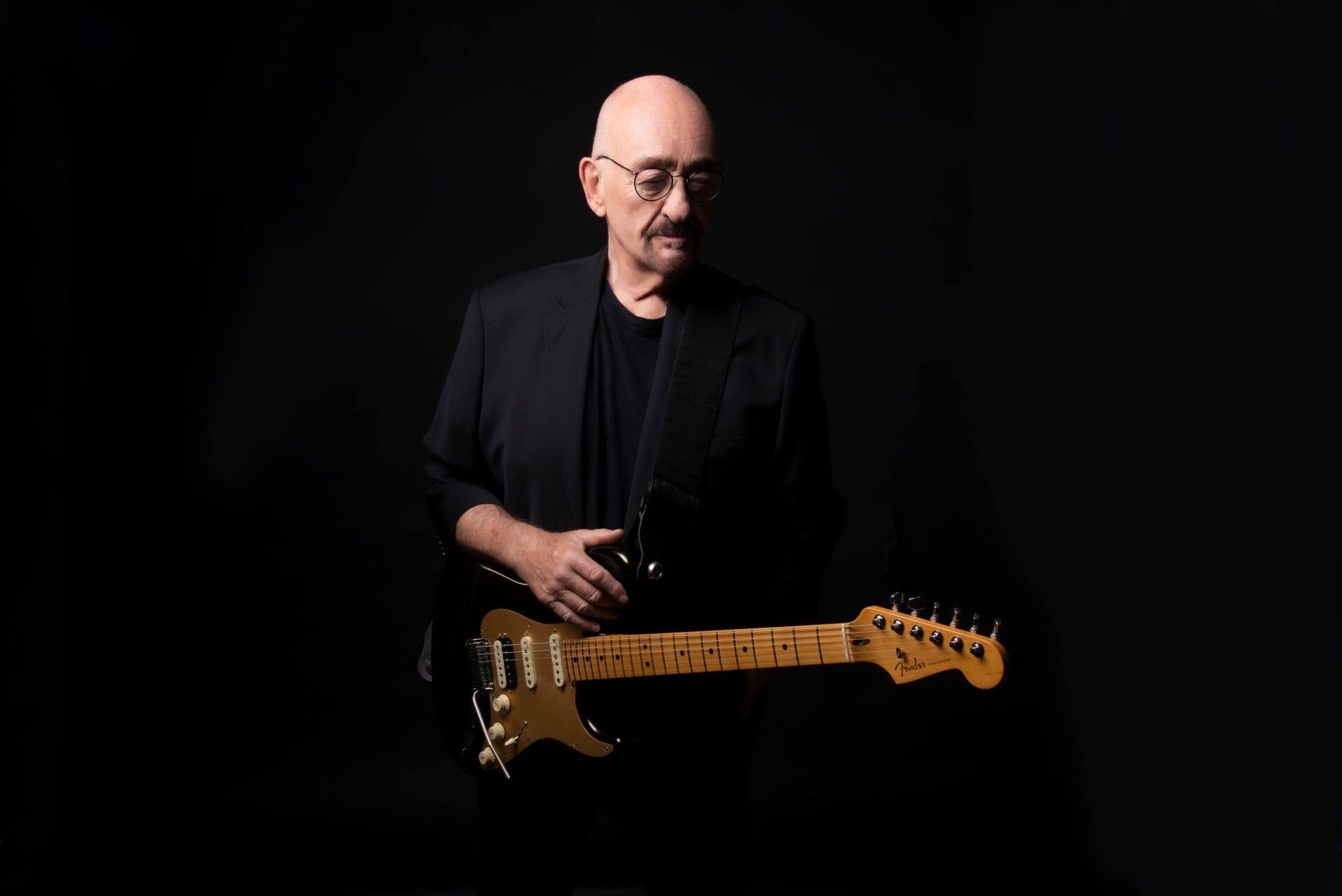
With a brand new album, his first-ever all blues collection, Dave Mason would love nothing more than to go out on the road and play. A Shade of Blues—released in March on the U.K.-born singer-songwriter and guitarist’s own Barham Productions label— had been percolating in his mind for quite some time. “Fans,” he says, “have long been saying, ‘Dave, you’ve got to do a blues album.’ I just wasn’t ready before, but I had a lot of stuff that I’d been fooling around with in my studio, and then things started to come together. It’s not a strict blues album; that’s why it’s called A Shade of Blues,” he adds. “But it’s blues-influenced. For me, a good blues tune is about the feel.”
Instead of putting all of his time and energy into promoting the album properly though, Mason has spent most of 2025 thus far recuperating from a debilitating health episode. The initial vocal cord surgery he underwent didn’t cause any significant problems that would prevent him from making music—“The voice is perfect,” he says—but while he was laid up in the hospital, he was smacked with an infection that knocked him for a loop. “Doing big things is very hard,” he said when Relix spoke with him at the end of March. “I’ve got to pretty much rebuild my entire body, my head, everything. It’s pretty bad.”
As a result, Mason was forced to cancel all of his planned concert dates from March through May. And as if that weren’t enough, to compound his recent health woes, this latest setback came only months after he underwent a successful heart valve replacement procedure. “I’m pretty beaten,” he confessed.
Despite these issues, Mason, 78, was eager to let fans know about A Shade of Blues, which finds the Rock and Roll Hall of Famer and founding member of Traffic offering his takes on three blues standards—Albert King’s “Born Under a Bad Sign,” Elmore James’ “Dust My Broom” and Robert Johnson’s “Come On in My Kitchen” (retitled here “Come Home in My Kitchen”)—as well as Traffic classics “Dear Mr. Fantasy” and “The Low Spark of High-Heeled Boys” and a handful of original compositions. The LP features guest appearances by guitarist Joe Bonamassa, keyboardist singer Michael McDonald and others.
Although he couldn’t be described as a blues guitarist, per se—he was never one of those Brits like The Rolling Stones, who sought out rare American blues numbers that could be plugged into a setlist back in the ‘60s—the genre was always present in his own music. “I probably got into blues about the time we started Traffic,” he says. “But I was listening to all kinds of music at that point—blues, classical, jazz, country, Bulgarian music. When Traffic started, we were more into wanting to write our own songs, so we weren’t really digging around for blues tunes. A lot of the English records, the hits, were covers of American records in the first place. You’d have producers, or whatever, getting advance copies of American hits and giving them to bands in England to record, to have a hit with. But it’s in all of [my music], somewhere or another, sure.”
Mason first came to the attention of most rock fans with the emergence of Traffic in late 1967. He played and sang on the band’s debut LP, Mr. Fantasy, and wrote or co-wrote several songs. However, following the album’s release, he was unceremoniously booted from the group—an episode that he recalls at the start of his memoir, Only You Know & I Know—and then rehired in time for their next LP, which was simply titled Traffic. Some of Mason’s contributions to that release, including “Feelin’ Alright?” and “You Can All Join In,” were among Traffic’s most memorable songs, but he then left again, busying himself with session work for the likes of Jimi Hendrix, Delaney & Bonnie, The Rolling Stones and others.
“There’s no use going through life with excessive baggage. It is what it is,” he says about the rocky relationship he had with Traffic frontman Steve Winwood. “It would have been nice to have resolved it along the way, but it never happened. C’est la vie.”
When Mason finally went solo for real in 1970, with the release of the album Alone Together, he did so with a splash—many record buyers remember that album for its marble-patterned colored vinyl, which became an instant collector’s item. “There was no way to control the colors,” he says, “so, every one of them came out different.”
Mason’s subsequent career could be described as erratic: His follow-up to Alone Together, a collaboration with former Mamas & the Papas singer Cass Elliot, was not a big hit, nor were most of his other albums. But then, in 1977, Mason bounded back with “We Just Disagree,” a song written by longtime band member Jim Kreuger, which just missed the Top 10 and was covered in concert by no less than Bob Dylan. “[Jim] came to me and said, ‘Hey, I’ve written this song, I think it’s perfect for you,’” Mason recalls. “It did pretty good; it’s a good song.”
Mason has kept busy ever since, even spending a brief period in the ‘90s as a member of Fleetwood Mac. Now, however, he just wants to regain his health so that he can make up those canceled tour dates. As he put it in a recent press release: “I can’t just sit around doing nothing. I still love playing guitar, I love being out on tour. I just want to keep this music alive for new generations.”