Love, Devotion, Surrender: Jeff Tamarkin on Five Decades of Music Journalism and His Stellar New Santana Book
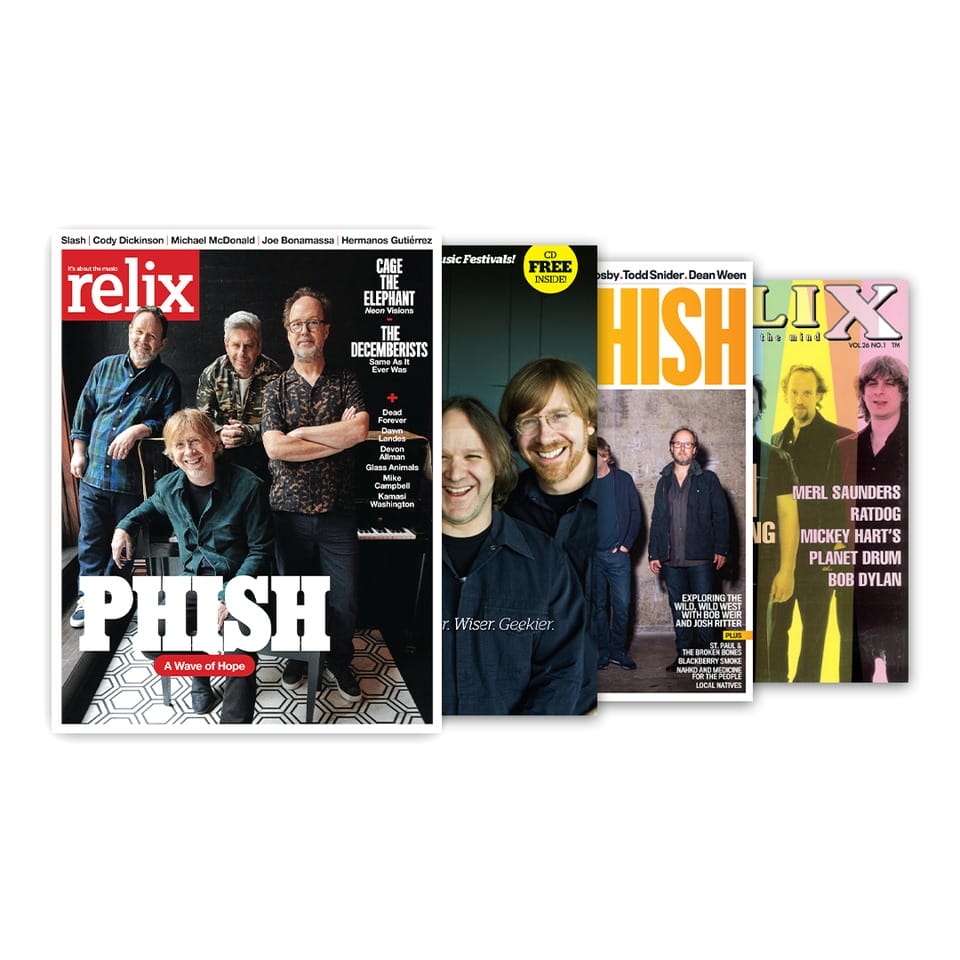
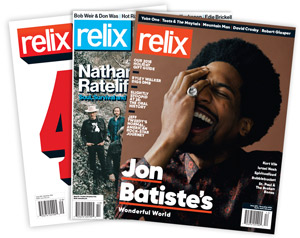
“I never in my life thought I would end up doing this and certainly not for this long,” Jeff Tamarkin says of a career that began with a review he filed for the San Francisco State University student newspaper of The Band’s Last Waltz concert in November 1976. He has been working for music publications ever since, including a stint as Relix’s editor-in-chief from 1978-80, followed by runs at Goldmine, Jazz Times, Global Rhythm and other outlets. Tamarkin also wrote the definitive history of Jefferson Airplane, 2003’s Got A Revolution!
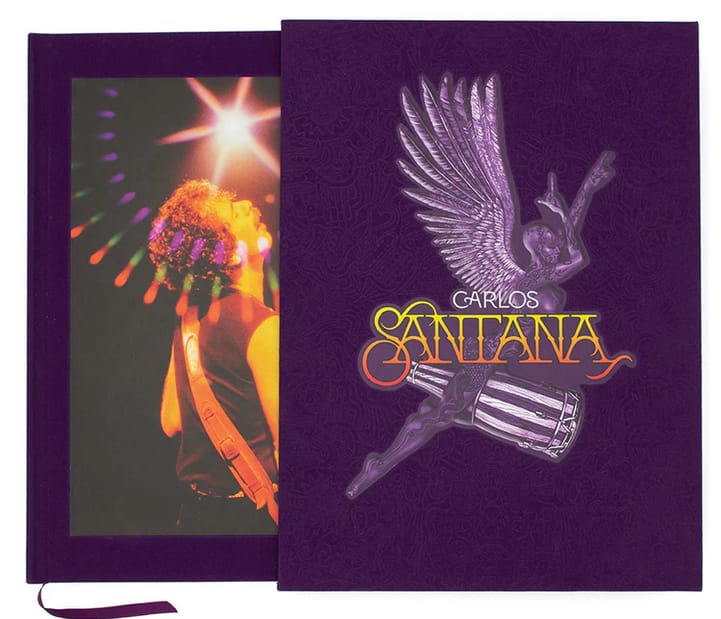
His latest book project is the massive new tome, Carlos Santana: Love Devotion Surrender: The Illustrated Story of Santana’s Musical Journey. This voluminous work presents previously unseen material from Santana’s personal archives, including photos, drawings, posters, tickets and assorted mementos. Tamarkin paired these with a series of interviews he conducted specifically for this project with Carlos, Cindy Blackman Santana, John McLaughin, Clive Davis, Steve Miller, Rob Thomas, Gregg Rolie, Michael Carabello and Rob Thomas. There is also a limited edition version that features a numbered card signed by the musician himself, as well as a standalone sketchbook with additional Santana art, an original backstage pass from the Supernatural tours, three special enamel pins, an art print of a 1968 photograph, replicas of album covers and other fascinating ephemera.
Tamarkin, who first saw Santana perform on two occasions in August 1969 just prior to Woodstock, remarks, “During the process of creating the book, I was able to see a lot of the proofs, but to actually hold the final, physical thing in my hands was something else. It’s just so high quality. I’m really proud to have my name on it. It’s a keeper.”
At what point in your life did you first anticipate that you might become a music journalist?
I was one of those guys who read every liner note and all the credits. I also subscribed to lots of rock magazines. So I knew fair amount but I never thought I’d be writing about music.
Then, when I was in college at San Francisco State University, I had some assignments where I had to come up with ideas. So I said to myself, “Well, I might as well write about music, which is something I know.”
After that, there were a few openings at the college newspaper because there was a political thing where some people were leaving and they needed new people. I went in there and said, “Hey, I can write about music, if you’re looking for that.” They said, “Sure, how’d you like to go write about this concert that’s coming up? It’s called The Last Waltz.”
I was going to go anyway, I had tickets. So I told them, “I’ve read enough concert reviews, I guess I could do that.”
They published the review, and eventually I sent that clip along with some others to BAM magazine. I said, “Hey, this is what I’ve done. Maybe you could use my stuff.” Pretty soon after that I started writing for them, including interviews.
Then the next thing I knew, it was 2025. [Laughs.]
Did the filming of the Last Waltz detract from the concert experience in any way?
No, it felt like a regular concert. There might’ve been some gaps where they had to change camera angles or that sort of thing, but those didn’t last very long. It wasn’t like one of those deals where they would do second takes or third takes. It was a regular show and they did have to please the audience that was there.
At the time, my friends and I knew this was something special and that we were really witnessing history. I remember at one point, close to the end when we’d already seen everybody—Joni Mitchell, Van Morrison, Muddy Waters, Dylan—I turned to my friend standing next to me and I said, “There’s a Beatle and a Stone on stage, and nobody’s even surprised by that.” It was great.
I recently watched the film again for the first time many years. It played at the Film Forum and I took my son because he’s a fan of The Band but he hadn’t seen it. He was like, “You were actually at this?” I told him, “When you were in your 20s and you lived in San Francisco and it was 1976, you were going to that thing.”
Was there a momentous early live show you attended that instilled a passion for the experience?
The first concert I ever went to was in 1964 when I was 11 years old. It was at the Brooklyn Fox Theatre, and it was hosted by Murray the K and the Swingin‘ Soirée. It was one of these package shows where everybody would come on and do two or three of their hits, then get off the stage. It starred Dusty Springfield, the Searchers, the Shangri-Las, and then pretty much almost all of the Motown revue. I don’t think Stevie Wonder was there, but it was The Supremes, the Temptations, Marvin Gaye, etc.
So that wasn’t a bad way to start. Then just whenever I could do it, I’d go to this kind of shitty venue a couple miles from where I lived in Long Island called the Island Garden. That’s where I saw the Dave Clark Five, Donovan, Blood, Sweat & Tears, and a bunch of people like that.
Once I was old enough to get into the city and the Fillmore East opened, that was it. Between Fillmore East, Capitol Theatre and all the other venues in New York, it was game over. Pretty much every weekend I would be there, sometimes for more than one show a weekend. It’s really never stopped since then.
Thinking back on your days at the Fillmore East, what initially comes to mind?
Oh, God, there were so many great shows. I mean, the first show I saw there in ’69, was The Who, Chuck Berry and Albert King, three great acts and it probably cost me $3.50. My first dead show was January 2nd, 1970. Then I was there the next month for the famous 2/13/70 with the Allman Brothers and Love on the bill.
I mean, whoever I could get into the city and see, I would see: Creedence, Traffic, Procol Harum. Thinking back now I’m trying to figure out how I afforded all this. I didn’t have a job or anything.
When was the first time you saw Santana?
I first heard of Carlos Santana in ’68. He had a cameo appearance on an album called The Live Adventures of Mike Bloomfield and Al Kooper, so I knew his name. He was one of the special guests, along with Elvin Bishop. I guess Mike Bloomfield left the stage for a while and Bill Graham said, “Carlos, get out there and play something.” So he played this blues tribute called “Sonny Boy Williamson.”
Then in August of ’69, two weeks before Woodstock, I went to the Atlantic City Pop Festival in Atlantic City, New Jersey. I call it the great lost rock festival because in some ways it was better than Woodstock—there was a much more diverse bill.
So anyway, Santana was there and I was really looking forward to seeing the band. By that point I’d read about them in Rolling Stone, and I knew they were supposed to be this hot new fusion of rock and blues and Latin and jazz and everything else.
They came out and they were mis-introduced as the Santana Blues Band, which was a name that they had used in San Francisco but weren’t using anymore. So Carlos said, “We’re just Santana. We don’t just play blues.”
They blew me away to the point that a week or so later when they played in Queens at a place called The Pavilion—which was part of the old World’s Fair—I went to see them again.
So I actually got to see them twice before they ever played Woodstock and continued doing so. I lived in San Francisco from late ’72 through most of the 70s, and they were just about the house band other than the Dead. I probably got to see them 15, 20 times. They might be topping a bill of somebody else I also wanted to see, or they were playing their own show.
After that, I lost track of them at times, although I still tried to keep up with what they were doing. Then, of course, Supernatural came out in ’99. It was like, “Hello, remember us?” and they had a number one album throughout the entire world.
Carlos has facilitated so many elevated musical endeavors that people should revisit. This book is titled Love Devotion Surrender, which references one of my favorites, his 1973 record with John McLaughlin.
A lot of the pleasure I derived from doing this project was I had to fill the gaps in my own collection because I didn’t have a lot of those albums. I might’ve heard them once or twice when they came out and then dismissed them. It was like, “Okay, now I have to go back and listen albums like Amigos, Zebop!and Shangó.” There were so many of them, and most of them I’d put on and go, “Wow, this is really good stuff. How did this not catch on?”
I made sure to get all of these in the book because it was really meant to be about his music. I didn’t want to get into a lot of other stuff. He wrote his own memoir about 10 years ago, so there was no need to repeat the biography.
This book was really about the music, album by album. It gave me a chance to go and listen to albums I hadn’t heard in 20, 30 years. There were Santana albums that just kind of flew by. It’s not that the guy ever lost it, he just changed direction a lot. After the first three albums, he told Clive Davis, “Okay, my next album’s going to be something really, really different.” Then he came out with Caravanserai. This was after having two number one albums in a row. Clive Davis heard this and told him, “You’re going to kill your career. It’s crazy that you’re putting this out.” But Carlos said, “I don’t care, I’m putting it out.” It still sold well, but it was definitely a change in direction.
He did that a lot. He would suddenly shift completely—like going into fusion and the stuff that he was doing with McLaughlin. He did a duet album with Buddy Miles. He collaborated with Alice Coltrane. There’s some amazing stuff on those albums. It’s not like he ever lost his touch, although he did lose some of his audience.
As for Love Devotion Surrender, it’s one of my five favorite things that he’s done. I got to talk to McLaughlin about that for this book, which was great.
Did you ever see McLaughlin with Mahavishnu?
I got to see them once at My Father’s Place on Long Island. This was a tiny club and it was one of the five loudest bands I ever heard in my life. I was maybe six tables back and I remember feeling, “Oh my God, I’m never going to hear again.”
But the power of that band was incredible and with the musicianship, it was like, “Holy shit, these guys are really something.” I don’t go back and play those early albums a lot, but when I do, I’m reminded of just how incredible and innovative they were. At that time you also had bands like Return to Forever and Weather Report where it wasn’t quite jazz, it wasn’t quite rock, and those who knew, knew.
Back to the book, when you took on this project, how was it initially described to you? What was the assignment?
I was contacted out of the blue by an editor who described the company and explained that they were doing a book on Carlos Santana—specifically Carlos Santana, not the band. After she told me what they had in mind, and I didn’t have to hear anymore. I was like, “I get a chance to write a book about Santana? Yeah, I’m in.” She said that they wanted to stress the music—the whole soup to nuts—starting with him as a kid violin player in Mexico, and going right up through the complete discography.
One thing that made it special was they had the cooperation of Santana’s management who were going to let them loose in Carlos’ Warehouse in Las Vegas. Apparently he’s saved most everything he’s ever done, including photos, posters and art. If you look at the book, there are all these pullouts that include Carlos’ drawings and writings.
So they brought a photographer out there and shot everything they could. The title of the book is Love Devotion Surrender: A Visual Journey and that’s what it is, really. I’m sort of putting the words to the pictures. Usually it’s the other way around, but with this book you don’t even have to read my part of it, you can just look at the posters and the guitars and all that stuff. Of course, it’s quite a story.
I love the beginning part where they somehow unearthed all these childhood photos of him growing up in Tijuana playing the violin, which I’d heard about but I’d never seen before.
I was able to do interviews but we were very careful about who we chose. They wanted to keep it to select people who represented various aspects of his career. I think in the end, we did about 10 interviews, including Carlos and his wife Cindy Blackman Santana. I wanted to concentrate on the early people, so we talked to Michael Shrieve, Michael Carabello, Greg Rolie. Then I spoke with some of the people from the later days, like Rob Thomas, who did “Smooth” on the Supernatural album. I also spoke with McLaughlin, like I said, and we managed to get Clive Davis who doesn’t do a lot of interviews anymore but he wanted to talk about this. One thing he wanted to set straight was that story I mentioned about Caravanserai. He insisted that he never told Carlos that this was going to kill his career. He said he knew it was going to ruffle some feathers, but that he always wanted to let Carlos follow his own muse, and he came up with an album that’s just gorgeous. It’s definitely one of the ones I play most often.
When you began conducting interviews, was there something that really struck you?
I really enjoyed talking to Carlos, which was great. I also enjoyed talking to some of the other people, like Michael Carabello. All I knew about him was he was percussionist on the early Santana albums, but he ended up really going to bat for this project and calling me back like 10 times with additional information.
Michael Shrive wants people to know that his drum solo [at Woodstock] is not the only thing he ever did. He said he rejected it for a long time. He wanted people to know that he made other music. Then at some point he finally accepted something that’s he’s known for. He was ready to say, “That’s me up there. I was 19 years old when I did that.”
You mentioned that you saw Santana numerous times when you were living in San Francisco. What drew you out there from New York to attend college?
Basically I went out there with a friend in the summer of ’71 just to kill the summer, and we had a great time. I actually met Jerry during my first minutes in the Bay Area. We decided to go see the Dead because we had their office address in San Rafael. When we showed up to the house, there was Jerry in the driveway, talking to a guy. We walked up to him when he was done and told him that we had driven across the country with an album of Dead bootlegs. He invited us to come in and to listen to it, then shared a couple joints with us. It was the best weed I’d ever smoked.
After that summer, I came home to New York and said, “I’ll be moving back.” So that’s what I did the following summer, then I began at San Francisco State. But I basically moved there for the culture. I probably saw shows three or four nights a week. I’d think nothing of driving two or three hours to a show in some godforsaken part of California.
I went out there in late ’72 and I left right after the last run of Dead shows in ’77. So I was there for about five and a half years. It still had a lot of the flavor of the Haight era when I got out there but it also started being overrun by the whole junkie thing and all those nightmare stories you’ve heard about the Haight collapsing. It was a great experience, though, and I’m really glad I did it. The weekend I got out there, I saw the final Airplane gig at Winterland and I think Pink Floyd the weekend after that. So it was a nice way to say hello.
Speaking of Jefferson Airplane, what are the origins of Got A Revolution!?
It began around ’76 when I was still going to San Francisco State and had to come up with story ideas for the school newspaper. I knew that Starship had this place over at Fulton Street, so I decided to see if I could get some of them to talk.
I made a simple phone call and told them who I was and what I hoped to do. They said, “Oh, sure, drop by the house.” So they put me with David Freiberg and Craig Chaquico. Then I interviewed Jorma, Jack, Grace and Paul, one-by-one.
When I moved back to New York in early ’78 and started writing for Relix magazine, I think the first cover story I did was on Starship.
At that point I had a lot of stuff on all of them. I interviewed Grace several times, and after RCA started doing the reissues and the box set, I knew people there and I said, “You guys are going to need somebody to write the liner notes for these things.” They responded, “Oh, do you want to do those?” So I ended up doing over 25 liner notes on Airplane-related projects.
Several years into this, I said to myself, “Maybe it’s time somebody did a book on them.” There’s been a thousand books on the Beatles, Stones, Dylan and the Dead but nobody’s ever done a book on the history of Jefferson Airplane. So I decided I was going to do it and I got a deal. Then it took over five years. I did over a hundred interviews.
I didn’t realize when I was getting into it that these were six people who had been very stoned every day of their lives. So they all remembered it differently. I would ask the same question of these six people and get six completely different answers. Somewhere therein I would try to sort out the truth and I’d go to Bill Thompson, their manager, and say, “Well, this one said this and this one said that.” Then he’d respond, “No, no, they’re all wrong. Let me tell you what really happened.” And this went on for five years.
Even though the book has been out for a while, I know a few folks who discovered it recently.
I still get emails about it at least once a week, including a lot of people from other parts of the world. I’m not sure how they’re finding this 20-something year old book but they’ll reach out to me—”I just read Got A Revolution! and it’s incredible!” I always appreciate that although I can’t answer every question about it because I wrote it nearly 25 years ago.
Going back even further, what are your memories of working at BAM in the late 70s?
The people at BAM were very welcoming. I met Dennis [Erokan] at the time. [Editor’s note/fun fact: Erokan, who founded BAM, is the father of actress D’Arcy Carden (The Good Place, Barry, A League of Their Own).] I also met Blair [Jackson] and the other editors.
I learned a lot but I didn’t stick around very long. My first interview ever was Bill Kirchen. I also talked to people like the Rowan Brothers and David Grisman, which was fun.
Then I came back to New York and said, “Well what am I going to do, now? Oh, okay, there’s this thing called Relix…”
How did you come to be the editor?
That was something of an accident. I knew about the magazine, even when I was in San Francisco. At that point, in the late 70s it was still really a Dead fanzine.
When I got back here I didn’t know Les, I didn’t know Jerry Moore or any of those people, but I made a phone call as you did back then. I told Les I’d written for BAM, and he said, “Come over, we’ll talk.” Then at that point Jerry said, “Oh, you have Airplane interviews? Let’s do a story on Starship.” As I mentioned, that ended up being my first cover story.
Then at one point pretty early on, Les called me and said, “Between me and you, I’m going to fire Jerry Moore. I need a new editor and you have some experience being an editor. Would you like to be my editor?” I said, “Yeah, I guess. Why not?”
So we had this meeting at Les’ apartment in Brooklyn. I forget who else was there. Les had a lot of his friends on the staff, people that are long gone, and there were like four or five of us sitting around when doorbell rang. Les went to answer it and Jerry Moore pied him—he threw a pie right in Les’ face. Then Jerry ran down the block with Les chasing him.
One of the first things I did was to be subversive and start putting people like Blondie and Cheap Trick on the cover—people that had nothing to do with what Relix was about. Les was supportive but the readership was not, although I think it probably helped set the tone for what Relix is now, because if Relix had stayed a Grateful Dead fanzine, it would not have lasted.
What followed for you?
I was balancing a lot of stuff at the same time. I was editing Relix while I was also editing CMJ, which was the college music trade publication. I was doing both of them to help pay the bills, and occasionally there was some crossover, which was kind of interesting. Then I stopped doing both of those around ’81 when I was approached to edit Goldmine magazine. I began editing that exclusively while continuing to write for anybody that would have me, including Relix. I did Goldmine for about 15 years—which is still my world record—and then a lot of other publications that have come and gone.
One of the ways I keep myself interested is by taking assignments that are way out of my ballpark. For a while I was editing a technical publication about the recording industry. I also was an associate editor at Jazz Times for seven years.
During that stretch is there an article of yours that stands out for one reason or another?
Looking back, one of my favorite things was interviewing Yoko in her kitchen at the Dakota. I remember standing in that apartment, looking at the white piano in living room and thinking, “Holy shit, this is where they lived. This where they worked.”
At that time I was editing a world music magazine called Global Rhythm. Yoko had a project that involved going back to her Japanese roots, which was not something she did often. So we expressed interest in talking to her about Japan and her early involvement in music. Of course, the conversation ended up going a lot of other directions, but it was great to be there with her and talk to her.
Returning to Love Devotion Surrender, is there a particular image that feels definitive or particularly evocative for you?
This is not an uncommon picture, but the shot of them from Woodstock where Shrieve is in the forefront, and then you look at Carlos, who’s got that typical pose of his where his head is tilted back and he’s looking to the sky. That really sums them up to me.
That to me is a classic Santana picture. You can look at his face, and as he’s said a number of times over years, he was tripping his balls off, seeing snakes coming out of his guitar.
There are so many things in the book, including a copy of the contract for Woodstock. They were paid $1,500 to appear, which was not a whole lot but they were pretty much an unknown band. They also were paid $750 for the film rights, and in the bottom it says, “Not to exceed three minutes.” I think their segment is probably the longest one in the film because of the drum solo. I think they’re in there for 10-12 minutes.
I really enjoyed being able to see that contract. It’s the standard one drafted by the American Federation of Musicians, Local Number 6.
I’m sure they thought nothing of it at the time—“Oh God, we have to go to a weird place in upstate New York. Okay. Whatever. Pack the van…”
Did you make it to Woodstock?
I could not get there. I was still only 16. I did get to the Atlantic City one, but that was because my parents drove my friend and I there, and then they stayed. We all stayed in a hotel in Atlantic City, and my mother would come pick us up at the festival.
Now that’s a nice mom.
I remember she got there early on the last night. So my mother walked inside this rock festival and saw Janis Joplin jamming with Little Richard. That was the closing act of the festival. So my mom saw Janis Joplin. She didn’t know who she was but still…
Finally, as you writing Love Devotion Surrender, did you have an ideal reader in mind?
I did a dedication at the end to a fellow named Carl Kunstorff, who’s no longer with us. He was my Santana guy in the 70s. I was a fan, I really liked them, but not on the level that he did. He was an early taper, but his thing was Santana not the Dead. I’d go over to his house, drink some wine, smoke some weed, and listen to Santana over and over and over again. Eventually he got to know Carlos and become good friends with him.
Carl passed away but I was thinking about him a lot when I was doing this. He was the most intense Santana fan I’ve ever known. He taught me a lot about them and turned me onto a lot of stuff that I’d never heard before.
He kind of invigorated my interest in Santana music, so I wanted to give him a shout out at the end. My friend Ed Perlstein, who I knew from back then, also knew Carl. In fact, Carl ended up giving Ed all of those tapes when Carl had cancer and he knew he was passing away. So Ed called me up and he said, “I’m really glad you gave the dedication that Carl Kunstorff, because he really deserves that.”
To me, he was the ultimate Santana fan. There must be other people like him out there and this book is for them.