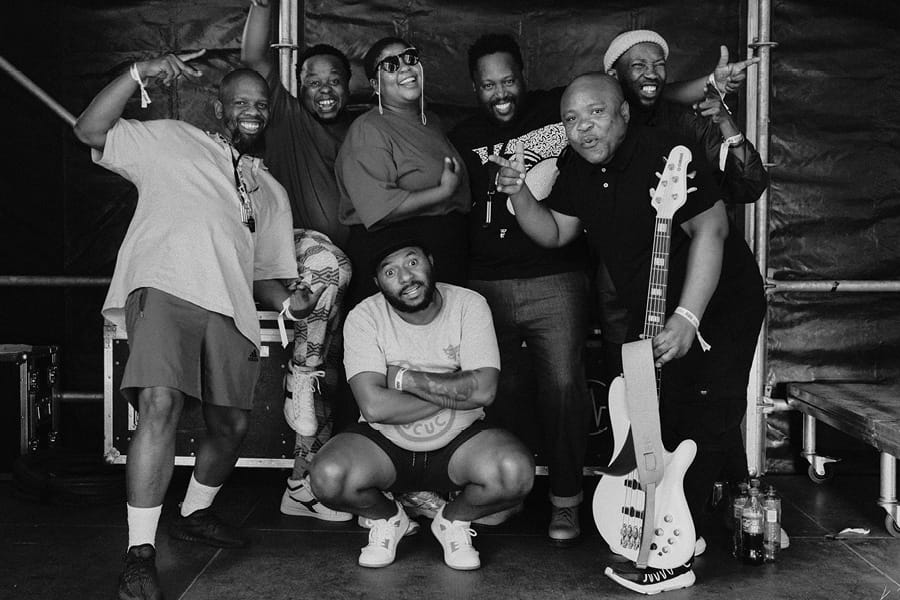
For many bands around the world, international success comes when they decide to start writing songs in English. But for South African funk collective BCUC, success came when they stopped.
Short for Bantu Continua Uhuru Consciousness, BCUC was founded in Johannesburg, South Africa’s most famous musical neighborhood, Soweto. Lead singer Zithulele “Jovi” Zabani Nkosi, then barely out of his teens, “wanted to change the world with our music.”
But an early decision to stop singing in English opened a door for BCUC—deepening their ties to their ancestors and spreading their music around the globe.
“Singing in English allows you to be classified—this is neo-soul, this is rock-and-roll,” he says. “But when we started singing in Zulu and other indigenous languages, something changed in our heads. We returned to our people, to our ancestors. What might’ve been called a rock-and-roll song in English became an ancestral war song. We shed any sense of genre entirely and embraced the languages of our grandmothers.”
Without dressing BCUC back up in the genre labels they cast off, let’s just say this—the band’s music will make you dance. It’ll make you shake and sweat. It might make you scream. And you’ll be in good company because BCUC’s performances feel like musical exorcisms— when he raps, chants and sings in Zulu, Jovi’s voice simply explodes out of his mouth. The band’s music is deeply, mesmerizingly rhythmic and bass-heavy, pulling in punk-rock fury and the frenetic energy of Fela Kuti-era Afrobeat.
Jovi grew up in an incredibly musical household; his uncles were part of a local band and his family regularly sang in church. His mother was also a Sangoma—or a trained Zulu healer—who introduced him to many traditional medicine songs at a young age.
“Music was everything to me,” he says, smiling wide. “My f irst memory is being 2 or 3 years old, standing on top of my bed, singing and dancing for my babysitter. That feeling of really being seen and making someone say, ‘Wow!’ It was so powerful.”
When he put together BCUC in the early 2000s, the band was truly a product of their environment and time. Jovi came of age in Soweto as South Africa finally abolished its oppressive apartheid system. There was great hope for change in the country. And the famous township had long been a hub of music, art and political protest.
“Soweto has always been vibrant and alive. It breathes with the people, and it never sleeps,” says the 48-year-old Jovi. “Sunday is our big day. After leaving church, people sit together. It starts with a coffee, then a drink or two, and it evolves into a proper hang. People congregate at the car wash, keeping their car clean for the week—and it becomes a party until someone tips us off that the police are coming to shut it down.
“Mondays have no business being fun,” he adds with a laugh. “But even Mondays are exciting here.”
But as a young man, Jovi also sensed that the post-apartheid dawn of South Africa wasn’t delivering on its promises.
“Democracy,” he says, “was being marketed to us like a brand—as if suddenly everyone would have a job and education would be free. But this was just untrue. And we were unafraid to speak out.”
BCUC pushed young South Africans to avoid idealizing the new chapter their country had entered a decade earlier—and to embrace that they, too, could cause change.
“When South Africa was in its [post-apartheid] honeymoon, you couldn’t say anything negative about Nelson Mandela. We made him into a god. And I believe that South Africa is capable of raising millions of Mandelas. He didn’t make South Africa. He is a product of South Africa.”
BCUC began playing shows in Soweto, channeling the fire of their township into sharp political critiques and pulsating energy. They finally cut their first album years later and— through the magical connectivity of the internet—started landing bookings around the world. While BCUC dropped its explosive album Millions of Us in 2023, and is currently wrapping a new album, Jovi maintains that the only way to fully experience BCUC’s magic is to see them perform. And this year, those opportunities include rare US stops at the Newport Jazz and Newport Folk Festivals, globalFEST and more.
“We all grew up with music made to be performed live, in church and in the streets,” he says. “When people see us live, they say, ‘Well, I liked it on the album, but live, oh, man!’”
The band stacks more than half a dozen musicians on stage, singing in multiple languages and promising that every single show will be different. In fact, Jovi says that he spends the first few songs of every set truly feeling out the audience.
“The first 10 minutes of a show, we’re reading the room and saying, ‘Let’s see what happens when we get louder. When we quiet down or speed up, can these people stay with us?’” Jovi explains. “Once we’ve mapped out the audience, the show can really start. And when we get started—well, for me, it’s an out of-body experience. We know exactly what’s at stake for us and the audience—euphoria.”
Jovi says that a BCUC concert is also a deeply personal and vulnerable space for him—not just a performance.
“In South Africa, music is a form of therapy,” he says. “I’m becoming my own therapist in front of you on stage. I’m exorcising and confronting demons in front of you. I might lose my cool in front of you— and I might discover something amazing.”