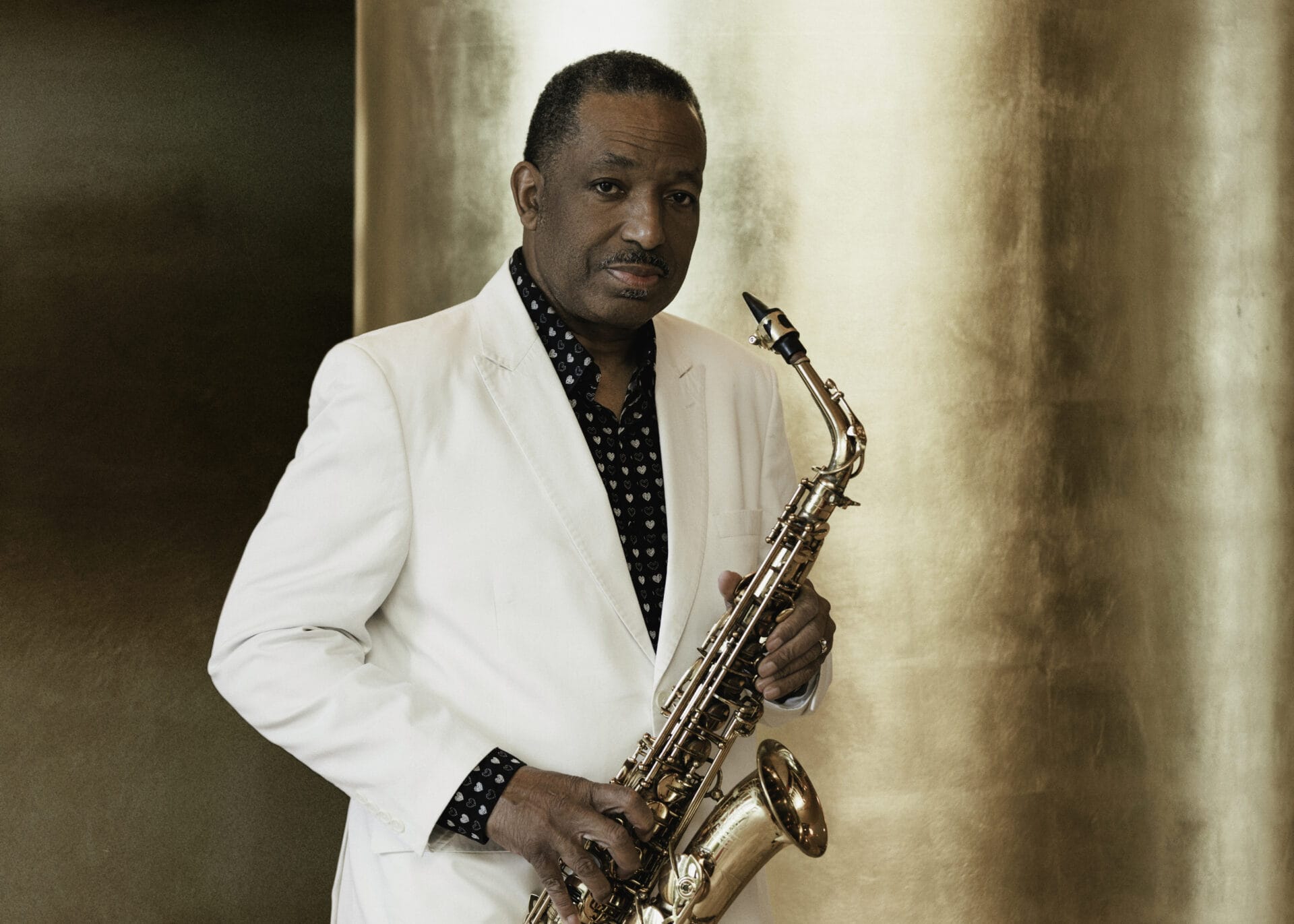
“I’m working with a quantum physicist on quantum improvisation,” Donald Harrison says of a concept that has long propelled his musical direction. “We were discussing Max Planck and how scientists say that if multiverses exist, each one has the same quantum elements, but they all function differently. That was a light switch for me because music has the same elements—it has a rhythm, it has melody, it has the feeling of the people that created it as a group, and most of it has a dance element.”
The NEA Jazz Master then adds, “My reaction to hearing that was thinking, ‘I guess all music is the same, it’s just different.’ An analogy I sometimes use when I talk to audiences is that if you take a chicken and you bring it to China or Jamaica or New York or New Orleans, when each of those areas cook that chicken, they’re going to do it their way. That’s what we’re doing with music. We’re just doing it our way and usually it speaks of the time and the experiences of the people who are creating it. The same elements are there from the beginning to now. Robert Johnson was using the same ones that I’m using, but I have all of these other things to draw from so I can create a different way of looking at it.”
Harrison has explored this idea in various forms throughout his career. When the 64-year-old musician was just 19, he wrote a song called “New York Second Line,” which merged traditional New Orleans second-line music with modern jazz. Harrison’s father Donald Harrison Sr. was Big Chief of the Guardians of the Flame Mardi Gras Indians, while Harrison later became Big Chief of the Congo Square Nation Afro New Orleans Cultural Group.
“New York Second Line” was the title track to the 1983 album he recorded with Terence Blanchard while they were members of Art Blakey’s Jazz Messengers. Harrison recalls, “Those bebop guys were the most open-minded musicians I ever saw. I remember I bought a synthesizer and Art Blakey said, ‘Please bring it to the band.’ I didn’t, but I should have listened to him. Later, when I did what they call a smooth-jazz soul record, I was afraid that the jazz world wouldn’t accept me for it. But I was talking to Art and he said, ‘You have to do it because you need to follow your talent to find out where it’s going to lead.’ That approach gave me the confidence to forge straight ahead to this day.”
In 2005, Harrison wrote, performed and produced the multi-volume 3D, which explored different genres across three discs, moving from smooth jazz and R&B to classical jazz and what he calls nouveau swing—a melding of modern jazz, hip-hop, funk and soul.
Last year, Ropeadope released The Art of Passion, a collection of three tracks in which Harrison and his collective took a single song and presented it as hard swing, then trap hip-hop jazz and, finally, trap-hop.
This concept now finds its apotheosis with the saxophonist’s new release The Magic Touch, in which he again uses a single composition as a jumping off point. He explains, “On this one, I wanted to explore more styles of music and bring more styles of music into a jazz style than I was doing before. I wanted to see if I could put all of these thoughts inside. So I did eight different genres, and then the nouveau swing version mixes those first eight genres into a new template for jazz music.”
“We’re going to do some more styles of music with that song,” Harrison indicates, affirming that he’ll continue to expand on the project. “I’ve already arranged a jamband version. We’re also going to do a classical version with a chamber group and we’re going to do an Afrobeat version, along with other styles of music that I love.”
He also mentions the possibility of performing multiple iterations of “The Magic Touch” at a live gig, noting, “We could play about six of the different versions now with my quartet, but we’d need more people to play the salsa version. I’d also like to get someone to run the hip-hop part of it. With about 15 people, we could present it.”
The conversation then turns to Jam Cruise, on which he appeared in February, guesting with numerous acts, including Galactic, Snarky Puppy, Dragon Smoke and Lettuce. “I was an artist-at-large and I was also able to see some of my friends with their bands, like Karl Denson. He noticed me and said, ‘Why don’t you come up and play?’ I told him I was listening and he said, ‘No, when I’m playing, you need to come up every time.’ The love and the comradery made for a beautiful experience, and the music is just off the chain.”
Harrison anticipates a similar vibe at the second-annual Quantum Leap Music Festival, which will return to the North Fork of Long Island on August 14-17, with a lineup that includes Dirty Dozen Brass Band, The Headhunters, Leo Nocentelli, Preservation Hall Legacy Band and New Orleans Klezmer All Stars. It will also feature a couple of Harrison’s projects, including one that is specific to the fest with Big Sam Williams, Will Bernard, Raymond Weber, Wil Blades and Nori Naraoka. Once again, he will work with event producer Bennet Lapidus and their goal is to “focus our format on dance music with connections to New Orleans.” As he explains, “The music ranges from funk to soul, jazz, traditional New Orleans, New Orleans tribal culture, jamband and brass band, with a smidgin of Klezmer, hip-hop and my nouveau swing. Each day is a different kind of musical journey.”
This manifests Harrison’s ongoing creative catalyst. As he notes, “When I was young, I wanted to play with all the masters because of Bird’s statement: ‘If you don’t live it, it won’t come out of your horn.’ When I read that in high school, it changed my idea of what music could be. I had been taught that there’s a boundary line to art, but there is none. So I went on a quest to learn from all the great masters of almost every style of music that you can imagine. I think that gives me an ease in understanding how to keep the essence of certain styles of music when I’m putting them together.”
Harrison then returns to the quantum mechanics of it all: “When I started working with my friend [theoretical physicist] Stephon Alexander, I got a revelation that there was an analogy between all of these different genres of music and Max Planck’s work. We know that the electron is everywhere at once, but when you observe it, then it’s at one point. So I was thinking, ‘OK, I have all this information in my mind, everything is inside of my head, but I’m choosing that this is where I’m going to be at this moment.’ I’m doing the same thing in my mind that an electron does.”