There were a lot of goodbyes at the 2026 edition of Hardly Strictly Bluegrass, including the bestowing of the inaugural Legacy Artist award to retiring Dry Branch Fire Squad founder Ron Thomason to open day three on the Banjo stage, the day two, Aaron Lee Tasjan-curated Todd Snider Rules! tribute set at Towers of Gold and covers galore in memory of the late Dolly Parton.
That Tasjan really loved Snider was beyond evident in his creation, which included a new take on the late songwriter’s “18 Minutes Speech,” amped up versions of “Beer Run” and “Just Like Old Times” and appearances from John Craigie, Tony Kamel, Elizabeth Cook and Steve Poltz, who planted a fat kiss on Tasjan as they jammed.


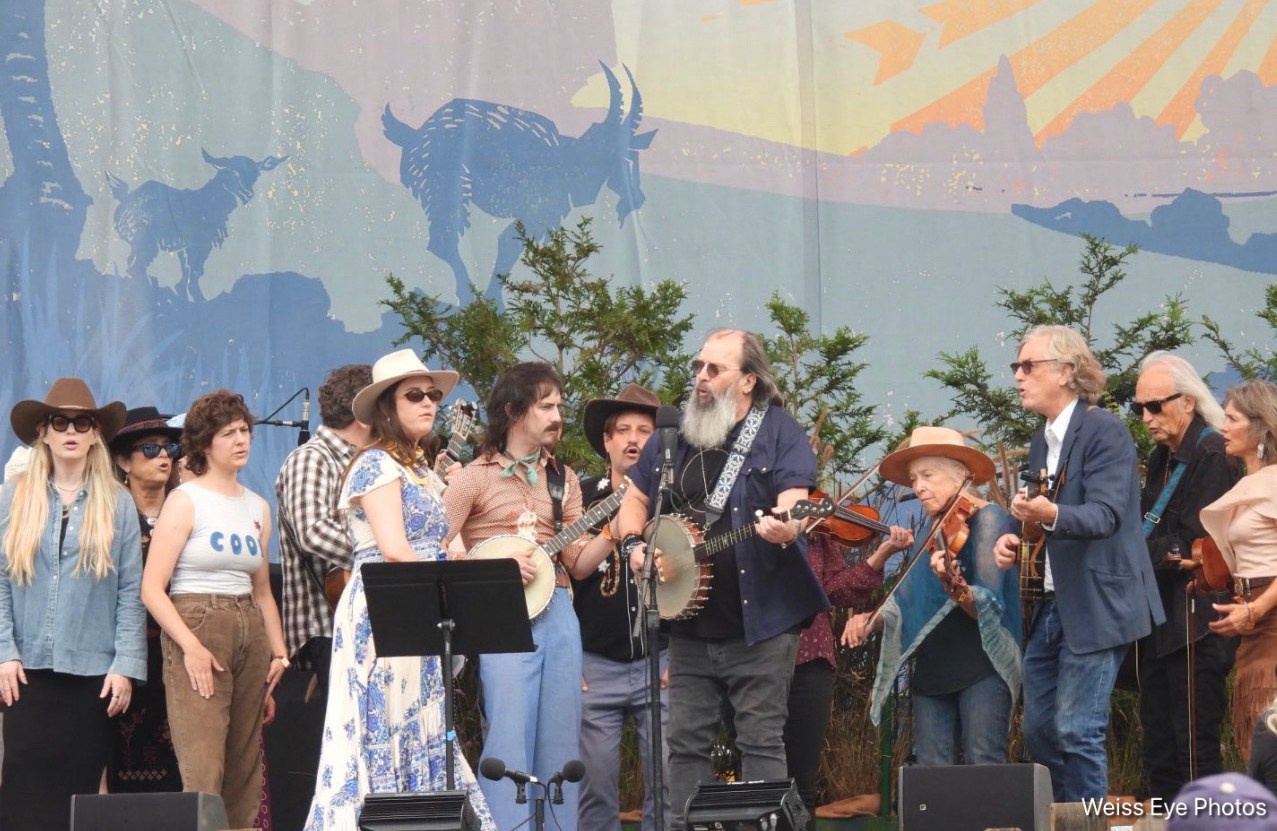
Snider would’ve said he didn’t deserve the honor. Snider totally deserved the honor. As did Thomason, who was feted by the Wronglers, Jimmie Dale Gilmore, Laurie Lewis, Steve Earle and others. And as the entire assemblage sung the final refrain of “Big Rock Candy Mountain” as “Hardly Strictly Bluegrass!” and Thomason walked off the Banjo stage for the final time, emotions bubbled to the surface.
As festival founder Warren Hellman’s daughter said to Thomason before the music commenced: “You’re going to leave a huge, mandolin-shaped hole in our heart.”
Amid all the melancholy was a ton of joy Oct. 2-4 in San Francisco’s Golden Gate Park, perhaps best encapsulated by the Crosby Collective’s Saturday-morning performance on the Swan stage. With a large band that included Miko Marks on vocals and Barry Sless on pedal steel, Jason Crosby’s ensemble made unworkable mashups workable. And so it happened that Marks wailed the words to Grateful Dead’s “Scarlet Begonias” while the band played Led Zeppelin’s “Black Dog” and Michael Jackson’s “Billie Jean” appeared in the form of the Doors’ “Riders on the Storm.”
It began Friday with Larry Campbell & Teresa Williams on Banjo, cooking up their Gumbo Americana for a 40-minute serving that ended with the pair’s hauntingly viscous version of “Keep Your Lamp Trimmed and Burning,” a song Hot Tuna, appearing as an acoustic quartet on Towers of Gold, reprised the following day during Jorma Kaukonen and Jack Casady’s homecoming.
As is tradition, Emmylou Harris closed the festival on Banjo. She said farewell to her Trio bandmate Parton with “To Daddy,” set “John the Baptist” to a Bill Monroe-inspired arrangement, led a charismatic gospel singalong on “Help Him Jesus” and joined three of her bandmates around a shared mic for an a cappella take on “Calling My Children Home.”
Between the bookends was an abundance of musical styles and selections ranging from intimate performances on Horseshoe Hill that included small-band vocal jazz from the Stella Heath Quartet, bluegrass from the I’m With Her-inspired trio Sweet Sally and acoustic-guitar instrumentals from Yasmin Williams and William Tyler to overflowing crowds for Los Lobos on Swan and Jesse Welles and Robert Plant and Saving Grace on Towers of Gold.
Buffeted with balky speaker towers in the field, Lobos nevertheless sizzled with a set of its most-aggressive material including “Shakin’, Shakin’ Shakes” and the Dead’s “Bertha.”
Welles half-electric (Black Sabbath’s “War Pigs”) and half-acoustic (“War Isn’t Murder”) set was so affecting, Plant mentioned it during Saving Grace’s folksy presentation that included songs from its debut LP and reworked Zep numbers, including “Ramble On,” “Four Sticks” and “Friends.”
They’d been bridged by the Record Company, who bludgeoned the Swan stage audience with Pat Travers-inspired, guitar-based rock during a set that included the Dead’s “New Speedway Boogie” and the Kinks’ “All Day and All of the Night” sprinkled among original material.
Saving Grace marked Plant’s second appearance. He’d previously walked on unannounced during Buddy Miller’s Saturday gig on the Rooster to play harp and sing such numbers as the gritty “Satan Your Kingdom Must Come Down” with Marks, Cook and Victoria Wolf and the more down- (or up)-to-Earth “Angel Dance,” in a shimmering nod to the aforementioned Lobos. This followed Harris’ surprise appearance to sing a tender duet of “Love Hurts” into a mic shared with Miller.
But speaking of Marks and Cook, they each turned in incredible sets of their own. Cook, who’d previously sung “Play a Train Song” during Todd Snider Rules!, turned her country music toward rock ‘n’ roll Saturday on the Rooster, and the hyper-energetic Marks slayed the Banjo stage on Sunday - “We’re having us some church right now,” she declared - with a heavy blues-and-soul display that included a funky take on Parton’s “I Will Always Love You.”
“It ain’t Whitney. It ain’t Dolly. It’s Miko,” she said. And it was.
And then there’s Mavis, as in Staples. At 87, she seems to have stopped aging somewhere around 70 and she and her band delivered an uplifting set of righteous material including “Respect Yourself,” “Freedom Highway,” “Beautiful Strangers” and “Work to Do.”
“We don’t need no dictators. We don’t need no king,” Staples said to an outpouring of adulation from the throng gathered at the Banjo stage. “We don’t need no men telling us women what to do with our bodies.”
After getting his folkie on with “I Can’t Complain” during the Snider tribute, Craige went all in with rock ‘n’ roll on the Rooster with help from the Coffis Brothers. Suddenly, songs like “I Wrote Mr. Tambourine Man” and “Judas” were for head banging and it was cathartic. Anna Moss - who’d previously played an innovate set on the Arrow stage backed by trombone, percussion and four singers - joined Craigie to reprise her guest appeared on the studio version of “Fire Season,” in another only-at-a-festival moment.
That covers the Hardly and the Strictly. Now, here comes the Bluegrass.
Laurie Lewis & the Right Hands transformed Banjo into a front porch midday Saturday while promoting their recent release with “O California!,” celebrating Hazel Dickens on “Cowboy Jim” and eulogizing Parton with “Little Sparrow” and “Put it off Until Tomorrow.” Later that afternoon on the same stage, Gillian Welch and David Rawlings struggled to be heard over a talkative, overflow audience that rendered numbers such as “Cumberland Gap” little more than aural wisps.
Molly Tuttle inserted pop into the ’grass at Banjo with a band that included keyboards and drums on covers like the Stones’ “She’s a Rainbow” and Joni Mitchell’s “Big Yellow Taxi” with a 21-century flair. She also provided an HSB highlight, dieting with her father, Jack, on “San Francisco Blues.”
Sierra Hull also had drums for her set in Swan. But there was no pop involved. Given only 45 minutes, Hull and company nevertheless spanned her discography with the hopeful “Boom,” the mournful “How Long” and pieces from their bluegrass concerto, the Movements.
The bluegrassiest of them all was the Darrell Scott String Band - namesake guitarist, fiddler Shad Cobb, bassist Bryn Davies, Matt Flinner on banjo and mandolin and Dobro player Rob Ikes - on the Rooster. They welcomed early arrivals with a soundcheck of Joni Mitchell’s “Urge for Going” and then began their set 10 minutes early. They, too, marked Parton’s recent death with “In the Good Old Days (When Times Were Bad),” with Ikes adding melancholy and Scott’s big guitar sounds matching his big voice.
The DSSB is like bluegrass on steroids, whether spitting fire on Ikes’ instrumental “The 33 String Band” or Scott’s bitter and much-covered “You’ll Never Leave Harlan Alive” or Paul Simon’s “American Tune.”
This is just what we were able to see and hear with so much happening simultaneously. Indeed, when it comes to music, Hardly Strictly Bluegrass is entirely, strictly unbeatable.
***