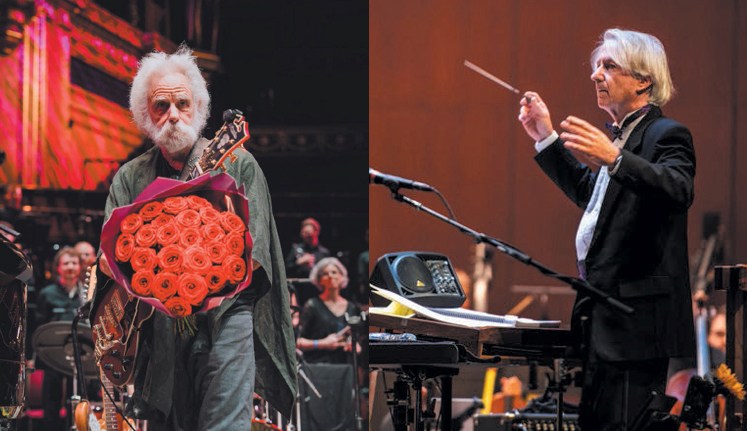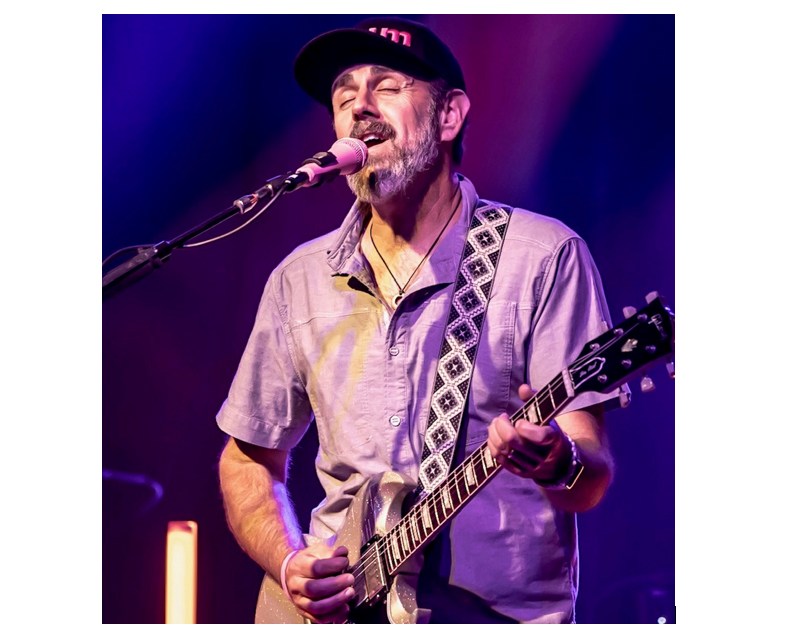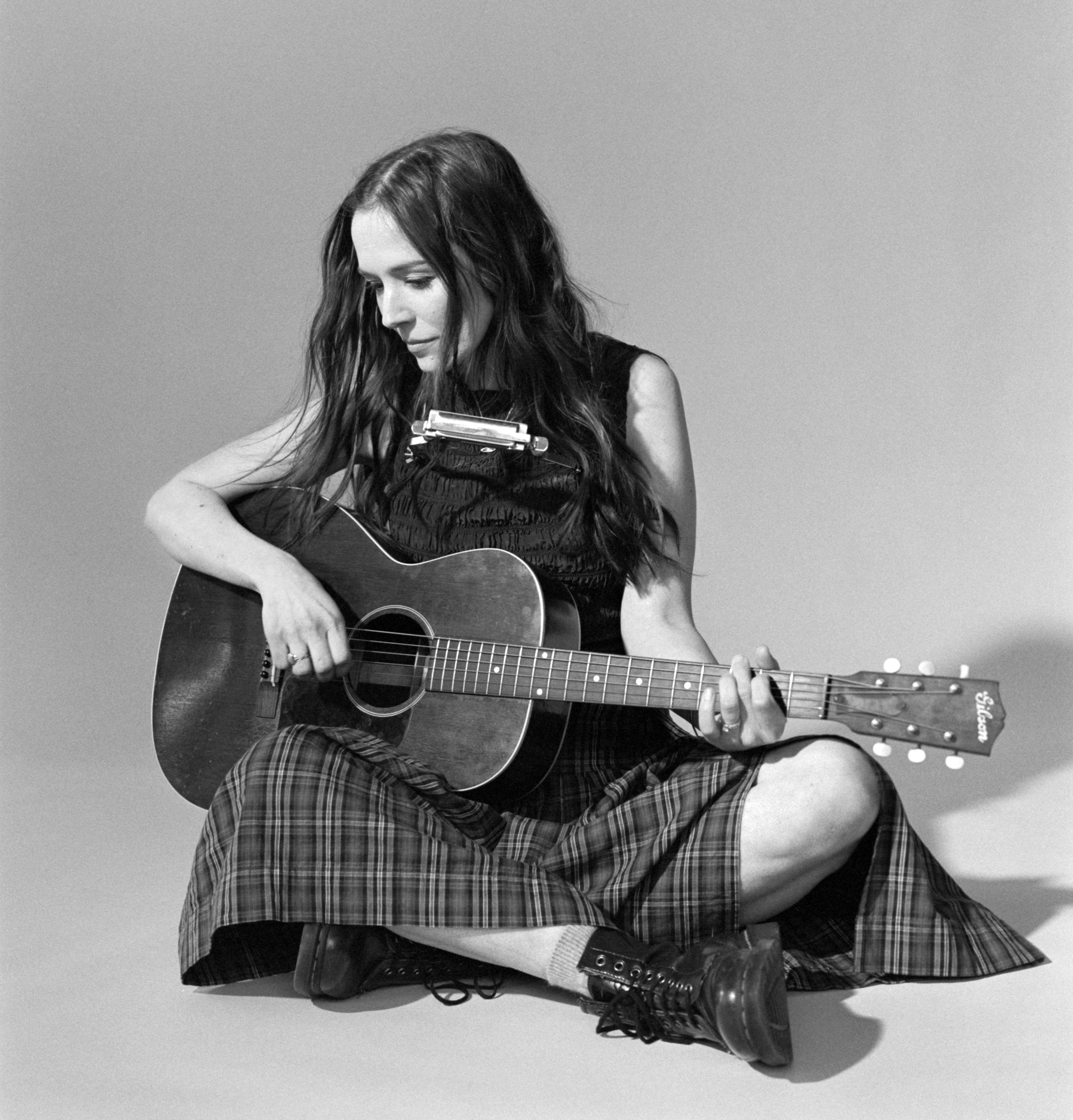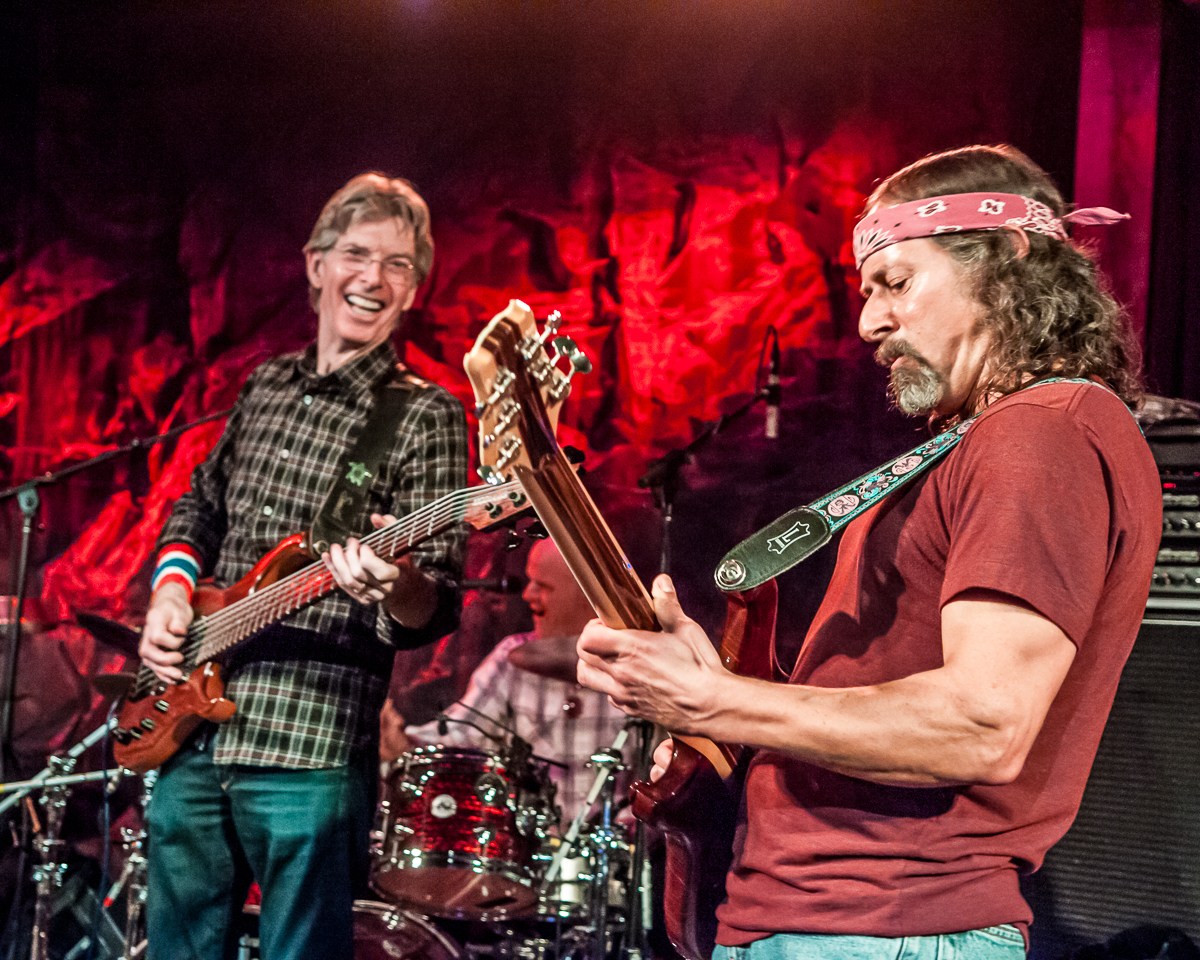
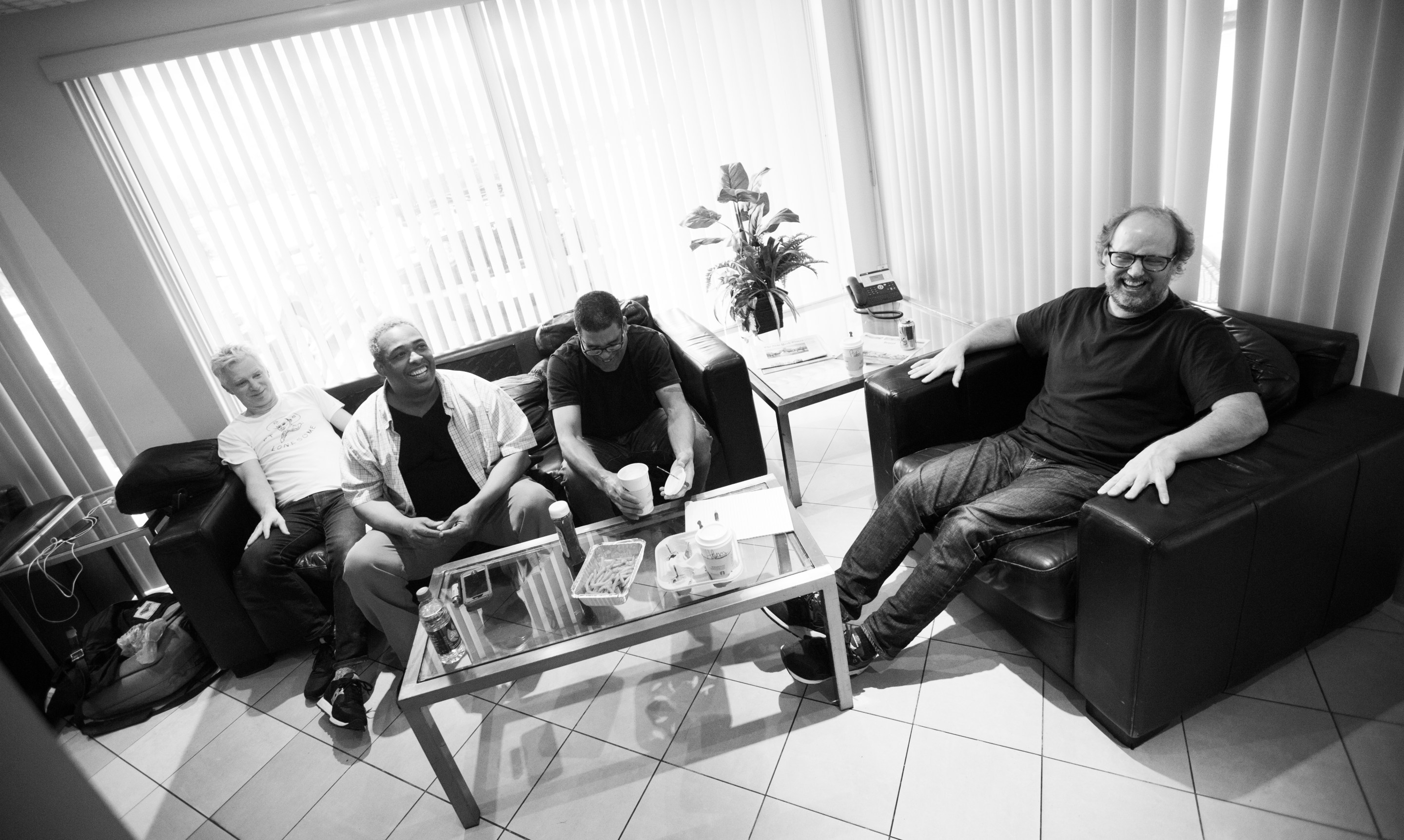
Vida Blue today: Adam Zimmon, Russell Batiste Jr., Oteil Burbridge, Page McConnell (l-r) (photo by René Huemer)
This article originally appears as the cover story in the September 2019 issue of Relix. Use code VIDABLUE here before Sept. 21 and get $5 off all subscriptions!
After a 15-year hiatus, Page McConnell returns to the studio and the stage with his Vida Blue project, alongside Oteil Burbridge, Russell Batiste Jr. and Adam Zimmon.
“Even though it had been nearly 15 years, I never really thought it was over,” Page McConnell says of his recent decision to reconvene the electro-funk project Vida Blue, which hadn’t performed since the third Bonnaroo Music & Arts Festival in 2004. “I do a lot of work in my studio, not for anything in particular, just because I like doing it. Then, at one point, I realized that I had a handful of songs that the band would be a great vehicle for—or, perhaps, the songs would be a great vehicle for the band. So I reached out to Oteil and Russell to see if they wanted to do it.”
McConnell initially assembled Vida Blue in 2001 after attending two nights of live music in Manhattan—first seeing drummer Russell Batiste Jr. with the funky Meters at Irving Plaza, then watching bassist Oteil Burbridge with the Allman Brothers Band at the Beacon Theatre. McConnell envisioned the adroit tandem as the ideal rhythm section to support his exploration of synthesizer sounds. He had never quite pursued this interest with Phish—who were then in the midst of a 26-month hiatus that began in October 2000—opting instead to focus on piano and organ.
Invigorated by a collective creative alchemy, Vida Blue released two studio albums and embarked on a few national tours in relatively short order before that final Bonnaroo gig.
Although the three musicians crossed paths on occasion over the intervening years, in the late fall of 2017, McConnell felt that the time might finally be right to revisit the project. As befits someone who wrote “Most Events Aren’t Planned,” the opening track on Vida Blue’s debut album, McConnell is understated and matter-of-fact while describing these developments. Batiste, by contrast, is anything but restrained.
“Oh, man, I practically fainted!” he exuberantly recalls. “I livefor the moment of kicking, playing live. And I had missed trying tomake people happy with that Vida Blue groove. There’s no otherband I’ve played in that has that sound. So when I heard from Page,it took all the wind out of me for a second.”
Burbridge’s reaction landed somewhere between his once-and-future bandmates: “When Page told me what he had in mind, I wasn’t that surprised at first. I thought, ‘Oh, cool, sweet.’ It wasn’t until we got together and he said, ‘You know, it’s been almost 15 years,’ that I was like, ‘What? No, say it isn’t so!’ I couldn’t believe that much time had passed. Of course, as soon as we started playing, all those years fell away.”
By the time Vida Blue arrived at Criteria Studios in Miami,they had expanded to a quartet with the addition of guitaristAdam Zimmon.
“I made the decision, at least 10 years ago, that if I ever got VidaBlue back together, I wanted Adam to be part of it,” McConnell says.“Adam’s a wonderful person, an incredible player, very tasteful andone of the nicest guys in the business. We’ve always gotten along.”
Zimmon first met McConnell after Vida Blue recorded their2003 sophomore album, The Illustrated Band, with the SpamAllstars, a Miami-based outfit that blends electronica, hip-hop andAfro-Cuban beats. Zimmon had missed those sessions because hewas touring in Shakira’s band but, by the time Vida Blue hit theroad for a series of gigs with the Spam Allstars in January 2004, theguitarist was back in the fold.
“I imagine the idea that I was working with Shakira and thenwith Page might make some heads explode because it doesn’t seemto make sense,” Zimmon observes with a laugh. “But, to me, thatShakira gig was a really good one because I got to see the world. TheSpam Allstars always operated as a collective, so whether or not Iwas there, they could still work. And, when I came off the road, Icould show up the next day and play. When Page first encounteredthe Spam Allstars, they didn’t have a guitar player with them. I owegratitude to Andrew [Yeomanson, who performs as DJ Le Spam],the guys and our manager, who said, ‘We have this other guy who’sone of the main members of the band.’ I don’t think Page intendedto have a guitar player. It was really a stroke of luck and then, wejust hit it off.”
In the days leading up the January 2018 recording sessions,McConnell extended eight additional invitations to evoke the totalspirit of the Vida Blue experience.
“That initial connection with the Spam Allstars was reallyspecial,” he affirms. “It certainly blossomed into something. Sincewe were recording in Miami, I thought of at least two songs thatcould really benefit from them. Criteria Studios has some giantspaces where all of us could set up comfortably and track togetherin one big room. Everyone had a blast.”
When McConnell reflects on the four days at Criteria thatsupplied the foundation for the third Vida Blue album, whichwill be released in September 2019 as Crossing Lines, the wordhe returns to is joy. “It was certainly fun the first time around,”he notes. “But the thing that sticks out to me about this recordingsession is there was so much laughter, so much positivity and somuch joy.”
Burbridge affirms, “Page is such a sweet person. Me and himand Russell had such good times, and that has not changed one bit.The amount of laughing that we do together is just stupendous.As soon as we got back together, a lot of the old inside jokes werecoming out. There was lots and lots of laughter, which is the bestthing for a person. In a lot of ways, that hasn’t changed at all.”
However, the bass player also makes a point to contrast hiscurrent headspace with his frame of my mind during the group’sinitial go-round.
“I’m in the best spot I’ve been in my entire adult life, almost 180degrees from then,” Burbridge acknowledges. “At that point, I wasstarting to get out of a low point. The negativity knew it was on itsway out, and it was putting up a fight—a last-ditch effort. We wereslugging it out but the negativity was destined to go down. Now,I’ve been in a sweet spot for a while, and I think you can feel thaton the record.”
Batiste echoes this sentiment.
“It was a rough few years there, a rough few years,” he concedes.“But, right now, I’m really happy with my life and I hope itcontinues to get better. I’m in my zone where Jah put me on thisearth, where I’m supposed to be: playing that funk, making peoplehappy and making myself happy.”
However, even as Burbridge relates his prior struggles, he is quick to point out that Vida Blue’s sound never suffered duringthose early days.
“We always made good music, no matter what,” he says. “Youuse whatever’s in your life—light or dark—as fuel when you’replaying. Plus, as much as I was really going through the negativestuff back then, we had a lot of laughter. And when you’re feelingthat good about the people that you’re playing with, you can’t helpbut have some really amazing moments come out, musically.”
Batiste adds, “We connected right away. We still touch oneanother when we play and there’s no other place to get that VidaBlue flavor. I’ve never heard anyone say this band sounds like this,and then start naming other bands. They can’t think of anybodyelse we sound like; we only sound like us.”
Vida Blue’s unique sonic amalgam is a product of the individual members’ creativity, commitment and command. Burbridge came up through the School of Hampton, playing with the late Col. Bruce in The Aquarium Rescue Unit for many years, before joining the Allman Brothers Band and, more recently, gaining new levelsof acclaim for his role in Dead & Company.
McConnell recalls, “I first met Oteil on one of my favoritenights of going to see music. We were just starting to tour downSouth with Phish. We’d never really played much down there andwe were doing gigs with Widespread Panic—they would come upNorth and open a few shows, and we would go down there andopen a few shows. We were in their hometown of Athens, Ga., andThe Aquarium Rescue Unit was playing right down the street ina little bar. It was a night off so we got to see Oteil, Jeff Sipe andBruce. It might have been the first night that Jimmy Herring playedwith The Aquarium Rescue Unit—there was another guy, Charlie[Williams], who was playing guitar, too. Matt Mundy wasn’t inthe band yet. There were only a few of us in the club, and I wasstanding in front of them watching them play, saying to myself: ‘Ican’t believe I’m seeing this band.’”
Batiste is another true force of nature—Zimmon describeshim as a tornado—who immersed himself in music at a very earlyage. His father, David Russell Batiste Sr., was a celebrated NewOrleans keyboardist, who joined The Meters after Art Neville leftto focus on The Neville Brothers. New Orleans journalist KeithSpera has written how “the young Russell would fall asleep on thesofa watching Meters drummer Zigaboo Modeliste practice in thefamily living room.”
In 1998, McConnell shared some studio time with Batiste, Art Neville, George Porter Jr., Bill Summers and Mike Gordon to record a song for the Get You a Healin’ album, which benefited the New Orleans Musicians’ Clinic, founded by Page’s father, Dr.Jack McConnell.
Burbridge—a former drummer himself, who has playedwith the likes of Sipe, Dennis Chambers, Mickey Hart, BillKreutzmann, Butch Trucks and Jaimoe over the years—raves,“Russell should be on the cover of every drum magazine. Thatcat is such a freak. He’ll mess with me, too. If I’m seeing himsomewhere in New Orleans and he spots me in the audience, he’llplay something blistering and then give me this look while I’vejust been decapitated. It’s ridiculous.”
Batiste chuckles at Burbridge’s observation and confirms, “Isaw him walking through the club while I was onstage one night.At that moment, I said to myself: ‘I’m gonna start chopping. I’mgoing to go off.’ I don’t like to take drum solos these days becauseI like to keep it in the pocket as much as I can. So while the bandwas playing, I did a couple of licks on the drum that were out of theordinary and got his attention real quickly. Then, I looked at himand nodded my head to let him know, ‘I’m still out here kicking,waiting for you. Come on and get some of this...’”
“He’s also an amazing piano player and composer; he can readand write music in all the different clefs,” Burbridge adds. “Iwalked in on one of his studio sessions, and he was playing andtalking to the band at the same time that they were playing. Hewas like, ‘Hold up there! E-flat! E-flat!’ One of the horn players wasplaying an E natural instead of an E-flat, and he caught it like aconductor while he was playing drums in the session.”
Zimmon’s relationship with McConnell flourished soon afterthey met and eventually extended beyond Vida Blue. WhenMcConnell began the recording sessions for his 2007 eponymoussolo album, the guitarist recalls, “I soon found myself in a Brooklynstudio with Mike Gordon, Jim Keltner and Page, which wassurprising and wonderful.” Zimmon also ended up as part of thegroup that toured in support of that record and later contributedto McConnell’s 2013 all-instrumental release, Unsung Cities andMovies Never Made. (He is currently a member of Ziggy Marley’stouring band and has put in stints with Colbie Caillat, GlenCampbell and Enrique Iglesias.)
Zimmon is particularly adept at lending texture and nuance,although McConnell points to his solo on “Maybe” from CrossingLines and declares, “I really love Adam’s playing on that. When wegot into the studio, I didn’t know it was going to turn into the jamit did. He killed it there at the end when he opened up and tookover for a few minutes. That’s one of my favorite tracks on thealbum.” It’s also noteworthy that Zimmon has joined McConnellon more recordings and stages than any other guitarist not namedTrey Anastasio.
Batiste offers his own testimonial for Vida Blue’s bandleader: “He’s one of a kind. He’s a keyboard player to be reckoned with and, when he cuts loose, I don’t think of anybody else. That’s thewhole purpose of expressing yourself musically: to be one of a kind,to leave something that everybody is going to remember when youleave this earth, so that they know what you’re about and they feelyou. I believe, with this record, he has accomplished that becausethis album is different from the first one—he wasn’t just comingout to jam and see how things were going to turn out. He had moreon his mind.”
McConnell returned home to Vermont energized by the sessions but a bit daunted by the task at hand. The band had reconnected just as he had hoped, despite the long, fallow period. However, he now had 15 songs to shape and sequence for the record.
The process had been somewhat different from the group’sinitial experience at Piety Street Recording in New Orleans. Batisterecalls, “On the first record, it was like a meet-and-greet sessionbecause I didn’t really know either one of them. Page walked in,plugged in his keyboard, played some sort of pattern and then Istarted to groove.”
McConnell contrasts this with the group’s latest effort: “Wedid a fair bit of recording and playing together from the end of2001 to 2004, and those guys really developed a rapport musicallyand got inside each other’s heads. So even though we hadn’t beentogether for a long period of a time, they’re both so talented, suchgreat technicians and so musical that they can do things that otherrhythm sections aren’t capable of. They really had developed astyle and, once we got into the studio, it all came right back.”
The keyboardist’s songwriting had progressed significantly over that stretch as well. The majority of the selections on Vida Blue are credited to both McConnell and Burbridge. By contrast, seven of the eight tunes on Crossing Lines are McConnell solo compositions, with Batiste contributing the final offering.
“I really didn’t start much songwriting until I was in my40s,” McConnell explains. “When we did A Picture of Nectar, Iwas studying jazz—or that had been more of a focus for me—so‘Magilla’ is a jazz-standard, rhythm-changes tune. That was in theearly ‘90s and I didn’t really write much after that, until the firstVida Blue album.”
McConnell dispersed Vida Blue in mid-2004. He now says thathe felt like a chapter had come to an end following the secondrecord and tour with the Spam Allstars. So he opted to put theproject on hold, also motivated by the opportunity to spend moretime at home with his young daughter. However, he continued tobuild on his songwriting experiences with the group, both throughhis two subsequent solo records and his increased productivitywith Phish.
“Writing lyrics was new to me. It’s not something I’ve been doing my whole life. It started with Vida Blue. Then, the first song with lyrics that I wrote and Phish recorded was ‘Army of One’ [which debuted in 2003]. So that’s a newer thing for me and, witheach attempt, I’m having a little more success, so I’m enjoying it.”
While some of the songs on Crossing Lines were drawn from hissteady accumulation of material, he composed “Analog Delay,” thepulsing opening track, specifically for Vida Blue in the month priorto the studio sessions. McConnell’s goal was to produce additionalsynth-driven material for the record.
The playful “Checking Out” then follows, which he reveals wasby design. “I probably front-loaded the album with stuff that feltupbeat. It was partly because I liked some of the tracks on the firstVida Blue album that felt that way, and partly because I liked theLatin influence and percussive fun stuff that the Spam Allstarsbrought to the second album. I also wanted to have an electronicfeel and a synthesizer feel, so I start the album that way.”
“Checking Out” came together through what McConnell jokingly refers to as a “backward process” that also yielded “Where Did It Go.” Both of these songs left Criteria Studios as instrumental tracks. However, six months later, McConnell decided that hewanted more songs with lyrics, so he spent some time with each ofthe tunes, fashioning words to complement the music.
On the other hand, “If I Told You” was already a completedsong that McConnell wrote for his wife during Phish’s secondbreak between 2004 and 2009. The band tracked it for 2009’s Joybut never completed the process because McConnell “didn’t feelit was quite how I imagined it. I really liked the demo, though,which is what ended up on the Party Time album we put out.Then, after I decided to put Vida Blue back together and realizedwe would be recording in Miami, it was one of the songs that I feltcould benefit from the Spam Allstars.”
McConnell named Crossing Lines after the album’s fourth track,“Phaidon.” The song evokes a mood closer to McConnell’s statelycomposition “Halfway to the Moon,” which appears on Phish’sFuego. It might not feel like a Vida Blue tune circa 2002, but thisgraceful offering is well supported by McConnell’s masterfulbandmates. The pacing and dynamics of the record along with itssequencing lend a richness to the listening experience.
As Batiste observes, “One song doesn’t sound like the next one;they’re different flavors. But the one thing they all have in commonis that Vida Blue groove.”
That groove resounds clearly on the drummer’s own composition,“Real Underground Soul Sound.” “The song is a tribute to ArtNeville and my dad, the two keyboard players I admire the mostin my life,” he discloses. “Nobody had that flavor like them. It’swritten to honor them and, since it was a keyboard song, I askedPage to check it out. It turned out he loved the groove, and I lovePage for giving me my props and allowing me to do this.”
Zimmon recalls that, while recording the tune, “Russellwas teaching it to us in real-time. That’s why you can hear himshouting throughout the whole thing because he’s throwing stuffat us—he’s saying, ‘Put that F-sharp on top, play that C chord likethis.’ He’s arranging the thing almost like Duke Ellington. He hasthe most sophisticated musical mind, harmonically—he’ll comeup with this incredibly dense, sophisticated stuff and he’s doing itwith a spirit that’s street.”
It’s a fitting track for an album that is, by turns, both playfuland palatial. Crossing Lines stands on its own as a recordedstatement but leaves plenty of room for Vida Blue to extend theconversation when the band takes the material on the road forthree dates in late September.
While those nights will offer their fair share of improvisedmoments, one can also reasonably predict that Batiste will becomeemotional along the way. On Dec. 31, 2001 at Roseland Ballroom,during Vida Blue’s second-ever gig, the band performed thedrummer’s original, “Russell’s Tune.” He recalls, “It was the firsttime I played a song of mine in front of so many people. It was abeautiful moment and one that I’m taking with me to my grave.I’m surprised I made it through the night after that because I wasjust so overwhelmed. I had tears in my eyes the whole song; Icouldn’t hold them back.”
He suggests that this may well reoccur when the banddebuts “Real Underground Soul Sound.” If this happens, henotes, “I have a device for that called a fog machine. Hopefully,I’ll have so much fog around me that no one will be able to tell ifI’m weeping.”
As for any conjecture regarding the future of Vida Blue, McConnell divulges, “I wanted it to start small. I didn’t want to overwhelm myself with too many dates or too many sets, and just get it back up and running. I would like this to continue over the years and not be a one-and-done or three-and-done kind of thing. It’s such a fun band, with such great players. It’s a true honor for me to play with them.”
This article originally appears as the cover story in the September 2019 issue of Relix. For more features, interviews, album reviews and more, subscribe here.