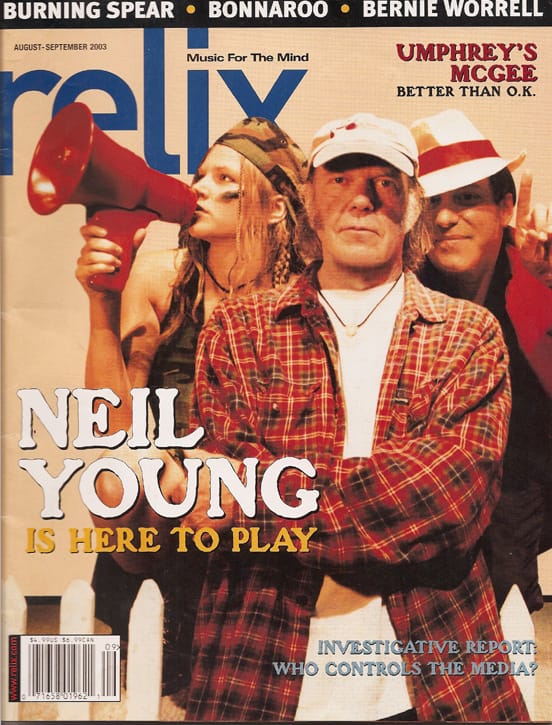
Here’s a look back at our August-September 2003 cover story, which ran following the release of Neil Young’s Greendale album.
**
He is a helpless pyromaniac in the face of his own creative fire. "It has a life of its own;' he says of his music, with a possessed look in his eye. He is a slave to his art. It controls him. It whispers in his ear while he sleeps, often waking him to a moment of inspiration. And he listens to that inner voice without hesitation, which is perhaps his greatest quality. He is defined by his indefinable nature. After more than three decades, he has yet to fade away and his passion for the muse continues to burn.
Tonight, Neil and his longtime band, Crazy Horse guitarist/keyboardist Frank "Poncho" Sampedro, bassist Billy Talbot and drummer Ralph Molina-captivated an attentive crowd at New York's Madison Square Garden. Just moments after a blistering five-song encore, which included anthems such as "Hey Hey, My My (Into the Black);' "Like a Hurricane" and "Powderfinger;' musicians and actors are celebrating with friends and family backstage. Almost three weeks into the Greendale tour, the consensus is that tonight was the best yet; ''A new level;' Young would later say. The post-show celebration spills out of the dressing rooms into a packed corridor decorated with vivid, framed photos of the venue's most famous performers. At the end of the hall, Neil emerges with a grin, eating a bowl of fruit salad and passing by images of Lennon, Elvis and Sinatra. Dressed casually in shorts and a T-shirt, he blends in with the crowd, although given his legendary body of work, he could just as easily be hanging on the wall.
He stops to pose for a picture with some eager fans, and a record label rep asks if she should hold his dessert. "No;' he says with a hint of sarcasm, "they'll find out I eat." A crowd of meet-and-greeters begins to surround him and rave about his new material. "Yeah, people like it because it's not just a rehash;' he tells them.
Greendale is Young's latest project, a theatrical production comprised of ten songs that will appear on his new CD of the same title. (It is also the soundtrack to a forthcoming DVD.) This is the first time he's performed an entire album of unreleased material onstage since 1975's Tonight's the Night. "That was a performance that, in its own way, was like
Greendale in that it's like one song, the whole show. It told a story." While the depressing, drunken tone of Tonight's the Night was Young's way of mourning the loss of roadie Bruce Berry and original Crazy Horse guitarist Danny Whitten- both from heroin overdoses—Greendale is his quirky social commentary on corporate greed, media voyeurism and "saving mother earth."
Many are referring to Greendale as a concept album, although none of it was preconceived. The story just unfolded one song at a time in Neil's head and he simply followed along. "It was like watching a soap opera or something," he quips nonchalantly. "I was just as surprised by what happened as anyone else."
"Everyday we'd come in and say, 'Well, what happened to Lenore?' or 'What happened to Jed?' says Larry Johnson, producer of the live version of Greendale and co-producer of the DVD and album. "Then there'd be this song and we'd go, 'Oh yeah: But we're still trying to figure it all out:'
Young changed all of his routines during the making of the album in order to get into a "new headspace." He stopped exercising. He hired fewer studio engineers. He even downsized the band, eliminating Poncho's rhythm guitar in order to achieve a sparser sound. For the tour, Sampedro plays keyboards during the Greendale set. "I wasn't too happy about it at first;' he says, "but then when I got home and heard the CD, I heard all the little nuances. I got a better concept of what Neil wanted me to do with the keyboards and I tried to get a hypnotic drone going through most of the songs." When asked for an explanation of the plot, Poncho laughs. "I still don't know what 'Powderfinger' is about."
Much of the album is the Neil Young equivalent of rap; not in tone, but in functionality. The music serves as a repetitive backdrop to the story, often times lacking any changes at all-no chorus, no bridge, no solo. There are exceptions however, such as the lone acoustic track, "Bandit;' which is as gorgeous and timeless as anything on After the Goldrush. The driving pulse of "Be the Rain" and the gentle hippie aesthetic of "Falling from the Above" are also standouts.
The DVD, which is due out later this summer, was directed, shot and edited by Neil under his alias Bernard Shakey. It's an apt moniker given the herky-jerky quality of the film. "He had a vision for this;' says manager Elliot Roberts. "He's not going for 'What's the best film we can make of Greendale; but what's the best film Neil can make using his own hands so that it's one unified work with the record, rather than just an idea that a lot of people collaborate on. That's how Neil likes to work: no barriers, no restrictions, under the guise of the muse:'
The concert version of Greendale features primitive video projection and amateur-looking stage props: a town jail, a rickety old house and two-dimensional cars. It looks intentionally low budget, as the whole story occurs in a high school play, portions of which take place in a dream. This, of course, allows for plenty of artistic freedom (though it's not like Neil has ever needed a license for that). The characters [see sidebar] lip-sync the lyrics that Young sings, a practice that is also purposely loose. "I just sing whatever I wanna sing;' states Neil. "We told all of the [actors], 'It doesn't matter if you're right on or not.' Who cares? Everybody knows that I'm singing and they're lipsyncing. I don't ever wanna feel like it has to be locked. This thing was born of the music and it should be agile enough to go wherever the music goes right there live."
The tour has garnered mixed reviews among certain fans. Some complain about high ticket prices and the fact that the two-hour production of Greendale has not been advertised. Fans paying top dollar to hear classics like "Heart of Gold" or "Down by the River" get restless sitting through ten brand new songs. "He's a greedy bastard. Where's my 'Cinnamon Girl'!?" one drunk hollered in the bathroom at MSG. Years from now, that same drunk will be screaming for "Be the Rain:' But none of that matters to Neil, who turns 58 in November. His peers in Crosby, Stills & Nash may be largely content with giving fans the greatest hits from yesteryear, but Young is more concerned about creating something fresh, regardless of expectations. Pleasing himself is the priority, as has always been the case, and ultimately that's what keeps Neil young.
***
Well, here's your opportunity to use the media.
NEIL YOUNG: Hey, everybody should get a shot.
So, aside from the encores, you're playing the same set every night on this tour. For someone who thrives on constant change, what nuances do you look for to stay challenged?
The groove is number one. If the groove is good, then we're just playing. If the groove is frantic, then we're performing and we like to stay away from the performance and just play. That's what this music is looking for, to be played-not overdone. If I get to that point where the band and I are all in one big space and I can forget about the entire stage show and just see the pictures in my head while I'm singing the song, that's always when the groove is good. A disturbance in the groove is like a disturbance in the force, and if I lose it and see something going on, then I have to refocus. And who knows what I've lost? There's a chain of communication that gets broken every time that happens.
Then why have all the people running around onstage and the projected images to distract you?
Well, they're not there to distract me; they're there to present the story. The thing is, how good am I at being focused at my music, which is the core of the whole thing? How much can I put together, knowing what all this stuff is, choosing all the people and putting the words in their mouths and getting the art created that supports it? Having done that, the challenge now is to return to what brought it all about in the first place, which is the music, and just let it live. It's got its own life.
Some fans have been disappointed because they're not getting your greatest hits show.
Greendale is two hours of brand new material. I knew people were not going to be ready for Greendale because they hadn't heard of it and they knew nothing about it unless they've been watching my website. It doesn't have to do with the crowd getting what they want. It has to do with the music. That's what it's all about. If people really know who I am, they like me because of the music. They don't like me because I'm a celebrity or because I have some political view or because I've been around for a real long time and was part of something they related to years and years ago. If they're looking at me like that then they may be disappointed by this, but if they're looking at me like a musician and as a writer, then this is exactly what they'd hope would happen.
At one point in the production, there's a Clear Channel billboard that reads, "Support Our War." Clear Channel is also promoting your tour. Some find the juxtaposition ironic and some seem confused by the message.
Clear Channel is an interesting subject. I like to give people a chance to reflect on that. The reaction to the billboard is amazing. They were pretty quiet about it last night. Some places, it's deafening. It's amazing how different it is. Sometimes you can't tell whether everybody feels the same way about it or not, like if some people feel positive about Clear Channel or some people feel negative. I can't tell. The sound they're making is like an indescribable sound. It's like conflict. And that gives everyone a chance to express themselves without me having to. You know, I've got a bully pulpit if I wanna use it, but I don't wanna use it.
So you're not taking a stance either way?
Clear Channel is something that exists. It's an important corporation or whatever you want to call it, because it has purchased all of these guys that I work with-everybody: the venues, the promoters, they've all been purchased by Clear Channel. They're the same people that I dealt with before, but it's an invisible difference.
Let's talk about the story of Greendale. You've said you didn't have any control over it and it just flowed out of you. Can you take us back to the first song that spawned the story?
I think "Devil's Sidewalk" was the first one that I realized, but I didn't know what it was. I wrote it and went, "What is this?" Things started filling in after that. There was another one that came along with it "I Don't Wanna Be Sorry;' and we didn't use that one. It was like a transition between when I worked with Booker T. & the MG's and this, but it was written at the same time as "Devil's Sidewalk:' After that, there was "Fallin' From Above;' which is the one that has the chorus about "love and affection." But at the same time, I had been singing this kind of blues riff thing based on Jimmy Reed and some extra changes that I had and a J.J. Cale kind of melody. Then I started writing words for that, which was the "Double E." At that point it was time to start recording. I realized that characters were starting to come out and they were being introduced in the songs. From that moment on, there was just no stopping.
Is it rare that you get that inspired and the songs come all at once?
You definitely have to recognize it and be open to it. That's the art of creation I think, knowing when you're plugged into the source. And when you're open to that, then you just gotta do what you do, whatever it is. Don't think about it and don't judge it. Just be surprised by it and don't try to change it. That's what I try to do.
It's interesting when I think back on it because it all happened so fast and I look at it like an opportunity to play a bunch of new songs for people and have them not coming just to enjoy their relationship with me. It's about being a musician. It's about presenting music and who I am has made it so the crowd is so big, but it wouldn't matter if it was 300 people. It would be just as good to be able to just present the music and go out and play ten new songs for an hour-and-a-half and leave. That's what I used to do. When I first came along, people didn't know who I was and I was doing "Cowgirl in the Sand" and "Everybody Knows This is Nowhere" and "Cinnamon Girl" and all of those songs. We'd come out and play maybe a 60-minute set with nothing from Buffalo Springfield.
And would people be yelling for Buffalo Springfield songs?
Well you know, they were just looking at us. It was so new and different and not such a big deal. People didn't yell out for songs as much in the old days. They came to hear what was going on. They weren't reliving it—they were living—and that's what's happened to concerts. They've become celebrations of life and the past, and in some cases, the now.
You talked about inspiration as being "plugged into the source." Then you mentioned those three classic songs. Weren't a couple of those written when you were bedridden with a temperature of 103.
Oh yeah.
That seems like a bizarre time to be so inspired.
It was spooky.
Have there been any other times that songs have just come to you when you least expected it?
It happens, but it doesn't happen for such a long duration. It happens in independent ways. Writing is obviously a very personal experience. I don't know. It's hard to answer that. You might have to ask me that a different way.
Okay.
Maybe you'll trigger something.
The character of Earl Green keeps painting because if he stops painting he starts to think and painting is better than thinking. Is there a little bit of you in there?
I think so. Yeah, you could say that.
You feel more comfortable expressing yourself through music than through conversation?
Well, I know what I'm doing with music. I feel familiar, so that's comforting. I like being with my family and I like playing music.
So do you identify most with the character of Earl Green or with Grandpa, or is it a little bit of both?
Well you know, they're both there. Grandpa's kind of “a narc-y old buzzard” as someone called me very recently in some review of the acoustic shows in Europe.
A narc-y old buzzard?
A narc-y old buzzard, which is like, you know, kind of cantankerous. So, during these interviews I'm trying to be as nice as I can be. [laughs loudly]
Don't pull any punches for me.
No, I'm doing it more for me than anyone else [laughs]. It's all the same information anyway.
Well, if you have any new information, feel free to divulge it.
Hey, if anything comes up, you'll be the first to know.
So, you were talking about Grandpa, and he dies in the story of Greendale. Or am I not supposed to ruin that part of the plot?
No, it doesn't matter.
So, Grandpa dies. And I heard that you were very sad when Grandpa died.
Well, we were all kind of down about it in the studio. As we were going along, we developed these characters that showed up in the songs. So every day when I'd come over, the characters would be there in the songs and Grandpa was one of our favorites and he kept coming back with expressions. Almost everything that he said I found very interesting, the point of view of his dialogue. So we began to think a lot about him. That's how we got into all these characters and that's how Grandpa seemed to be such a cool guy and such a funny guy.
But it was your decision to kill Grandpa.
You know, I'd write one song and then we'd record it and then when that was all done I could wake up the next day and there were usually just a couple more chords in my head. I just lived it, you know? And no one knew what was next and I didn't know what was next. It was kind of like The Sopranos or something. It was all stuck together and kept unraveling. I'd usually just pick my guitar up and play and whatever came out first would be the key, and if there were more than one chord, those would be the chords and whatever the rhythm was, that would be the rhythm and I'd just repeat it over and over again.
Do you consider yourself a perfectionist?
In some ways. I'm a little bit obsessed with some things. I like to capture the moment. To me it's much more important to capture the essence of the song and the feeling of the words in the moment than it is to make a finished-sounding record. Finished-sounding records are like cars. Okay, they're so many of them and you can buy any kind you want. But, something that's a moment in time, that's what I try to capture. I'm a perfectionist in that way. People might listen to my records and go, "Oh, what a piece of shit, he didn't even try to fix that," or "He didn't care" or "It's just a toss off," you know? It's just all point of view.
You quote a couple pretty legendary artists in Greendale. The first is John Lennon: "One thing I can tell you is you got to be free." You're a pretty prolific lyricist yourself. Why did you choose to quote Lennon?
Well, it's not me. I'm the character. The character in the song was quoting John Lennon.
But you created the character...
He could have just as easily quoted me.
That would have been a trip.
Yeah, exactly. That's why I can have all of the different points of view. I'm not limited to being Neil Young with Greendale. There's nothing about Neil Young specifically. I can step back. I can take off that coat and let the characters come out.
I assume Sun Green is loosely based on your daughter?
Sun is actually one of my daughter's classmates, but you know, it's my daughter and all her friends. It's just fresh. There's idealism and all of that. And all the problems that are talked about and the headiness of the politics and all the shit that's going on in the first part of [Greendale] all leads up to, "Thank God there's a new generation that hasn't been completely just hammered. Here they are and what are they gonna do?" That's what's so beautiful about it.
There really is a triumphant moment at the end, during "Be the Rain." It seems like one of a few songs that could stand alone on future setlists, separate from the Greendale story.
I think "Be The Rain" has that quality to it. I don't think about that aspect of it too much. How it lives by itself is going to be another matter. I can't control that. When it goes out there, who knows?
It seemed to go over pretty well at Bonnaroo. You gave all the kids classic Neil and then that was the one song...
I gave 'em one that they hadn't heard before and gave 'em something to let 'em know I was on their side, hopefully. They reacted nicely to it.
l know you were only there briefly, but what was your impression of Bonnaroo?
It was like a two-and-a-half hour haze and it was a really good experience. I love playing for crowds like that and I love jamming. There's a spirited freedom at Bonnaroo that encourages those kinds of things to happen and in Crazy Horse we like that. We also like sonic exploration, which we were able to do there in a very kind of endearing environment.
You headlined the event, which is primarily a jamband festival. A lot of those bands write complex jazz and classically-based compositions. You're sort of at the opposite end of the musical spectrum, yet you create the same amount of energy.
Well, we're all doing the same thing only we're doing it in radically different approaches. There's so much to music. There are so many places to go and it can all be played with a feeling. I think Phish does that. They are very good musicians. They're really great and they're not afraid to be light.
They don't have to be heavy to be cool. They can be heavy, but they don't have to be. It's almost like they can walk hard, but they can jump high. They got two things going on. Then you take a band like Sonic Youth-now that's some brilliant music right there. But there's none of the arrangement and knowledge-or demonstration of knowledge-of intricacy and technicality that Phish has. They got a lot going on, that band. People sometimes compare them to the [Grateful] Dead in some way. They're so different. There's the whole idea of music as life and sharing the life of music with others and letting it develop in waves. That is common to all jambands. Some of them are better at managing it than others, but they all want to be there.
The inspiration for improvisation, can you put it into words? Col. Bruce Hampton once called it "vomiting," because you have no control of your body and it just flows through you. Do you have an analogy like that?
[Laughs.] Well, I never heard it put that way, but there is something to be said for that. I think ... I don't think. That's when I play. That's it. There's a point you get to: the less you think, the more you play. The less you know what you're doing, the easier it is to go to new places. You just have to surrender. It's the muse. That's the whole art of playing. It has nothing to do with notes.
Well, in "Cinnamon Girl" you play a one-note solo which is regarded as one of the greatest solos of all time.
Yeah, well there are a lot of different ways to play one note. I mean, I know a few notes. I don't know nearly the amount of notes that Trey knows, okay. I don't know nearly the amount of notes that Jimi [Hendrix] knew and I certainly don't have the touch of Jimmy Reed or J.J. Cale. But that doesn't matter. What matters is if I can just get in touch with the music and whatever music I love in my life is gonna come through me and everything else is all gonna be there. Just let it completely come into your body and take over. Let it go. If you're lucky, you'll stay for a while.