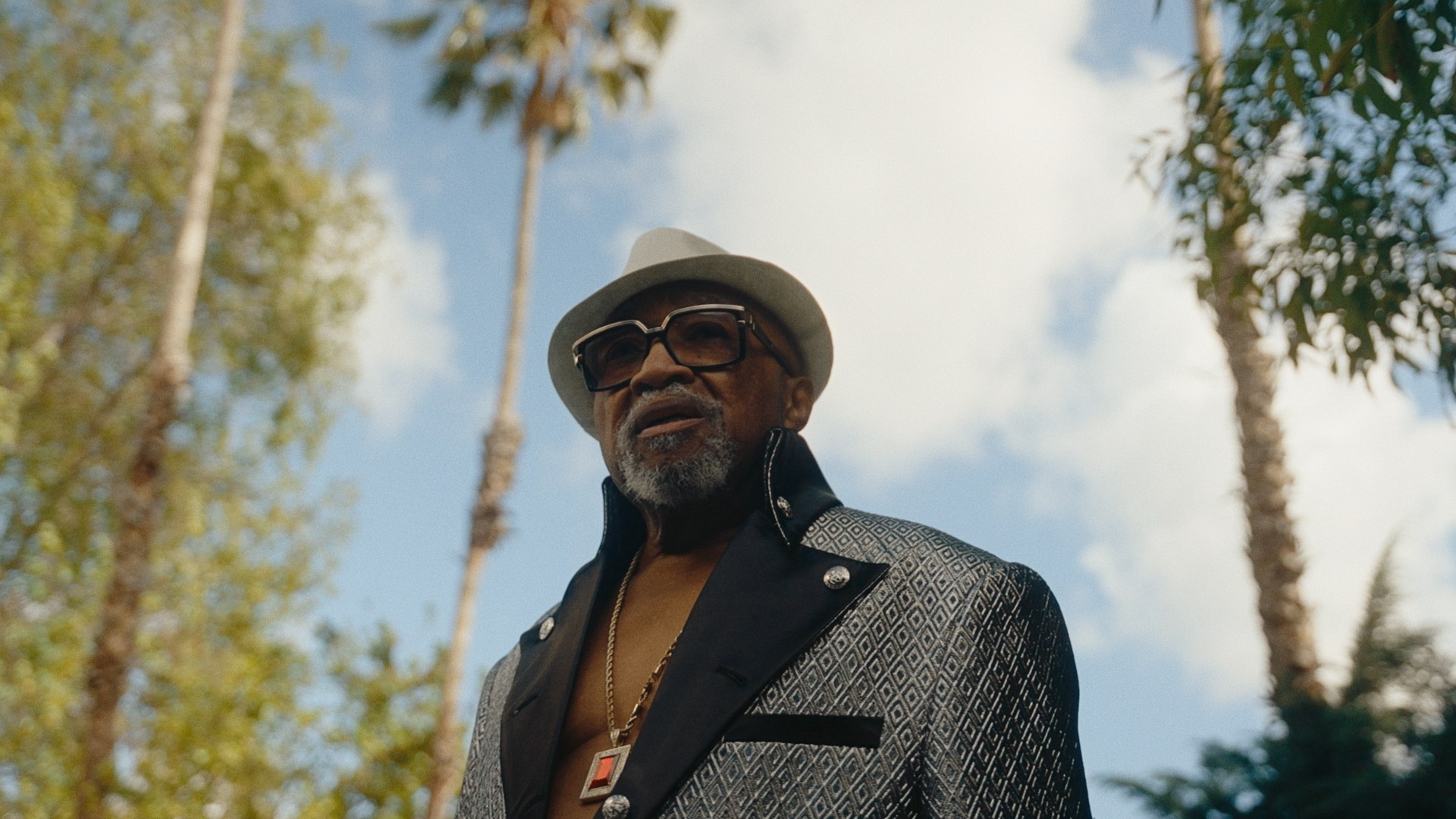
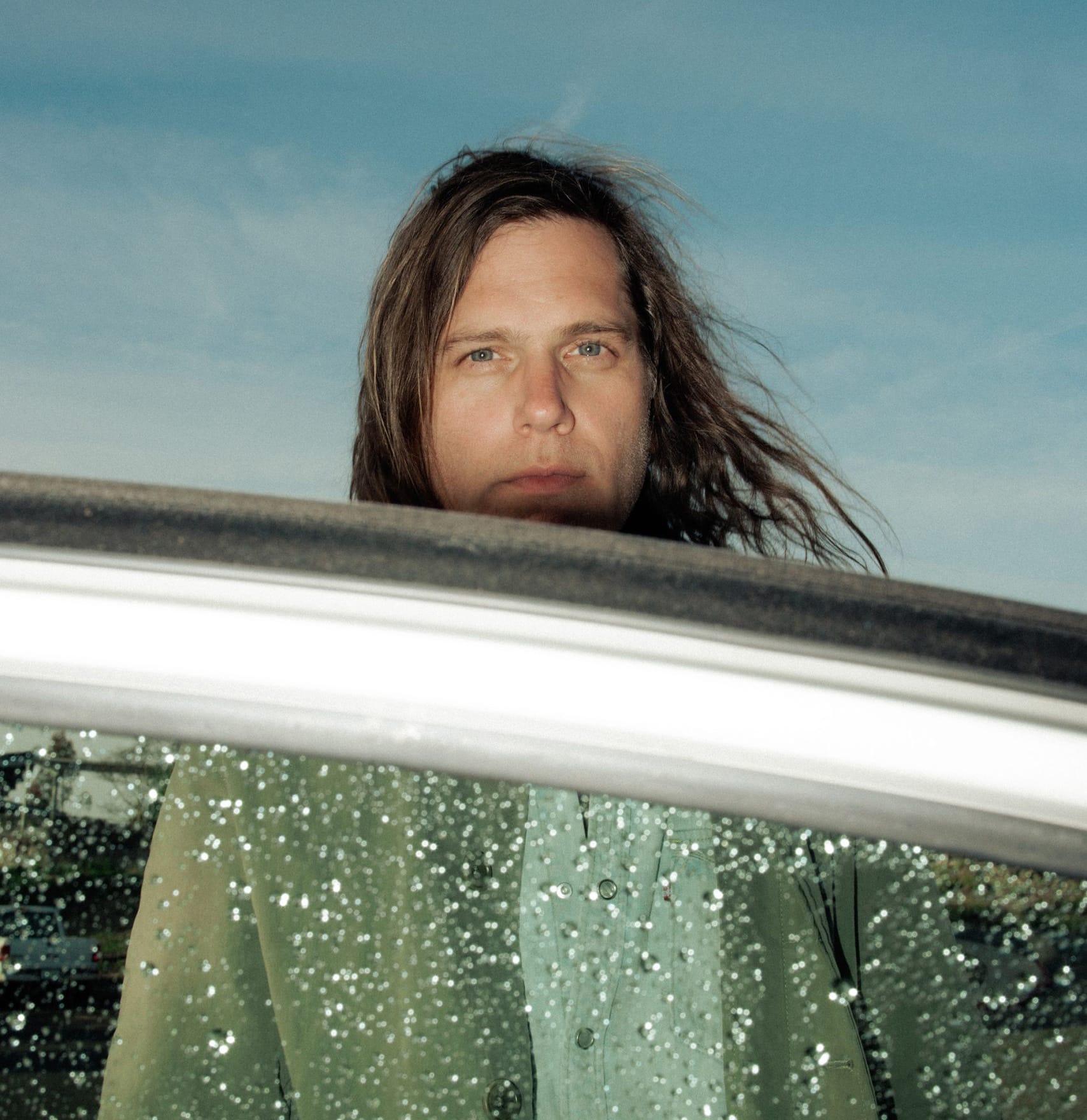
photo: Chantal Anderson
**
“Some are drawn to horizons/
Some are drawn to the sea/
And yeah, some find themselves family/
Some find inner peace/
But when it comes to figuring that all out/
I’ve had enough.”
– “Two Thousand Four,” Fruit Bats
As of spring 2026, Eric D. Johnson will have spent exactly half of his life releasing music as Fruit Bats. Twenty-five years will have passed since the project’s debut album, and the man behind it will turn 50. Just before these auspicious anniversaries, Johnson has birthed Baby Man into the world—his 10th Fruit Bats album and maybe the purest distillation of what has long made him such a beloved figure in the often overlapping universes of folk and indie-rock. And it’s filled with songs that echo between the chambers of your heart and a voice that could stop you in your tracks.
Indeed, Baby Man is just that—a sparse, stripped-down collection of goosebump worthy songs recorded completely solo. Intimate is the most obvious word for it, but Baby Man isn’t a For Emma, Forever Ago-type invitation inside a broken heart. The best description of Johnson’s latest is immediate. These 10 selections—consisting of either voice and guitar or voice and piano—were mostly written the night before they were recorded, during a streak of insomnia that struck Johnson last winter. They’re a straight-shot, unfiltered strike into the here-and-now consciousness of one of folk-rock’s most prolific artists.
What will you hear in the immediate present of Baby Man? You’ll hear raw, real late-night thoughts, scribbled down after dark and recorded in the light—captured in the studio as if he’s singing just to you. You’ll hear a man who loves his dying dog, the closest he’s come to being a dad—a man pondering what he’ll leave behind after he dies, a man who recognizes, self-aware, that his fans might do a double take when they realize there are no drums, or even a remotely danceable song, on this album. And you’ll hear a man who isn’t trying to figure it all out anymore and knows this weird, wild adventure of life could’ve led him in so many other directions.
As Johnson sings on “Puddle Jumper,” he’s “not preoccupied with dyin’ or age” or “even scared of the old blank page.” He goes on, “Think to myself: ‘What an odd circumstance’/ Gettin’ paid to do this song and dance.”
There are infinite universes in which he ended up anywhere but here. Baby Man is the sound of a career songwriter no longer trying to figure it all out and breaking down the wall between you and him so he can peak over and say, unequivocally: “What a trip it’s been.”
***
On an early fall day, Johnson is in a hotel room in Madison, Wis., while on tour with Bonny Light Horseman, a side project that’s become anything but that. Johnson formed the band with singer-songwriter/ Broadway scribe Anaïs Mitchell and multi-instrumentalist Josh Kaufman in 2019. Their first album, a collection of traditional folk songs from the British Isles, was, ironically enough, nominated for a Best American Roots Performance Grammy, among others.
These days, Bonny Light Horseman and Fruit Bats keep Johnson on the road much of the year—the former wrapping his voice in gorgeous, lilting harmonies and acoustic strings, the latter—at least before Baby Man—a vehicle for indie-rock grooves and psychedelic sing-alongs. Somehow, these two branches of the same tree are simultaneously rooted in ‘80s pop, hair-metal hits and the Grateful Dead.
Johnson grew up in Chicago, absorbing Tears for Fears and INXS from local, now defunct station Z-95. But by 1992, the Dead had entered his consciousness. In 1995, Johnson hit the road in his ‘86 Chevy pickup with a gang of friends, following the band during their last tour—including the band’s final show on July 9.
“In every Dead era, you could take what you needed from the scene. For me, it felt like a version of Jack Kerouac,” he remembers. “This was the way to go out and see the world, and there was something to do every night. But when Jerry died, everyone was like: ‘Where do we go now?’ And while a lot of people went on to jam music, I went to Pavement.”
While the Dead opened up his world, indie-rock acts like Pavement and Modest Mouse made music that felt more approachable. The songs he’d begun writing had always felt homespun; hearing indie-rock sparked a thought: “Oh, well, this I could do,” he recalls.
“I was never good enough to be in a jamband,” Johnson says with a laugh. “Like, I don’t play guitar solos. I’m still a three minute-20-second song guy.”
By the late ‘90s, he’d joined the lo-fi Chicago band Califone and began home recording cassette tapes of his own tunes. In 2001, he signed to Sub Pop just as indie-rock was entering the mainstream. However, Johnson’s first Fruit Bats albums, 2001’s Echolocation and 2003’s Mouthfuls, didn’t quite get swept up in the wave.
“I loved my community, and I did feel this rising tide lift up my work. But I didn’t make an instant classic back then, like [The Shins’ 2003] Chutes Too Narrow or [Modest Mouse’s 2000] The Moon & Antarctica,” admits Johnson, who eventually joined The Shins for a period between 2007–2011. “If you would’ve told me that then, I would’ve said, ‘I want it now.’ But now, I don’t have people saying, ‘Loved your early shit, man.’ I’m a late bloomer, which has actually been a weird blessing.”
“Still, at the time, friends in other bands were passing me by,” he continues. “And it often felt like, ‘When’s my turn?’”
Johnson remembers a conversation that planted the seed that turned everything around. This was an era of “indie-rock vocals—not exactly ‘great singers,’” he says. “In my early records, I’m trying to find my voice. I sang with this strangulation of my voice [to fit the style].”
At the time, he was hanging with a friend, cartoonishly singing Whitney Houson as a gag.
“I went into my full range, just as a joke. And he stopped me and said, ‘I know you’re joking, but that’s your real voice. That’s actually how you sing.’ It was an off-the-cuff comment, but I took it to heart. I remember that moment so clearly, even today. I didn’t change instantaneously, but my songs began to speak to [the full range of my voice].”
Slowly but surely, Fruit Bats took flight. Beginning with 2009’s The Ruminant Band, each successive album Johnson created showed his vision coming more into focus— and his fanbase step out of the fray. His sound became more robust, more rocking— less sweetly ramshackle indie-folk, more proudly weird and grooving.
As he offers on the title track off Fruit Bats’ 2016 crossover album, Absolute Loser, “So seasick and waiting for the storm to break/ An absolute loser on the verge of something great.”
With Absolute Loser, Johnson hit his stride. He no longer held back vocally—his greatest musical asset was set free and fans flocked. Bonny Horse Lightman came together three years later, and Johnson now had two bands expanding his universe. He was no longer seeking; he was listening to his intuition and reaping the benefits.
“When I was younger, I was so desperate to be understood,” he says. “If I felt like people didn’t get [my music], I’d become frustrated. But I both stopped caring about being understood and got better at expressing myself.”
Mitchell got to know Johnson precisely as he turned this corner.
“I think of Eric as fearlessly instinctual,” she says. “He receives music and lyrics in dreams quite often, and I think that’s an indication of the powerful free flow between his unconscious and conscious mind. Things sound and feel right to him, and he trusts that feeling. He’s like a little boy sometimes, playing in the sandbox. He’s alive to his muse and too in love to second guess.”
***
Baby Man was never intended to be Eric D. Johnson’s most immediate and personal album. In fact, it wasn’t really intended to be an album at all. It was late 2024, and the prolific songwriter had plenty of song fragments “sitting in the brick pile,” as he says, but his real interest was to record a collection of hair-metal covers—songs by Guns N’ Roses, Def Leppard, Cinderella and Poison were all kicking around in his brain.
He’d found unexpected success releasing a full-album cover of Smashing Pumpkins’ Siamese Dream in 2021, so setting his sights on hair-metal favorites felt like a similarly fun “why not?”-type project. Johnson connected with his old friend and producer Thom Monahan, whose Golden Void Studios in San Fernando Valley, Calif., is a short drive away from Johnson’s home. Yet, Monahan had wider ambitions than a covers album.
“When Eric began playing in Bonny Light Horseman, it led to a different part of his voice opening up. The guy I saw come in to do this record was a different person than I’ve worked with in the past,” Monahan says.
The producer and microphone aficionado wanted to capture Johnson’s voice unlike it’d ever been captured on record—piercingly clear, devastatingly rich and emotional. The week they were meant to work together, Johnson was experiencing insomnia— staying up late, writing and staring at the moon. He entered Golden Void Studios with songs he’d written just hours earlier. Monahan knew these songs needed to be recorded right there and then, without the fleshed-out, full-band sound of latter era Fruit Bats albums.
Some of the songs were strikingly here and-now, both sonically and lyrically. On “Moon’s Too Bright,” we hear Johnson in the studio kicking his shoes off before gently plucking his acoustic guitar, his warm voice filling your headphones: “This dog’s been barking outside my window every night/ I kinda know how he feels when the moon’s too bright/ And life’s been weird but I been writing up a storm/ Life’s been weird but I’ve been trying to stay aligned.”
He wrote “Creature From the Wild” around 2 a.m., the night before it was tracked. It’s an ode to Pinto, the Mexican street dog Johnson and his wife adopted from a Portland, Ore. no-kill shelter: “You came to us, a creature from the wild/ But you behaved just like a perfect child/ And you saved us for awhile,” he sings.
“We raise dogs as children, but we can outlive them fourfold,” Johnson says. “I wanted to write a hero’s journey about my dog. It’s a reflection, too—you could write a love song about a human, but that love is more complex. A dog’s love is so pure.”
Pinto died in March, Johnson says, having heard “Creature From the Wild.” “And maybe he understood.”
The gut-punch impact of the lyrics influenced Monahan’s decisions in the studio.
“When he played me that song, I had to take a moment,” Monahan says. “And I realized, the moment I was having, this strong emotional reaction—I needed to make sure there’s room in there for people to have one, too. In any emotional song, the singer hits some line that breaks your heart, and then in comes the bass and piano to fill the space. But on this record, I wanted to let that space exist. I wanted to make space for you to react.”
Baby Man opener “Let You People Down” is written to his loved ones, but also to fans: “I thought it was funny to open with a two minute song, like, you’re about to listen to this whole record and there’s no drums or groovy songs,” he says, grinning. “Like, ‘Sorry, guys, here we go!’”
Johnson and Monahan cut Baby Man in under two weeks—it was written and recorded in a heartbeat—and the sessions launched Johnson into a vortex. He felt immediate presence through each song, and life outside the studio glimmered.
“Everything becomes inspirational, even buying nail clippers at CVS,” he jokes. “Opening the valve on our brain, just like a baby’s, let’s you see the world with more beauty.”
The title track of Baby Man describes, in that roundabout way, the experience of making it. “Heart beating/ Breathing nothin’ but clean air,” Johnson sings.
The album left Mitchell in disbelief for multiple reasons.
“The velocity at which Eric wrote and recorded Baby Man is staggering to me,” she says. “But that’s not the headline. The headline is how fucking good it is. He tapped a vein and gold flowed out.”
Nearly 25 years after Fruit Bats played its first show, Eric D. Johnson has zeroed in on his mission through Baby Man—not to release an instant classic, not to seek anything, really, just to accept what comes, remain present and express himself the best he can. And if fans can dig that, it’s a bonus.