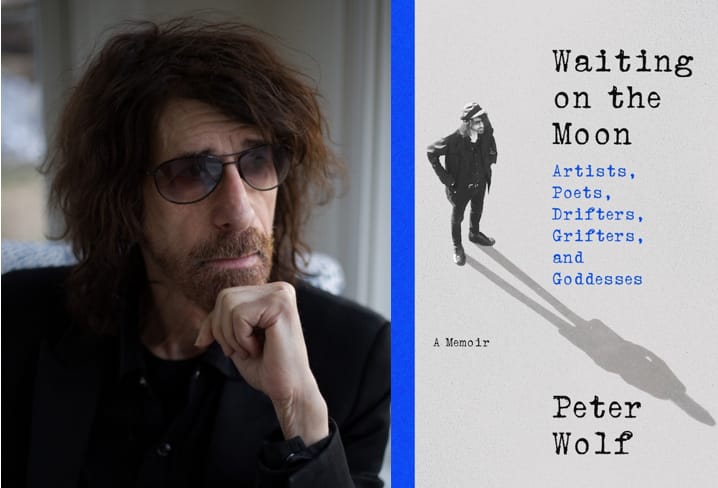
“I didn’t want to do a personal memoir. In fact, I really didn’t want this book to be about me at all,” Peter Wolf reveals, while describing how he came to write Waiting On The Moon: Artists, Poets, Drifters, Grifters and Goddesses. “I do a lot of reading and there are certain authors who bring their subjects to life. I’m thinking of Kenneth Tynan, Truman Capote, Christopher Isherwood and a fellow named Michael Korda, who did a memoir of his adventures in the publishing industry.”
So although Waiting on the Moon tracks his own life and career, including his extended stint in the J. Geils Band, Wolf’s personal narrative serves as a more of jumping off point for profiles of other cultural figures, such as Bob Dylan, Muddy Waters, David Lynch, Tennessee Williams, Alfred Hitchcock, John Lee Hooker, Robert Lowell, Aretha Franklin, Julia Child and The Rolling Stones.
“When I started this book, there were two things I didn’t want to write about: my marriage [to Faye Dunaway] and the Geils Band. I felt that would push me back into the typical memoir formula. Instead, my assignment was to write about these characters I admired. As great as their talents were, that’s how interesting I found them.”
Given your intent and influences, how would you characterize the process of finding your authorial voice?
It took a while. I’m not comparing myself to any of these people, but one of the big influences was I started to reread Raymond Chandler and other noir writers like [David] Goodis and Cornell Woolrich. Chandler wasn’t really interested in plot, but he was a genius, almost Hemingway-esque in describing a character in two or three sentences. I also went back to the Hemingway short stories like “The Killers” and “A Pursuit Race.”
There are also several books I read once or twice a year. One of them is Movable Feast, which I think is Hemingway’s great masterpiece although it was released after his death and edited by his wife at the time. Then there’s The Dubliners by James Joyce, which always brings me into that world with the candles, the smell of the soot, the cobblestone streets, the formality of the priest’s visit, the people sitting in the sitting room having tea and the different levels of class.
Truman Capote also has this book called The Dogs Bark. It's composed of profiles that he did on Marlon Brando, Marilyn Monroe, Humphrey Bogart and other people. The thing that interested me about it was that the chapters were very interesting, even if I didn't know who someone was. He brought the characters he was writing about to life, and that's what I wanted to do.
I know so many people who are blues enthusiasts and they adore Muddy Waters and John Lee Hooker. Other people I know admire and love all the Alfred Hitchcock movies. Sly Stone was a big influence on countless musicians. So I decided to write profiles on my experiences with them, and other people like Don Covay and Aretha, who I had the privilege to meet and get to know a bit behind closed doors.
But going back to Capote, my motivation—my assignment to myself—was to profile these characters who I admired. Besides their talents, they were just great characters.
To what extent did you research the people and incidents you describe or did you rely exclusively on your memories?
Once I got started, I became thoroughly involved in the process. I was going to the library and taking out books to make sure my timelines were correct.
For instance, I had a scene that didn't get in the book, where Mick Jagger and I were friends with the same lady. She was from Canada, I was visiting the Stones up in a hotel room, and I was surprised to see her in the hallway. I remember talking with her, then going into a room and where Keith Richards, Mick Jagger and Gram Parsons were sitting on the floor playing acoustic guitars and singing a Merle Haggard song, “Sing Me Back Home.”
Now I remember it vividly and I wrote it that way. I knew Gram Parsons and he recorded a song I wrote, but when I was doing the research, I realized Gram Parsons had died a year before the Rolling Stones did that tour. So there was no way Gram Parsons could have been in that room, even though I was kind of convinced he was.
Then what came to me was that I remember Keith and Mick being in the room playing acoustic guitars, singing the Merle Haggard song, and Keith telling me it was Gram Parsons who introduced him to Merl Haggard and taught him the song.
So I found that entire process of discovery really interesting, and I tried to keep the book as historically accurate as possible.
What did led you to change your mind and write about your marriage?
Grace O’Connor was one of my early readers and advisors. At one point she had just read this book called The Big Goodbye about the making of Chinatown. So I went off on this story about being on the set, at which point she stopped me and said, “Peter, are you kidding me? You sat with Roman Polanski, you sat with John Huston. You’ve got to write about that.”
As I would talk more about it, she said, “You tell these stories about Faye and she sounds so amazing, just write a chapter.” So I did, and one chapter led to another chapter. Faye would come out on the road in the middle of Oshkosh during a snowstorm to be with the band, and I would travel to Spain and we’d have dinner after a long day on the movie set. I didn’t want to do a kiss and tell, but I realized what an amazing romance we had because we were both so enamored with each other and we both were dedicated to helping each other’s careers.
How about the decision to include a chapter on the Geils Band?
My editor at the time asked me how long I was in the band. When I told him 17 and a half years, he said, “You guys disbanded when you had your biggest hits. I’m curious about what happened.”
So I started something but I didn’t want to get bogged down. That led me to write one chapter “Fratricide,” which included the reason why the band started, the nature of the band and what caused its demise from my perspective. I didn't want to add anything more and I didn't want to add anything less.
I have a very special kinship for my fans that we gained throughout the years. It was hurtful tragedy for me that the band ended, not unlike, in a different way, the tragedy I talk about with my first love who was killed in a car accident. We knew we were going to be partners for life. We were like swans.
Beyond your poetic chapter titles, you also identify each of your subjects up front. What prompted you to offer that information at the outset?
That came from Grace, and from Bruce Nichols, who was then my editor, although he’s no longer at Little, Brown.
I remember sending the book to Tony Garnier, who plays bass with Bob Dylan. He's probably been the longest member of the band. He told me that he didn’t have much time to read books these days and I said, “Tony, you could take any chapter and just read it. It's like short stories. There's a timeline, but you can read the Muddy chapter and then you can read the Robert Lowell chapter if it interests you. Just look at it that way.”
So that's what I wanted to do. I feel that each chapter is its own self-contained short story, some longer than others. You can pick up the Ed Hood chapter or the William Alfred chapter or the chapter on Tennessee Williams and not really need to read the previous chapters.
If you pick up the Sly chapter it stands alone in describing how I met Sly and our first encounters, continuing through my perspective on the demise of his career. I write about how it affected me watching this enormous star who had such an influence on the music I love playing, when he was at Jonathan Swift’s, which was down a basement across from Grendel's Den in Cambridge. It was like the last stop, the caboose of his career. After that, he sort of returned to living on a Winnebago.
The book is not really about playing with Black Sabbath when the Geils Band first started, or playing with the Allman Brothers or hanging out with Duane Allman, or when Tom Petty opened up for us or when U2 opened up for us, although I mention those things.
I also had to eliminate quite a bit. For instance, I played and spent a lot of time with Sun Ra, who was quite a character. I spent many hours with the Velvet Underground and I know that people are very interested in what they were like and what Lou was like. But in trying to keep the book moving, I couldn’t include all of that.
As for naming everyone in the chapter titles, I think it needed some clarification, like when I looked at the Capote book and I said “Oh, he's written about Bogart. Oh, he's written about Tennessee Williams.”
There’s an arc to the book and I think it's more interesting when one starts from the beginning and reads to the end. But I tried to make it so each chapter would stand on its own.
I appreciate how your personal arc often dovetails with other people who lived in the same era and are similarly discovering these cultural figures, albeit from a different perspective.
Well, I was and still am a fan of the Rolling Stones. I feel privileged that I have become close friends with them. I also love Muddy Waters for the same reasons that they did. I explain in the chapter that my first introduction was just looking at his album cover. It just sort of spoke to me, as this mystical kind of thing.
It was the same way with Bob Dylan. I didn't know what he looked like. At first he was just a voice behind a curtain and I wanted to hear more. I didn't know any of his history. I didn't know that he had just blown into town, but I became absorbed with him immediately. The same with Muddy, and then the Stones would release Muddy songs and they did it so well. I learned so much about the Rolling Stones from other artists that they loved and vice versa.
Years later, we would all play cassettes and stuff like that, and I would turn Keith onto things like doo-wop. We would all just listen to records because we loved the same genres of music. I think Gram Parsons really introduced the Stones to country music, especially Keith, but we all had love for so many different genres, be it country, be it blues, be it R&B, be it rock-and roll with people like Carl Perkins and Roy Orbison. We were just music fans, and we all had the same interests and were motivated by the same kind of music.
At one point you mention interviewing Rahsaan Roland Kirk during your time as a late night DJ at WBCN in Boston. When you think back on that gig what comes to mind?
The first thing that comes to mind is what an idiot I was because I never taped my show. There were hours of sitting around talking and playing with Van Morrison, Roland Kirk, Mose Allison and so many other people.
Roland Kirk somehow got to the radio station in the middle of a blizzard one night. He was dressed in a ragged coat with these wraparound black sunglasses and a cap, carrying all these horns. He was living at the YMCA and he heard the station because he was going around the dials. When I started playing Joe Turner and Amos Milburn, he called in and said, “Man, you’re playing such great stuff. I’m a musician, I’d love to come down.” He didn’t say, “I’m Roland Kirk” but I said, “Sure, if you can get over. It’s snowing pretty bad.”
Almost 30 years later this guy runs up to me and says, “I always wanted to thank you for helping Roland Kirk.” It turns out he was a flute maker and he was the one who drove Roland Kirk to the radio station, but there was a snowplow behind him and he couldn’t park the car. So he left him there hoping that somebody at the station would get him back to the YMCA, which we did.
The FCC required the station to record everything on tape but I think those reels are long gone. Radio waves keep going out into space though, so they’re somewhere in the galaxy and with AI maybe one day we’ll be able to pull in the Roland Kirk interview.
I’ve seen some people compare this book to Zelig which feels off to me because you’re not an accidental observer, you’re describing the people in your artistic community.
When I think back, I was this 18 year old and there’s the entire Muddy Waters band in my small funky apartment off of Harvard Square. I was like a fly on the wall in my own apartment, Muddy’s lying down on the futon, Otis Spann’s playing on the piano, James Cotton’s cooking. Everybody’s drinking and smoking, and I’m supplying the ice and glasses. Then it was “Hey, man, time to get to the club.” So they started getting dressed and walked over. This happened night after night, day after day.
Or I think about the moment sitting in the hotel room with John Lee Hooker watching Lassie. It was so rich, and it came to me as such a surprise. I really wanted to express the sweetness of the man.
A lot of the people I wrote about, if you analyze it, I met by serendipity. It wasn't that I pursued them at first, even if I did later on. For instance, the Stones came into the record shop where I was working. I was invited by someone else to have dinner at Julia Child’s home. I was introduced to Faye by one of her friends, and at first I didn't quite know who she was.
I met Robert Lowell through William Alfred. With Tennessee Williams, I happened to be there because Faye was in the 25th anniversary of Streetcar. I was sitting in the corner, when somebody bumped into me and I spilled wine on myself. Tennessee Williams happened to see this encounter, and he came up to me. I definitely know who he was, and I couldn't believe that Tennessee Williams was chatting with me. Then I was seated right next to him at this performance.
Someone I did pursue, and I talk about this quite openly, is Dylan. I became so interested in him and wanted to hear more. Then each time I heard him, he was reinventing his catalog and his style. It kept changing constantly. So it was almost like getting to visit this studio of Pablo Picasso, and every time you were there, you’d see something else. He'd be doing the Blue Period, then the next time it was Cubist, then there was the Rose Period and so forth.
So I agree with you that this wasn’t a Zelig situation and it’s not a typical memoir. It’s an attempt at something else.