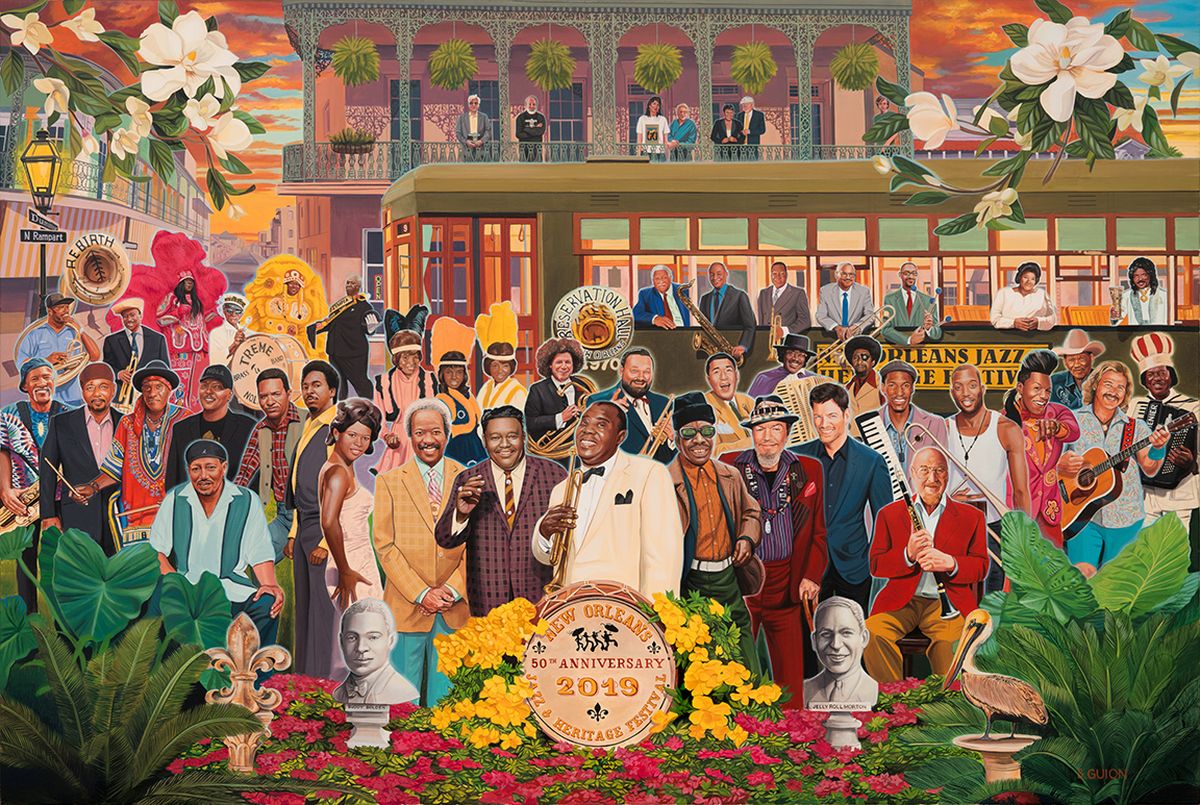
Scenic portraitist Scott Guion’s 2019 Jazz Fest poster, inspired by the classic photo “A Great Day in Harlem.” This complex family portrait was realized in 18 colors by chromist Luther Davis at the Powerhouse Arts atelier. (©2019 art4now inc & NOJ&HFF Inc. TM NOJ&HFF, Inc. Published by art4now.com)
In its 50th year, the New Orleans Jazz & Heritage Festival both embodies and transcends its name.
This article is part of 50 Years of Jazz Fest celebration and appears in the special Collector's Edition April/May 2019 issue of Relix. Subscribe here using code NOLA50 and get 20% off.
Ivan Neville made his New Orleans Jazz & Heritage Festival debut in 1977, singing alongside his father, Aaron, and his uncles, Art, Cyril and Charles. He was already a high-school senior at the time, but his real education began that day.
"Jazz Fest is a learning ground, somewhere to grow over the years," says Neville, now a four-decade veteran of New Orleans' annual springtime extravaganza. "I'm always learning something different, not just from being part of it musically, but also seeing how other people coming in treasure the New Orleans thing."
For 50 years, Jazz Fest has celebrated that "New Orleans thing" in all its funky splendor.
What started in 1970 as a handmade local festival staged underthe oak trees of a park near the city’s historic French Quarter hasgrown into the still-spry granddaddy of American music festivals.
Jazz Fest’s 50th anniversary celebration will take place April 25–28 and May 2–5, 2019. Hundreds of thousands of music lovers willdescend on the Fair Grounds Race Course while more than 600acts, the vast majority indigenous to South Louisiana, showcase thedepth and breadth of their talent on a dozen stages. Those localsare augmented by “visiting” musicians from across the spectrumof popular music, marquee names presented alongside authenticNew Orleans street culture.
This year’s visiting artists include The Rolling Stones [Ed. Note: Since the publishing of our April/May issue, The Rolling Stones have canceled their Jazz Fest appearance. Widespread Panic will now headline May 2], Dave Matthews Band, Chris Stapleton, Katy Perry, Jimmy Buffett, Van Morrison, Santana, Gary Clark Jr., John Fogerty, Bonnie Raitt, Pitbull, Leon Bridges, J. Balvin, Pitbull, Logic, The Head and the Heart, Kamasi Washington and many others.
They’ll join a host of more exotic acts from around the globethat link to the roots of New Orleans music: Martinique’s ChouvalBwa Traditionnel, South Africa’s Crocodile Gumboot Dancers,Haiti’s Boukman Eksperyans and Cuba’s Septeto Santiaguero areamong them.
“The festival has to be true to its history and honor people’sexperience here,” says longtime Jazz Fest producer/director QuintDavis, who was still a college student when legendary festivalimpresario George Wein hired him for the very first Jazz Fest. “Butit also has to be broad. This just can’t be a festival where you call upan agent and book a band. We have to dig all the way into the roots.”
But music accounts for only part of the festival’s appeal. At JazzFest, what happens between the stages is just as enticing as whathappens on them.
Dozens of food vendors serve up a cornucopia of culinary delights, from Crawfish Monica and cochon de lait—the former a creamy pasta dish, the latter a Cajun roast pig sandwich—to spicymeat pies and fried soft-shell crab po-boys.
For Galactic saxophonist and harmonica player Ben Ellman,“everything revolves around the pheasant, quail and andouillegumbo. I think that truly is the greatest gumbo I’ve ever had. I playa lot of festivals, and the food is never as good as it is at Jazz Fest.It’s one of the great food festivals, too.”
One of Ellman’s signature moves is to buy crackling—essentiallyfried pork fat—and sprinkle it on the cochon de lait. “Or you canput it in the gumbo, of course. It kind of goes with everything,except the strawberry shortcake.”
In defiance of the heat and rain that generally descend on south Louisiana each spring, the festival’s sounds, sights, smells and tastes are immersive in a way that transcends the typical concert, or even festival, experience. Most major music festivals—Bonnaroo, Coachella, Lollapalooza, even Austin City Limits—could be anywhere. But Jazz Fest is reflective of, and essential to, its host city.
Jazz Fest ranks second only to Mardi Gras in terms of economicand social impact. For the city’s musicians, it’s a seven-day SuperBowl that both celebrates New Orleans culture and serves as acatalyst for its continued vitality. After leaving the Fair Groundswhen the event shuts down at 7 p.m., patrons pack New Orleans’music clubs for what amounts to an all-night encore.
The festival itself is a one-stop shop for all that makes NewOrleans the most culturally rich city in North America. Thebrilliant plumage of the Mardi Gras Indians, the matching suitsand choreographed steps of the second-line parades that roam thegrounds, the potent kick of the brass bands, the flags and totemsthat flutter above the crowd, even the painted memorials thathonor festival “Ancestors” who have passed on—Jazz Fest feelsalive, with a celebratory spirit and sense of community all its own.
For the festival’s duration, the Fair Grounds is its own planetwith a gravitational field that pulls in all sorts of characters andspins off all sorts of traditions. At the Fais Do-Do Stage, withits Cajun, zydeco and Americana bands, fans host a ritualized“watermelon sacrifice.” Participants in the decidedly unofficial“Jazz Fest Triathlon” bike to the Fair Grounds, jog around theracetrack and then swim across nearby Bayou St. John. These aretribes within the tribe.
Jazz Fest offers unique experiences regardless of status. A hoodoo dancer draped her albino snake across Eric Clapton’s shoulders as Slowhand watched Crescent City legend Dr. John in 1992. (Clapton would headline the festival himself 22 years later.) U2 guitarist The Edge found himself singing “Stand by Me” with the New Birth Brass Band in 2006. Ed Bradley, the late 60 Minutes correspondent, was such a close friend ofthe fest that he merited his own golf cartand is now immortalized as an Ancestor.
It is not unheard of to encounterJimmy Buffett in line for the same gumbothat Ellman relishes—Mr. Margaritavillefrolics at the Fair Grounds even whenhe’s not on the bill and has been knownto make a surprise sit in. For years, JohnFogerty roamed the grounds anonymously,sometimes in a white Jazz Fest baseballcap and a pink Jazz Fest shirt, before hefinally agreed to make it a working vacationand perform.
Over the decades, the festival has foundroom for everyone from Bon Jovi to BongoJoe, a strapping Texan who beats on 55-gallonoil drums with homemade mallets.
To arrive at its 50th anniversary, Jazz Fest has survived fire and flood, wind and rain, politics and personality clashes, mud pools and the “Macarena.” It remains relevant even though it predates cell phones, laptops, CDs and Spotify. It is older than hip-hop and has outlived many of its legendary performers, even as it has embraced—sometimes slowly—contemporary music. It changes when it needs to, but also remains the same.
Jazz Fest is owned by a nonprofit foundation that uses theproceeds to underwrite a series of free festivals and variouscultural and educational initiatives. Since 2004, Davis haspartnered with AEG Live, one of the world’s largest producers oflive entertainment, to co-produce Jazz Fest.
The AEG alliance has enabled Jazz Fest to book some of thebiggest names in popular music, including Elton John, Billy Joel,Bruce Springsteen, the Eagles, Fleetwood Mac, Tom Petty & TheHeartbreakers, Foo Fighters and Rod Stewart.
Indicative of the festival’s growth, acts that previously appearedon the festival’s three biggest stages now headline smaller tents.Legends like Boz Scaggs, Buddy Guy, Mavis Staples and LosLobos will perform in the Blues Tent this year. Herbie Hancockwill appear in the Jazz Tent, as will brothers Wynton, Branford,Delfeayo and Jason Marsalis when they honor their father, pianistEllis Marsalis, one of more than a dozen tributes to various NewOrleans legends.
Some longtime fans of the festival believe that the type ofmainstream rock and pop acts that headline arenas don’t belong atJazz Fest. Ivan Neville, however, sees the benefit.
“That just brings more people down here to appreciate whatwe have,” he says. “If you’re a New Orleans group playing that day,you’re going to play for thousands of people that may have neverseen you. I love it.”
To maximize that exposure, Davis often schedules regional actson the same stage as like-minded headliners. On this year’s firstFriday, he slotted South Louisiana guitarist Tab Benoit on the mainAcura Stage ahead of Santana. “That, to me, is some of the magic ofJazz Fest,” Davis said.
So, too, is the fact that the big acts perform without their usualproduction, or even lights—the festival closes before sundown.Mick Jagger and company will strut their stuff under the AcuraStage canopy on May 2 with the same amount of bells andwhistles—none—as the local acts who precede them.
“The biggest band in the world has accepted playing Jazz Feston Jazz Fest’s terms, in the daytime, with no lights,” Davis says.“That says something about them, but it also says a lot about theNew Orleans Jazz & Heritage Festival.”
Ivan Neville’s deep-funk/R&B band, Dumpstaphunk, is booked on the same day as The Rolling Stones, with whom he has collaborated. (Tickets for “Stones Thursday” are sold out.) Over the decades, Neville has joined his father and uncles in The Neville Brothers onstage at Jazz Fest and sat in with his uncle Art in pioneering funk band, The Meters. He is as much a fan of the festival as a participant.
“Some of the most fun musical times in my life have been duringJazz Fest, whether at the Fair Grounds or the surrounding scene,”he says. “The city turns into one big festival. It’s a big giant bowl ofgumbo and we’re all hanging out. It’s like nothing else.”
Ellman first performed at Jazz Fest in 1990 with the Lil’ RascalsBrass Band. He’s since graced stages with the New OrleansKlezmer All Stars, Lump, All That, the Midnite Disturbers and,most prominently, Galactic.
“I always tell people to wander the stages,” he says. “JazzFest, from the beginning for me, was about discovering musicthat you’d never heard. Sure, you can go see The Rolling Stones.But at the Gospel Tent or the Fais Do-Do Stage, you’re going todiscover regional artists you weren’t aware of. Not all festivalsare like that.
“Jazz Fest exposes people to the culture in a way that they mightnot have another opportunity to otherwise,” Ellman says. “On theJazz & Heritage Stage alone, where else can you see all those MardiGras Indian bands and brass bands?”
Homegrown funk/rock hybrid Troy “Trombone Shorty”Andrews & Orleans Avenue have closed the Acura Stage on thefestival’s final Sunday since 2013. Andrews inherited the prestigiousclosing slot from the fabled Neville Brothers, who disbanded a fewyears ago.
For the 50th anniversary, the festival’s final show is billed as“Trombone Shorty & Orleans Avenue with Nevilles.” Ivan andAaron, among other members of the family, are slated to sit inwith Orleans Avenue for a symbolic passing of the torch, one thatshowcases the living tradition of New Orleans music in general,and Jazz Fest specifically.
For Ivan, it will be one more in a lifetime of special moments at Jazz Fest. “When people ask me on the road, ‘When is the best time to go to New Orleans?,’ I always say, ‘Go to Jazz Fest.’ I’ve never heard anybody say they were disappointed. Never.”
Keith Spera has covered every New Orleans Jazz Fest since 1990, most recently as a staff writer for the New Orleans Advocate. He is the author of Groove Interrupted: Loss, Renewal and the Music of New Orleans (2011, St. Martin’s Press).
This article originally appears in the April/May 2019 issue of Relix. For more features, interviews. album reviews and more, subscribe here.