***
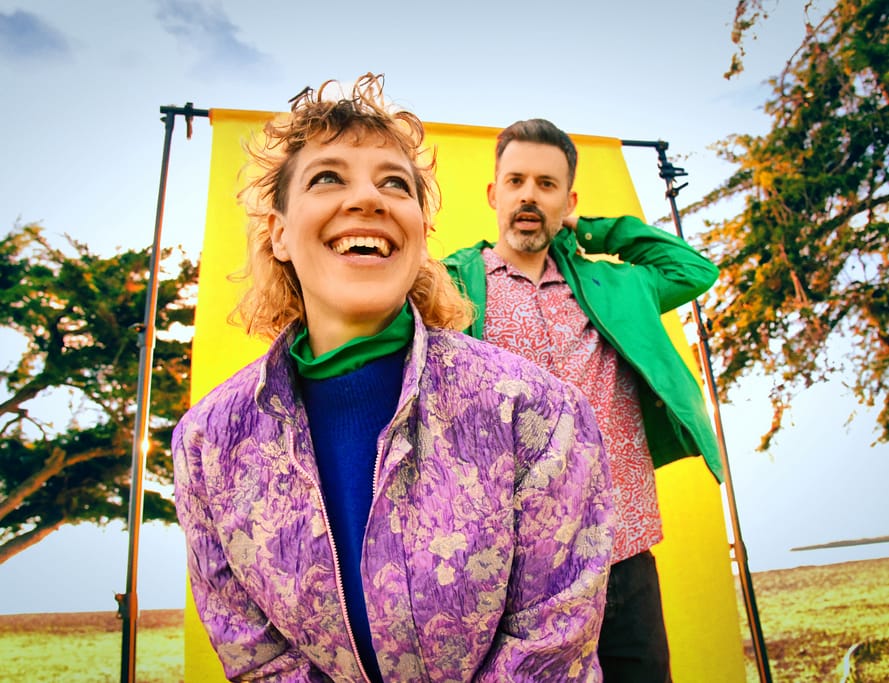
Merrill Garbus and Nate Brenner, the art-pop duo who perform as Tune-Yards, were dancing in the kitchen with their 2-year-old son, Leo, when they decided to surrender to the flow and feel the funk.
“We had made a playlist for him that had some of these songs that I loved when I was growing up on it, like ‘Atomic Dog.’ And he’d say, ‘One more time.’ We’d finish dinner and just dance. And all of the sudden, we’d have listened to ‘Atomic Dog’ every day,” Brenner says with a laugh, during a joint Zoom with Garbus from the couple’s longtime home in San Diego. “And then, you’re in the studio, and you’re like, ‘Why am I gravitating toward this funky music?’ So the influence of this music we had on repeat seeped in—Bootsy Collins, George Clinton, Parliament-Funkadelic. I was like, ‘If I liked this when I was 12 or 13, then Leo will like it when he’s 2 or 3.’”
Those impromptu family dance parties unintentionally ended up serving as a sonic compass, and a bit of a spiritual guide, for Tune-Yards’ latest batch of originals. The imprint is perhaps most apparent on “Limelight,” a groovy, beat-forward lead track off of Better Dreaming—their sixth proper LP and first since 2021’s sketchy. It’s also the worldbeat-informed indie band’s first full-length effort since Garbus and Brenner became parents.
“I’m, of course, very sensitive to ripping shit off,” Garbus adds. “And ‘Limelight’ didn’t start with us thinking, ‘Let’s make a George Clinton song.’ It started from a different place. What I leaned into was having a beat on every quarter note, a core groove. The groove has to do with this subtle way, where it’s really loose around those four beats. We were just letting ourselves embrace what we wanted, and needed, and also what our kid was wanting to hear—and not getting so cerebral about what we were trying to do or trying not to do.”
Better Dreaming actually started with a headier charge. In 2023, Tune-Yards set out with the stated goal of writing 44 originals to mark the year that Garbus turned 44. Garbus, the outfit’s lead singer and a multi-instrumentalist, and Brenner, a bassist who is also adept at a variety of other instruments, started work in February and March of 2023 and whittled their initial batch of ideas down to the 10 they decided to mix by the end of the year. They then brought those tunes to Panoramic House in Marin County—a scenic, live-sounding studio with a clubhouse vibe and views of the beach—to work with Eli Crews, the engineer they’ve partnered with on and off since their sophomore set, 2011’s w h o k i l l. However, of the 10 songs Tune-Yards arrived with, only four or five ended up making Better Dreaming, at least in their then current state.
“We thought we had finished, and we were going to focus on these 10 songs and mix them,” says Brenner, who Garbus jokes has lofty visions of making a double or even quadruple album one day. “And then, after giving it some space, we were like, ‘No, this isn’t quite ready.’ So we went back and reworked some songs that were part of the original 44.”
While sorting through that numerically driven batch of ideas in 2023, Garbus and Brenner explain that the compositions they were coming up with were based on whatever was going on astrologically. Some cuts written around the same time felt like natural siblings and easily made it to Panoramic House; others died on the vine or remained in demo form.
“No. 3 made it on and then, around No. 11 or 12, we got into a groove,” Garbus says. “We had another productive phase in the 20s and a small number didn’t go very far. It’s based on the stars.”
“It’s good to be constantly creating music,” Brenner adds. “But you end up being like, ‘We really like these five songs that we wrote in five days. The rest of them are not gonna make it to the finish line.’ And that happened on our last album, too, in terms of the songs that made it on sketchy. But it’s impossible to predict when that will be. So you just have to keep hoping that it’s today.”
Garbus shies away from fully explaining the significance of the number 44 in her world— as opposed to tagging the release to, say, a milestone birthday like 40 or 45—but admits that it ties back to one of her best friends.
“It’s her lucky number, and she was born on 11/11, and I was born on 3/3. We’ve been pretty close buds since 1997,” Garbus says. “She helped a lot on this record by just being a music fan. She’s been our fan forever, so she would make these playlists full of music that we might not be listening to. Her number is 44, so I love that number.”
While the final version of Better Dreaming was tracked at Tune-Yards’ home studio in San Diego, where Garbus and Brenner have lived since 2009 and 2005 respectively, they note that their time at Panoramic House still left an indelible mark.
“It really does feel like you can hear the ocean, you can hear the beach, on some of the records that were recorded there, like My Morning Jacket,” Garbus says. “We mostly recorded in our basement studio in downtown Oakland. So that’s what you can hear on our record—darkness. But I think being there helped. We’ve talked about being really in the computer and in the Pro Tools world, versus not looking at a screen all day long—being able to close your eyes and listen to the music. When we listened to what we had recorded, front to back, it didn’t feel like it was done. So we just ripped the whole thing open again. With those remaining songs, like ‘How Big Is the Rainbow,’ we ripped them apart again and started over.”
Having Leo there also made for a unique experience.
“Our 2 year old was with us, so we had to stay out of Eli’s way with Leo and then come in every now and again to put our ears on what Eli was doing—give him guidance and then leave again,” she says. “I hadn’t ever done it that way—we’ve been really present for a lot of our mixing. It was also a weird time for me because I had lost hearing out of one of my ears due to an infection. I had to stop using earbuds. It was surreal. So there was a moment where it just felt, frankly, miraculous that we were making music at all. That was when Eli mixed ‘Better Dreaming,’ the title track of the record—that one and ‘Limelight’ were both nearly finished there, 99%. And then we took a lot of what we did there—Eli printed stems—and reworked the remaining ones back at our studio.”
Brenner chimes in, adding, “When we got back home, we took some space, we went back to some of the earlier demos that we felt, at the time, we weren’t ready to mix and we found ‘Heartbreak,’ ‘Suspended’ and ‘Perpetual Motion.’ And then we started ‘Never Look Back’ from scratch.”
Both musicians were also acutely aware that they were creating music at a time of serious political turmoil and social upheaval, both at home and aboard. They considered their song titles carefully and injected charged lines like, “Nobody’s free until everybody’s free” into “Limelight,” which Garbus says is “probably the most funktastic” song on the record—at one point, she worried it was even too trite to include. (It also features a cute cameo from Leo, who can be heard saying, “It’s not working.”) But, ultimately—as the title makes clear—this time around, they were dreaming of a better, more uplifting future with their music.
“I’ve also always been really fascinated by music from apartheid South Africa and Congo—places where there is a true ebullience to the music and the music feels very connected to the strife of the people,” Garbus says, highlighting a signature element of Tune-Yards’ global sound from the start, before shifting her thoughts to the current state of world affairs. “I needed to do that for myself. But, I’ve never wanted my music to reflect my own sadness and depression. Music, to me, feels like the fire I need to ignite my will to live. I desperately tried to keep the song ‘How Big Is the Rainbow’ off the record for a long time because I was like, ‘I cannot write a song called ‘How Big Is the Fucking Rainbow.’’ But it turns out, we need a song called ‘How Big Is the Rainbow’—and a song that felt like that. At a certain point, Nate was like, ‘We’ve got some sad shit on here. We need another uplifting song.’”
***
Tune-Yards have long followed a circuitous path. Garbus grew up in New Canaan, Conn., absorbing the range of sounds in the ether—from the jazz and classical selections her parents played around the house to the vocal pop of Michael Jackson and the concurrent modern and alternative rock influences she discovered on her own. She has said that the political folk of Ani DiFranco and Dave Matthews Band’s unique instrumentation were both early signposts of what music could be. The budding songwriter attended college at Smith and worked as a puppeteer in Vermont, expanding her range of interests to include both a cappella music and the ukulele along the way. After playing in a few combos, she started Tune-Yards as a solo vehicle in 2006, recording her 2009 debut, BiRd-BrAiNs on a handheld recorder and self-releasing the project on cassette. She initially met Brenner—who grew up in Bloomington, Ind., and attended Oberlin College—while working at a summer camp in New Jersey and, with some encouragement from David Longstreth, officially added him to the lineup in time for Dirty Projectors to take Tune-Yards on the road for a European tour.
Tune-Yards inked a deal with uber-hip label 4AD around Garbus’ 30th birthday, and the first release they crafted for them, w h o k i l l was a critical success and favorite on the then burgeoning indie pop circuit. w h o k i l l topped The Village Voice’s veritable Pazz & Jop list, Tune-Yards’ scored prime television placements and the pair grew into a powerful live act, achieving a grand slam of appearances at the era’s “big four” festivals—Coachella, Bonnaroo, Lollapalooza and Austin City Limits. They continued to record for 4AD too, cementing their status as indie darlings and forward-thinking creatives in the studio.
However, throughout their rise, they never fit squarely onto the straightforward hipster-rock circuit. In addition to some impressive but in-the-box big moments—including packing clubs from Los Angeles’ Troubadour to New York’s Brooklyn Steel and opening for Arcade Fire— they joined institutions like The Blind Boys of Alabama and Preservation Hall Jazz Band for collaborative moments, made a pilgrimage to Haiti in order to experience the local scene in person and lent their voices to a range of causes, including The Water Fund. Even in the months leading up to Better Dreaming’s release, they sat in with Tibetan musician Tenzin Choegyal and a chorus of children at the Tibet House Benefit at Carnegie Hall, and could be heard as part of the soundtrack to the trippy, traveling immersive experience Luna Luna—which showcases relics from a lost amusement park featuring artwork from Jean-Michel Basquiat, Keith Haring, Roy Lichtenstein, Salvador Dalí and several other notable names. They also made inroads in the movie and television worlds, crafting soundtracks for the Boots Riley film Sorry to Bother You, the TV series I’m a Virgo and Riley’s upcoming NEON feature I Love Boosters, which stars Keke Palmer, LaKeith Stanfield and Demi Moore.
“I do think back to the film scoring—it’s just so adventurous,” Garbus says. “Boots challenges us to make sounds that we’ve never made before. And, with this record, it felt like, ‘Let’s try anything; let’s try everything.’ He’s inspired by the way that we have done that in our music, which is why he’s bringing us on. And then, he’s giving that energy right back to us.”
“Riley is incredible because he’s just so creative. We’d play him something we were working on for the score, and he’d suggest something and, whatever he’d say, I would have never expected him to say,” Brenner offers. “So being around someone who’s constantly surprising us with his ideas made Merrill and I want to approach our songwriting with this sense of, ‘What’s gonna happen? Who knows?’ It helped us get out of the predictable nature— whether that means the song structures or instrumentation—and open up the music to where anything’s possible.”
Between cycles for sketchy. and Better Dreaming, Garbus also taught a songwriting class in February of 2024, which left an impact on the latter record as well.
“I didn’t take the class, but I was there while she was working on the material,” Brenner says. “We were trying to come up with new ways of writing, instead of just our default methods, and approach everything from a fresh point of origin.”
Garbus chimes in, adding, “Fresh and old, though. It was a School of Song class, and that helped me, and us, develop the idea of what makes a Tune-Yards song a Tune Yards song. When I start songwriting, I’m like, ‘How did I ever do this? I don’t know what I’m fucking doing at all—I can’t write songs.’ That’s what my general mindset is when I start writing a new record. And it was helpful to have someone go, ‘How do you do this in your songs? And why do you do this in your songs?’ Having someone respect the way that we write and produce songs allowed me to go, ‘Oh, yeah, we’ve done this before. And we’re good at these specific things. And we’re intentional about writing. And I am intentional about writing in certain ways.’”
Better Dreaming also features a notable guest spot by Trey Anastasio, who adds some tasty ambient guitar over the album’s final selection, the four-plus-minute “Sanctuary.” Garbus notes that there’s an alternate version of the track floating around that she hopes will see the light of day at some point.
“He laid down some interesting little riffs on that song,” she says. “It felt like he was responding to what was going on in the song already. And then he did this epic solo that ended up competing so much with my vocal that I felt like I was ready for it to be Trey’s solo song. So we rolled it back, with the idea being that we would give him an alt version and give the Phish fans, and the Tune-Yards/Phish fans, something later on.”
Both members of Tune-Yards admit that Phish were part of their early musical DNA to varying degrees. Garbus, who grew up in prime Phish country—the Fairfield County section of Connecticut—says that she enjoyed early records like Junta and Hoist, noting that she was particularly drawn to the latter’s more compact “songier” songs.
“That’s the one my younger sister loved,” she says. “My younger sister got me into Phish and I listened to cassette tapes on my Walkman in the ‘90s, though I didn’t go to a Phish show until I was an adult.” She did, however, attend their famed Millennium show in Big Cypress, Fla.
Brenner, meanwhile, had an older cousin who was a Phish fan, and the bassist started seeing the band live when he was around 13. He went with that cousin, his mom and his aunt to check them out at Deer Creek in Indiana and saw them every summer until he was around 18 and Phish went on hiatus. He also traveled to the New Orleans Jazz & Heritage Festival regularly with his family.
“It was two nights at Deer Creek, so my mom and my aunt went the first night to make sure it was OK,” he says of his inaugural Phish outing. “We went the second night without them, just the cousins and my brother. And then I saw them when I was 39 or so. So I had a long phase. The thing I loved about Phish, and still love, is the improvisation. It really opened me up to all these other styles of music, and I really started getting into jazz—electric Miles, Bitches Brew. It led me to want to play with other improvisers, which are oftentimes jazzers.”
Garbus, who makes a point to note that she was just peeping a Phish show setlist on Relix.com, says she skipped out on seeing the Vermont Quartet during a recent Bay Area stop so that Tune-Yards could hone in on their own improvisational skills for their own show, but the inspiration remains. “To see a band who’ve done what they want for over 40 years,” she says before trailing off. “They do whatever they fucking want to do. And they have people supporting them.”
***
On May 16, Tune-Yards officially dropped Better Dreaming. The night before, Garbus and Brenner celebrated the release with an intimate underplay at Nightclub 101 in New York’s East Village. The space has a storied history to say the least, the site of the famed Pyramid Club from 1979 until the pandemic. During that extended arc, the room served as a launch pad for countless performers who have become core to the city’s drag and gay scenes as well as an incubator for the no wave and post-punk movements—Nirvana’s first New York City appearance even took place there in 1989. More recently, the room functioned as something of an office share for Baker’s Falls and Knitting Factory, two other shuttered venues, before reemerging in its current form a few months ago.
The evening felt like an intentional throwback to Tune-Yards’ DIY roots, in certain ways. Garbus and Brenner could be seen setting up their equipment—a mix of percussion, vocal mics and stringed instruments—and stuck around to sell merch after the show. The night kicked off with Garbus singing solo over a loop while the faint sounds of a goth party in the room below could be heard by the bar. Better Dreaming wasn’t technically out for a few more hours, but she led the crowd in a sing along based around “Sanctuary” anyway.
For some of their more recent outings, Tune-Yards have expanded their live instrumentation to feature auxiliary touring musicians. Most recently, that included Berklee-schooled drummer Hamir Atwal, who supported Garbus and Brenner on the album cycles for 2018’s I Can Feel You Creep Into My Private Life and Sketchy. Then, for their latest run, Tune-Yards are back to a duo.
“It’s a little bit of a few things,” Garbus says. “One is that the two of us have now developed a deep musical language with each other, and the album became less oriented toward a kit drummer, as it was last time. Hamir, who’s incredible, was such a big part of the last record, and this record turned into more of my drumming and drum loops—my fragmented drumming. And for that reason, it made sense to do the live show that way—having me play some drums live, having some drum machines up there and using some drum loops. We haven’t done it as just the two of us since the early days and also, frankly, this is a strange time to be a touring band, as some other bands might have told you. And so, to be a little bit more nimble, to not have so many people reliant on the schedule, is a good thing—in case a show gets canceled because of weird weather or a show gets canceled because of political situations. We have the agility of being able to rehearse whenever we need to, basically, as long as we can get a babysitter.”
“We were at a point where Hamir also was like, ‘I keep wanting to go back to school,’ and understandably so—he’s much older and wanted to have benefits and everything like that. It’s hard to be a touring drummer, although he’s still gigging a lot in New York, so he’ll always play the drums. But he just wanted a more stable income for himself. And we were like, ‘We don’t want to just find another hired-gun drummer.’ We felt, with Tune-Yards, there was something we loved about Hamir so much, but if we just added another drummer, it almost would make us into a power trio. Without a drummer, we’re this unique thing. We were wanting to embrace that more.”
They both agree that they are looking forward to the risk factor of playing as a two-piece combo, reliant on loops and the feeling that, in Garbus’ words, “things could fall apart at any moment.” As of press time, their current run is slated to stretch into November and include both some international stops and, in a wink to Garbus’ roots, dates with Ani DiFranco. They are also pumped at how full sounding their set feels, given the minimal personnel on the stage.
For their 2025 slate of gigs, Tune-Yards plan to both showcase their new work and revisit their back catalog. “We like the idea of remixing our songs,” Garbus says. “It’s pretty fun. We’re definitely going to give the fans what they want. We’re not above that, but we’re both always trying to better ourselves. I’m trying to figure out how to really sing all the ways I want to sing and keep my voice healthy along the way, running the marathon of touring. So that’s one of my growing edges. It’s just getting better.”
Looking ahead, Garbus hopes that some of the leftover tunes from the 44 song project will see the light of day at some point, either as part of an EP or a future anniversary set. And she is excited about the better dreams she might realize along the way.
“There’s so much to life,” she says. “You know that whole will to live thing? I have a greater will to live where I’m like, ‘There’s so much I don’t know how to do.’ And we are leaning into that versus saying, ‘Let’s just do the same old thing that we’ve always done before.’ That’s not gonna work for us.”